
Few crops compress as much disease pressure into one season as cucumber. The crop grows fast, carries a large soft canopy, and in most production areas is grown under protection or through summer rains — conditions that suit four problems at once: downy mildew, grey mould, powdery mildew and whitefly. A written program handles them better than reacting to whichever appears first, because each threat has its own weather window and its own mode of action. This guide sets out an integrated cucumber program built from the Chinese registration labels held by BNSD Agro (Shandong Bainong Sida Biotechnology Co., Ltd.): soil treatment at the seedling stage, a systemic oomycete active for downy mildew, a grey-mould specialist for flowering, a rotation pair for powdery mildew and an oil-in-water emulsion (EW) pyrethroid for whitefly. The products sit in the fungicides catalogue and the insecticides catalogue; samples and label documents are available through the contact page.
Why Cucumber Needs a Written Program
A cucumber canopy is dense, humid and handled at every picking, so infection pressure rarely falls to zero. The four pressures also do not peak together, which is exactly why a program beats a rescue spray:
- Downy mildew is an oomycete disease of cool, humid weather: water-soaked angular lesions bounded by the veins, with the grey sporulation on the leaf underside.
- Grey mould (Botrytis) enters through senescing petals and wounded tissue in the flowering and fruiting canopy.
- Powdery mildew shows as the familiar white talc dust on the upper leaf surface, driven by warm days with humid nights.
- Whitefly colonises the growing points through the picking season, produces honeydew and sooty mould, and contributes to virus spread.
The downy versus powdery mildew guide expands on the diagnostic split between the two mildews.
Seedling Stage: Soil Treatment Against Damping-off
The Chinese label for fenaminosulf + thiram 10% wettable powder (WP) registers soil treatment against damping-off at 1670–2000 g/667 m². Seedling losses at establishment are the most expensive losses in the crop, because collapsed patches in the nursery or transplanting bed have to be replanted at the worst moment of the schedule. Fenaminosulf brings oomycete activity and thiram a broad protectant spectrum, which is why the two actives share the soil-treatment registration. Application method and timing follow the label directions for the nursery bed or planting area, and the destination label governs both in your own market.
Downy Mildew: Dimethomorph as the Systemic Anchor
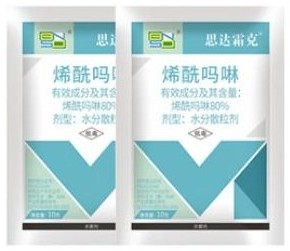
The Chinese label for dimethomorph 80% water-dispersible granule (WDG) registers cucumber downy mildew at 20–25 g/667 m². Dimethomorph is an oomycete specialist in FRAC group 40: it inhibits cell-wall synthesis in the oomycete and is strongly active against the sporulation stage — the part of the disease cycle that re-seeds the whole canopy. That profile shapes three practice points:
- Start at the first sign of lesions or ahead of the cool, humid window, not after the canopy has turned angular yellow-brown.
- Aim coverage at the leaf underside, where the sporulation and the next infection actually happen.
- Rotate with a multi-site protectant — the Chinese label for chlorothalonil 75% WP also covers cucumber downy mildew at 165–200 g/667 m² — so the FRAC 40 active is not the only line of defence.
The dimethomorph guide covers the active in depth.
Grey Mould: Pyrimethanil at Flowering
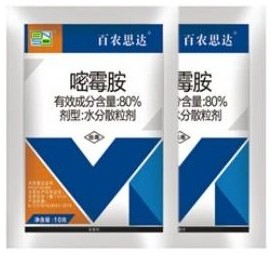
The Chinese label for pyrimethanil 80% WDG registers cucumber grey mould at 30–45 g/667 m². Pyrimethanil is an anilinopyrimidine (FRAC group 9) and a grey-mould specialist: it blocks penetration of the flower tissue and carries a vapour-phase effect that reaches clouded spaces inside a dense canopy. Botrytis management is timing management — the fungus colonises petals and young fruit scars, so sprays are positioned at flowering and ahead of long humid spells rather than after the grey sporulation is visible. Packs run from 10 g × 800 sachets for smallholder retail to 500 g × 20 for farm programs. The grey mould control guide sets out the full Botrytis program.
Powdery Mildew: Two Registered Options, One Rotation Logic
Two products carry the Chinese powdery mildew registration on cucumber, and they are best read as a rotation pair:
- Thiophanate-methyl 70% WP at 40–48 g/667 m². A group 1 (FRAC 1) active that converts to carbendazim inside the plant — systemic reach into the upper leaf surface where the talc dust sits.
- Thiram 50% WP at 75–150 g/667 m². A multi-site dithiocarbamate protectant with no single target site to select against.
Group 1 is a single-site chemistry with a long resistance history worldwide, so the rotation discipline is the program: position thiophanate-methyl windows where lesions are active, and place the multi-site thiram between them. The powdery mildew fungicide guide compares the wider toolbox.
Whitefly: Bifenthrin EW Through the Picking Season
The Chinese label for bifenthrin 2.5% EW registers whitefly control at 30–40 mL/667 m². Three practical points:
- Coverage. Adults and nymphs sit on leaf undersides; a spray aimed only at the canopy top wastes most of the dose.
- Formulation. The EW is an oil-in-water emulsion — the pyrethroid is carried in an aqueous phase with low solvent odour, suited to cucumbers grown in or near occupied greenhouse blocks.
- Rotation. Bifenthrin is IRAC group 3A and whitefly generations are short under protection, so the number of 3A applications per cycle should be capped and alternated with other groups as registered locally.
Aphid peaks have their own registered option: the Chinese label for acetamiprid 70% WDG covers cucumber aphids at 1.5–2.5 g/667 m² — IRAC group 4A, a different mode from the pyrethroid. The whitefly control guide compares the vector toolbox.
The Season Program at a Glance
| Growth stage | Main threat | Program anchor | Chinese label rate |
|---|---|---|---|
| Seedling / transplanting | Damping-off in the nursery soil | Fenaminosulf + thiram 10% WP (soil treatment) | 1670–2000 g/667 m² |
| Vine growth, cool humid spells | Downy mildew | Dimethomorph 80% WDG | 20–25 g/667 m² |
| Flowering – fruit set | Grey mould on flowers and young fruit | Pyrimethanil 80% WDG | 30–45 g/667 m² |
| Mid-season, warm days + humid nights | Powdery mildew on the upper canopy | Thiophanate-methyl 70% WP, rotated with thiram 50% WP | 40–48 g / 75–150 g per 667 m² |
| Through the picking season | Whitefly build-up (aphid peaks as flagged) | Bifenthrin 2.5% EW (acetamiprid 70% WDG for aphids) | 30–40 mL / 1.5–2.5 g per 667 m² |
Application and Rotation Notes
- Spray protectively on the program, and tighten the interval while the matching weather window — cool humidity for downy mildew, warm days with humid nights for powdery mildew — stays open.
- Underside coverage decides both the downy mildew and the whitefly passes; nozzle choice and spray volume matter as much as the rate.
- The disease program already rotates four FRAC positions (40, M, 9, 1/M) — keep that structure rather than repeating any single-site group.
- All rates above are Chinese registration label rates (667 m² = one mu, ≈ 1/15 ha). In your own market the destination label governs registered uses, rates and intervals.
The full portfolio behind this program is in the fungicides catalogue and the insecticides catalogue; physical compatibility between partners is covered in the tank-mixing guide. For label documents, samples or OEM packing, contact BNSD Agro.
FAQ
Can dimethomorph be tank-mixed with the grey mould or powdery mildew products?
The actives sit in different FRAC groups and the combinations are commonly built in the field, but physical compatibility of a WDG with other formulation families should be confirmed in a small jar test first, and any mixture must be allowed on the destination-market label. The tank-mixing guide walks through the jar-test procedure.
Which powdery mildew option should come first, thiophanate-methyl or thiram?
Decide by rotation position, not by preference: use thiophanate-methyl 70% WP where lesions are active and systemic reach is needed, and place the multi-site thiram 50% WP between group 1 windows so the single-site active is not applied back-to-back.
How often can bifenthrin be sprayed for whitefly?
Treat it as a limited-use tool: cap the number of IRAC 3A applications per crop cycle, do not follow 3A with 3A in the same whitefly generations, and alternate with other registered modes such as the group 4A option for sucking pests.
Do these rates apply outside China?
No. All figures are Chinese registration label rates and serve as a positioning reference for buyers. Registered uses, rates and spray intervals in your market are defined by the destination label, which should always govern the final recommendation.
WhatsApp / WeChat: +86 199 0636 5856