
Downy mildews and late blights form a world of their own inside plant pathology: the oomycetes are not true fungi, and many broad-spectrum fungicides barely touch them. That is why oomycete specialists such as dimethomorph exist as a separate procurement category. This guide explains what dimethomorph does, the registered use and rate for the 80% WDG held by BNSD Agro (Shandong Bainong Sida Biotechnology Co., Ltd.), the registered mixture partner on the same catalogue, and how the rotation logic works for this family of diseases. The full range is on the fungicides catalogue, with samples and documents available via the contact page.
What Is Dimethomorph?
Dimethomorph is a cinnamic-acid-amide fungicide in FRAC group 40. It inhibits cell-wall synthesis specifically in oomycetes, and its profile makes it a textbook specialist:
- Oomycetes only. Activity is confined to the downy mildews, late blights and related water-mould pathogens. It has no place against powdery mildews or other true-fungal diseases — a point worth repeating to channel partners, because mispositioning is the most common reason the product “fails” in the field.
- Cell-wall, not respiration. By hitting wall synthesis, dimethomorph works by a mechanism unrelated to the respiration inhibitors (FRAC 11) or the phenylamides (FRAC 4) that also target oomycetes — which is exactly what makes it valuable in rotation.
- Sporulation-sensitive. Dimethomorph strongly suppresses sporulation of established infections, cutting the secondary spread that makes downy mildew explode within days in humid weather.
Because the target is a cell-wall step unique to oomycetes, resistance to group 40 develops more slowly than in the high-risk groups, but rotation is still the standard: FRAC guidance treats every single-site oomycete chemistry as rotation material.
The 80% WDG: Registered Use and Rate
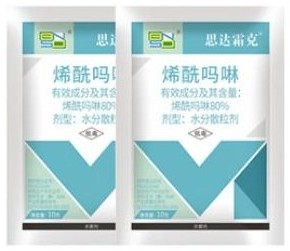
The BNSD Agro registration for dimethomorph 80% WDG covers cucumber downy mildew at 20–25 g/667 m² (667 m² = one mu, about 1/15 hectare; Chinese registration label rate). As always, destination-market label guidance governs in your own registrations — China’s label scopes the product, your market’s label tells you how to spray it.
The formulation is worth a sentence. A water-dispersible granule carries the active at high content without any solvent in the pack, stores through freezing temperatures, and ships as dust-free granules that disperse the moment they hit the tank mix. For an oomycete program — where applications are frequent, volumes are high and cucurbit foliage is sensitive to deposit injury — that combination of high content and clean application behaviour is the reason WDG is the preferred export format for this molecule.
Packaging follows the standard export ladder, from 10 g × 800 sachets for smallholder retail up to 1 kg × 10 bags for cooperative-scale programs.
Program Design: Partners for an Oomycete Specialist
Dimethomorph rarely works alone across a season, and it does not have to: the catalogue supplies a registered partner. 60% pyraclostrobin + metiram WDG is registered in China against downy mildew on Chinese kale and broccoli at 50–60 g/667 m² — a QoI (FRAC 11) plus multi-site protectant (FRAC M3) construction that covers downy mildew programs on brassica crops from the protectant side.
The program logic for buyers runs like this. Within a cucurbit or brassica season, an oomycete program typically alternates:
- A specialist curative-side product — the dimethomorph 80% WDG — at the point where downy mildew pressure appears, exploiting its sporulation suppression;
- A protectant layer — multi-site contacts or the pyraclostrobin + metiram WDG — between specialist passes, keeping pressure off the single-site chemistry;
- A different oomycete mode of action where the label allows, so group 40 never follows group 40.
One further note on scope: the same oomycete thinking covers soil and seedling diseases caused by water-moulds — damping-off programs use oomycete actives registered for that purpose, such as metalaxyl-based products, per the destination label. Dimethomorph’s own registration here is the foliar cucumber use; do not extrapolate uses beyond the label of the destination market.
Oomycete Rotation: The FRAC Logic
Downy mildew chemistry is one of the few areas where nearly every active is single-site, so the rotation discipline is structural rather than optional:
- Rotate FRAC groups across the season — group 40 (dimethomorph), group 4 (phenylamides, where locally registered), group 11 mixtures and multi-site contacts each take their turn.
- Limit the number of group 40 applications per crop cycle rather than defaulting to dimethomorph every spray.
- Use mixtures and protectant layers to carry the load between specialist applications.
- In greenhouses and humid coastal districts, where disease cycles are fastest, tighten intervals and shorten rotations accordingly.
The commercial upside of this discipline is direct: programs that rotate keep every product in them working, and buyers who import on a season-on-season basis are the ones whose customers renew.
Sourcing a Dimethomorph 80% WDG
For a WDG, quality lives in the granule. The buyer checklist is short:
- Instant, complete dispersion. Granules should disperse on contact with the tank mix — no lumps, no floating crust, no residue in filters.
- Dust-free granule. Fines mean handling loss and operator exposure; a clean granule is a manufacturing-quality signal.
- No caking in storage. The pack should pour freely after compression and after the hot/cold cycles of a sea shipment.
- Content by HPLC against the registration standard. At BNSD Agro every batch is released against the registration standard by HPLC or GC analysis before shipment (company practice).
- Documents. Registration certificate, production licence and batch traceability in the supplier’s own name.
FAQ
What is dimethomorph 80% WDG registered for?
On the BNSD Agro Chinese registration: cucumber downy mildew at 20–25 g/667 m². It is an oomycete specialist — downy mildews, late blights and related water-mould diseases — with any use in your market defined by the destination label.
Does dimethomorph work on powdery mildew?
No. Dimethomorph targets oomycetes only; powdery mildews are true fungi and sit outside its spectrum. Use a registered powdery-mildew active instead — mispositioning is the usual cause of apparent failure.
Can dimethomorph be mixed with other fungicides?
Yes, and programs usually should combine it with protectant layers. A registered example on the same catalogue is the 60% pyraclostrobin + metiram WDG used against downy mildew on brassica crops. Always jar-test a new tank mix before large-scale use.
How should dimethomorph be rotated?
Keep group 40 out of consecutive slots: alternate with other oomycete modes of action and multi-site protectants, cap the number of group 40 sprays per cycle, and lean on mixtures between specialist passes.
WhatsApp / WeChat: +86 199 0636 5856