
Powdery mildew is one of the easiest plant diseases to recognize and one of the easiest to get wrong. The white, talcum-like colonies look the same on a wheat flag leaf, an apple shoot and a cucumber leaf, yet the fungi behind them differ by host — and so do the products, rates and timings that control them. There is no single “best powdery mildew fungicide”; there is a crop-by-crop decision.
This guide sets out the powdery mildew positions BNSD Agro (Shandong Bainong Sida Biotechnology Co., Ltd.) holds on its Chinese registration labels — tebuconazole on wheat, lime sulphur on apple, thiram and thiophanate-methyl on cucumber — with the label rates on file and the rotation logic that keeps each chemistry working for more than one season.
One Symptom, Many Fungi
Powdery mildews are obligate fungal parasites: each species infects one host or a narrow host range, grows as white mycelial mats on the plant surface, and feeds through organs pushed into the outer cell layer. Spores spread by wind and do not need free water, which is why outbreaks follow dense canopies and warm, humid weather rather than rainfall alone.
That surface-dwelling biology drives two practical conclusions. First, spray coverage of the colony surface matters as much as the choice of active ingredient. Second, because the pathogen sits outside the plant, both multi-site protectants and systemic penetrants have legitimate roles — the choice is a crop and timing decision, not a quality ranking.
It also means a product registered against mildew on one crop cannot simply be transplanted onto another. Registration scope, dose and timing all move with the crop. The rates below are Chinese registration label rates (667 m² = one mu ≈ 1/15 ha); in your own market, the destination label always governs.
Wheat: Tebuconazole 430 g/L suspension concentrate (SC)
Tebuconazole is a triazole in FRAC group 3 — systemic, with protectant, curative and eradicant activity. On the Chinese label, tebuconazole 430 g/L SC is registered against wheat powdery mildew at 15–25 mL/667 m².
Timing is the whole game in wheat. Colonies usually start low in the canopy and climb toward the flag leaf and ear, which carry most of the yield. Standard practice is to treat when mildew first reaches the upper third of the canopy — early enough that a curative triazole spray still protects green leaf area through grain fill. A 430 g/L suspension concentrate disperses evenly in the tank and suits boom sprayers and drones alike.
Apple: Lime Sulphur in the Dormant Season
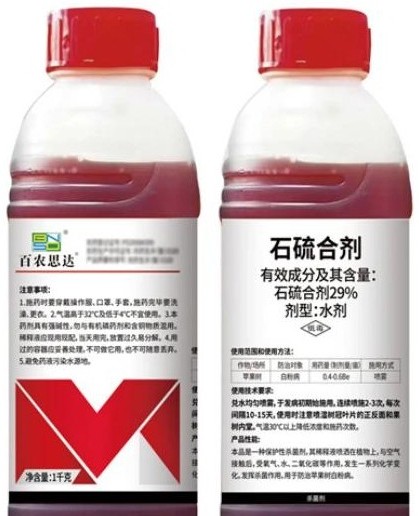
Apple powdery mildew overwinters as mycelium inside infected buds, which is why the apple answer to mildew is a winter answer. Lime sulphur 29% aqueous solution (AS) is registered on apple at 0.4–0.6 °Bé, applied during dormancy before buds break. The spray suppresses overwintering inoculum on wood and buds before shoots emerge, setting up clean early growth.
Because lime sulphur is strongly alkaline and caustic, three rules apply in every market: never mix it with oils or other pesticides, keep dormant rates off green tissue, and respect the interval to the next spray stated on the destination label. Within a resistance-management framework this is the most dependable kind of chemistry — a multi-site inorganic with no meaningful resistance risk, doing cleanup work that preserves newer molecules for in-season use.
Cucumber: Thiram and Thiophanate-methyl
Cucurbits carry mildew pressure through the whole season, so the Chinese label offers two complementary actives:
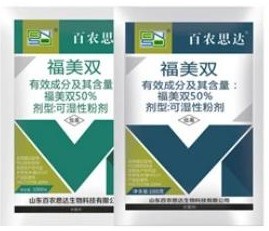
- Thiram 50% wettable powder (WP), 75–150 g/667 m² — a multi-site protectant (FRAC group M). Thiram works before infection, so it is positioned as regular preventive cover while the canopy is building.
- Thiophanate-methyl 70% WP, 40–48 g/667 m² — a systemic that converts to carbendazim inside the plant (FRAC group 1). It has curative reach but is resistance-prone, so it belongs in rotation, never as a season-long solo program.
Rotate FRAC Groups — the Point of Having Options
The four options above sit in different resistance classes, which is exactly what makes them useful together:
- FRAC 3 (tebuconazole): specific-site, moderate resistance risk, curative.
- FRAC M (thiram, lime sulphur): multi-site, no practical resistance risk, protective.
- FRAC 1 (thiophanate-methyl): specific-site, high resistance risk — the classic group to cap and rotate.
Standard FRAC guidance, applied everywhere: alternate unrelated groups within a season, do not follow one group-3 spray with another, limit group-1 use to the label minimum, and anchor the program with multi-site sprays. Rotation is not a formality — mildew populations are large and short-cycled, and resistance selected in one season arrives in the next.
Options at a Glance
| Crop | Product | FRAC group | Chinese label rate | Position |
|---|---|---|---|---|
| Wheat | Tebuconazole 430 g/L SC | 3 | 15–25 mL/667 m² | Curative, upper-canopy timing |
| Apple | Lime sulphur 29% AS | M | 0.4–0.6 °Bé | Dormant-season cleanup |
| Cucumber | Thiram 50% WP | M | 75–150 g/667 m² | Preventive season cover |
| Cucumber | Thiophanate-methyl 70% WP | 1 | 40–48 g/667 m² | Curative partner in rotation |
All rates are Chinese registration label rates. Registered crops, doses and use patterns differ by country — always follow the destination-market label before positioning stock.
Sourcing and OEM Notes
Bainong Sida holds 70 ICAMA registrations with around 60 more pending, releases every batch against the registration standard by HPLC/GC analysis, and packs across a 10 mL–40 kg ladder in more than eight formulation types for OEM customers. The full range is in the fungicide catalogue; for samples, registration documents or private-label packing, contact the export team.
FAQ
What is the best fungicide for powdery mildew?
There is no single best — the answer is crop-specific. On the Chinese labels held by Bainong Sida: tebuconazole 430 g/L SC on wheat (15–25 mL/667 m²), lime sulphur 29% AS on apple (0.4–0.6 °Bé, dormant), and thiram 50% WP (75–150 g/667 m²) or thiophanate-methyl 70% WP (40–48 g/667 m²) on cucumber. The destination-market label decides what may be sold and how it may be used.
Can one powdery mildew product be used across all crops?
No. Powdery mildews are host-specific fungi, and registrations are crop-specific too — a label covering wheat does not cover apple or cucurbits, and the dose differs by crop even where one product carries several crops. Always check the crop line on the destination label.
When should wheat be sprayed for powdery mildew?
At the first sign of colonies moving into the upper canopy, before the flag leaf is heavily infected. Tebuconazole is systemic and curative, so it stops active infections, but it cannot recover leaf area already lost — early timing protects the flag leaf through grain fill.
Can lime sulphur be mixed with other sprays?
No. Lime sulphur is strongly alkaline and must not be tank-mixed with oils or most other pesticides; sequential applications also need the interval stated on the label. Used alone in the dormant window, it is the multi-site anchor of an apple mildew program.
WhatsApp / WeChat: +86 199 0636 5856