
“Downy” and “powdery” sound like two degrees of the same problem. They are not. One is an oomycete (a water mould), the other a true fungus; one arrives with cool, wet weather, the other thrives on warm days and humid nights; and their chemistries barely overlap. Diagnose wrongly and a perfectly good fungicide fails through no fault of its own. This guide gives the field identification, then matches each disease to the registered products held by BNSD Agro (Shandong Bainong Sida Biotechnology Co., Ltd.).
Identification: Read the Lesion and the Weather
The fastest field check takes about a minute: look at the upper surface, then turn the leaf over, then ask what the weather has been doing.
| Feature | Downy mildew | Powdery mildew |
|---|---|---|
| Pathogen type | Oomycete (water mould) | True fungus (ascomycete) |
| Upper surface | Water-soaked, yellowing patches, often angular where veins fence them in | White to grey talc-like dust, wiping off like powder |
| Underside | Grey-violet downy sporulation beneath the lesions | Sparse white growth; underside mostly clean |
| Favourite weather | Cool, humid; leaf wetness, rain, condensation | Warm dry days with humid nights; no free water needed |
| Typical course | Explosive after rain or overhead irrigation | Steady build-up in shaded, lush, crowded canopies |
Two traps catch growers every season. First, by the time downy mildew shows its upper-surface yellowing, sporulation on the underside is already producing the next generation — the “clean-looking” leaf you sprayed yesterday was already infected. Second, powdery mildew does not need wet leaves: spraying more often does not fix it, and opening the canopy while keeping leaves dry does.
Downy Mildew: Product Logic
Because downy mildew is an oomycete, it needs chemistry built for oomycetes — many broad-spectrum “disease” products miss it entirely.
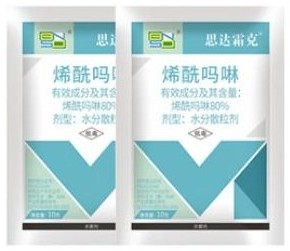
Dimethomorph 80% water-dispersible granule (WDG) is the systemic anchor here. On the Chinese label held by BNSD Agro, cucumber downy mildew is registered at 20–25 g/667 m² (667 m² = one mu ≈ 1/15 ha; the destination-market label governs in your own country). Dimethomorph belongs to FRAC group 40, acting on cell-wall formation in oomycetes (general classification), and its systemic movement lets it reach the tissue a contact spray misses — relevant for a disease whose underside sporulation sits below the leaf you actually spray.
Around that anchor, the registered multi-site option plays the protectant role: chlorothalonil 75% wettable powder (WP), cucumber downy mildew at 165–200 g/667 m² on the Chinese label. As an FRAC M5 contact protectant it contributes broad, resistance-robust cover ahead of infection windows, and it is the natural rotation partner for single-site oomycete chemistry. Downy programs that alternate a specific oomycete active with a multi-site protectant — rather than repeating the same single site — hold up far longer in the field.
Powdery Mildew: Product Logic
Powdery mildew is a true fungus, and its registered options come from two different families.
Thiophanate-methyl 70% WP is the cucumber-house option: Chinese label registration for cucumber powdery mildew at 40–48 g/667 m². Thiophanate-methyl is the benzimidazole precursor of FRAC group 1 — in planta it converts to carbendazim, the active form (general chemistry) — giving systemic, eradicant action against established surface growth, not just protectant cover.
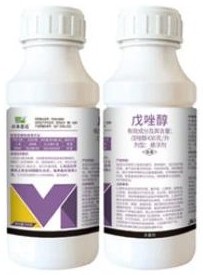
Tebuconazole 430 g/L suspension concentrate (SC) carries the wheat label: wheat powdery mildew at 15–25 mL/667 m² on the Chinese registration. Tebuconazole is a triazole of FRAC group 3 — systemic and curative (general classification), stepping into an epidemic that has already started. The same triazole family covers the rust-and-powdery window on cereals, which is why one formulation earns its place across the cereal program.
For cucumber growers the practical takeaway: thiophanate-methyl (group 1) and a triazole (group 3) alternate cleanly, and where labels allow, triazoles can also double for other targets in the same spray window.
Rotation Notes
Both diseases are handled by single-site chemistry, so both programs live or die by rotation (general resistance-management knowledge):
- Downy: alternate FRAC 40 (dimethomorph) with multi-site M-group protectants (chlorothalonil) and any other oomycete groups registered locally. Cap consecutive single-site applications per cycle; never chase a slipping product with higher rates.
- Powdery: FRAC 1 and FRAC 3 are both single-site. Rotate between them rather than repeating either, cap uses per crop cycle, and support the program with canopy and humidity management.
- Both: spray before the weather event, not after the symptoms. Downy mildew infections you cannot yet see are the ones that cost the crop.
Where to Get It
The fungicide export range of BNSD Agro covers the actives above across WDG, WP and SC formats; the full list is on the fungicides catalogue. For samples, registration documents or OEM packing, contact BNSD Agro.
FAQ
How do I tell downy mildew from powdery mildew in the field?
Turn the leaf over. Downy mildew shows water-soaked, often angular yellowing on top with grey-violet down on the underside; powdery mildew shows a white, talc-like dust that wipes off the upper surface with the underside mostly clean. Weather history confirms it: downy follows cool, wet, humid spells; powdery builds on warm days with humid nights.
Is downy mildew actually a fungus?
Not in the strict sense — the pathogen is an oomycete, a water mould, which is why it needs oomycete-specific chemistry such as dimethomorph (FRAC 40) rather than broad fungicides that miss it. Powdery mildew, by contrast, is a true fungus and responds to FRAC 1 or FRAC 3 chemistry as registered.
What is the label rate for dimethomorph 80% WDG on cucumber?
On the Chinese label held by BNSD Agro, cucumber downy mildew is registered at 20–25 g/667 m². For powdery mildew, thiophanate-methyl 70% WP is registered on cucumber at 40–48 g/667 m² and tebuconazole 430 g/L SC on wheat at 15–25 mL/667 m². Rates are Chinese registration label rates; follow the destination-market label in your own market.
Can downy and powdery mildew occur on the same plant?
Yes, and in late-season cucumber houses both can be present at once — they favour different weather, not mutually exclusive crops. When both are active, resist the urge to stack products casually: build a program with a confirmed oomycete active for downy, a confirmed powdery-mildew active for powdery, distinct FRAC groups throughout, and follow each destination label’s tank-mix and interval provisions.
WhatsApp / WeChat: +86 199 0636 5856