
Whitefly is the pest that most often breaks a protected tomato program. Adults fly up in clouds when the canopy is disturbed, nymphs and pupae sit where sprays do not reach, and within a few warm weeks every life stage is present at once. A program built on a single spray simply cannot keep up. The workable structure, and the one this guide follows, is contact knockdown for the adults plus systemic support for what emerges afterwards — using the whitefly registration held by BNSD Agro (Shandong Bainong Sida Biotechnology Co., Ltd.) as the registered anchor.
Why Whitefly Is Hard to Kill in Protected Crops
Greenhouse and silverleaf whiteflies (Bemisia and Trialeurodes species, general knowledge) are difficult for structural reasons, not because the chemistry is weak:
- All stages live on the leaf underside. Eggs, scale-like nymphs and pupae glue themselves to the lower surface; only adults and newly hatched crawlers move. A top-of-canopy spray wets the wrong side of the leaf.
- Generations overlap. In a warm protected house, breeding is continuous, so one application against adults is followed within days by a fresh wave of hatching crawlers.
- The damage is stealthy. Nymphs suck sap and exude honeydew that feeds sooty mould on fruit, and Bemisia transmits tomato yellow leaf curl virus — losses that appear long after the sprays ended.
This is why the whitefly program has two legs: a knockdown product that removes adults before they lay eggs, and systemic support that protects new growth between passes.
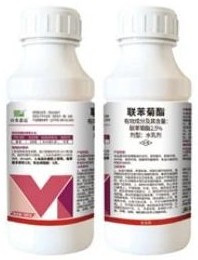
The Registered Knockdown: Bifenthrin 2.5% EW
On the Chinese label held by BNSD Agro, whitefly on tomato is controlled with bifenthrin 2.5% EW at 30–40 mL/667 m² as a foliar spray (667 m² = one mu ≈ 1/15 ha). As always, the destination-market label governs use in your own country.
Bifenthrin is a synthetic pyrethroid in IRAC group 3A, acting by contact and stomach poison. Its strengths fit the whitefly job precisely: fast contact knockdown of the mobile adult stage before it lays the next generation of eggs, and a persistent film on treated surfaces.
The formulation choice is deliberate. An EW (oil-in-water emulsion) carries the active in tiny oil droplets dispersed in water instead of the large organic-solvent load of a conventional emulsifiable concentrate (EC) — a lower-solvent profile that is gentler on operators, less pungent in enclosed houses, and generally softer on sensitive crops under plastic (well-established formulation knowledge). For protected tomatoes, that difference shows up in crop safety as much as in pest control.
Systemic Support: The Drench Logic
Knockdown sprays act on what is present the day of application. Whitefly rebounds because the eggs and nymphs survive. The complementary concept is systemic support at the root zone (general agronomy logic):
- A soil drench or seedling-hole application of a systemic active is taken up by the roots and transported xylem-mobile into new foliage, protecting the tissue that expands during the one to two weeks after each knockdown spray.
- Root-zone delivery does not depend on hitting the leaf underside, which removes the coverage problem entirely for that pass.
- Applied early — at transplant or first application — it reduces early population pressure, buying time between foliar passes.
Where this is authorized, BNSD’s neonicotinoid line supplies the actives: thiamethoxam (70% water-dispersible granule (WDG), 25% WDG, 35% suspension concentrate (SC) seed treatment), imidacloprid (10% wettable powder (WP), 70% WDG), acetamiprid 70% WDG, and clothianidin 48% SC — the latter itself registered in China as a root drench against chive maggot, illustrating the drench delivery pattern. The critical caveat: each active’s drench use is crop-specific on each label. Whether a root-zone whitefly use is available in your market is a question the destination label answers — never improvise a drench rate from a foliar label.
Coverage and Timing: Spray the Undersides
Whatever the product, whitefly control lives and dies on coverage technique:
- Angle the spray upward. Drop nozzles, a hollow-cone pattern or an angled lance that throws droplets into the lower leaf surface are worth more than any dose increase. The canopy should be opened and the underside wetted to run-off at the working height.
- Slow the walk, raise the volume. Under-sizing water volume is the most common cause of “the product stopped working” complaints on whitefly.
- Time the pass. Adults flush and fly when disturbed, so move gently through the house to keep them on the leaves while spraying. Evening applications reduce bee exposure and evaporation.
- Scout with yellow sticky traps to catch population upswings early — traps show adult pressure weeks before honeydew shows on fruit.
Rotation: One Group per Generation
Bifenthrin is IRAC 3A; the neonicotinoid support actives are IRAC 4A. Treat the program as a rotation, not a repeat:
- Do not follow a 3A spray with another 3A spray against the same generation; the same rule applies within 4A.
- Alternate the knockdown group between generations — 3A this generation, an unrelated group the next, as registered locally.
- Cap total applications of each group per crop cycle. Overused pyrethroids and neonicotinoids are the two fastest routes to whitefly resistance in protected systems.
Building the Full Program
Put together, the program reads: drench or seedling-hole systemic support where registered, a bifenthrin 2.5% EW knockdown spray when adults flare, underside-directed coverage every pass, and group rotation between generations. The full insecticide and acaricide export range — including the neonicotinoid line named above — is listed in the insecticides catalogue. For samples, label documents or OEM packing, contact BNSD Agro.
FAQ
What is the registered rate for whitefly on tomato?
On the Chinese label held by BNSD Agro, bifenthrin 2.5% EW is registered against whitefly on tomato at 30–40 mL/667 m² as a foliar spray. Registration scopes and rates differ by country, so always apply the destination-market label rate in your own market.
Why an EW instead of an EC for protected tomatoes?
An EW (oil-in-water emulsion) delivers the active in fine oil droplets dispersed in water, with far less organic solvent than a conventional EC. In enclosed houses this means lower odour and operator exposure, and generally better crop safety on sensitive foliage under plastic. The pest-control performance of the active is unchanged.
Can I pour a neonicotinoid drench around tomato roots?
Only where the destination label authorizes a root-zone use on that crop. Drench rates are entirely different from foliar rates — often tenfold or more per unit area — and a foliar label never justifies a drench. Where a drench use is registered, systemic support from the root zone is the natural complement to foliar knockdown, because it protects new growth that no spray reaches.
How often should whitefly sprays be rotated?
Rotate by generation, not by calendar. Do not apply the same IRAC group twice against one whitefly generation, alternate 3A knockdowns with unrelated groups across generations, and cap each group’s total uses per crop cycle. Overreliance on repeated pyrethroid or neonicotinoid applications is the classic path to whitefly failures in protected crops.
WhatsApp / WeChat: +86 199 0636 5856