
Grey mould is the disease that turns a wet, overcast week inside a cucumber house into a crop event. Flowers, old petals and wounded tissue go grey-brown, the fuzzy sporulation spreads by air onto fruit in contact with the canopy, and within days a lesion here and there becomes a picking problem. Under plastic, no fungicide program works without humidity management, and no humidity program replaces a correctly timed fungicide. This guide sets out both halves, anchored on the grey mould registration held by BNSD Agro (Shandong Bainong Sida Biotechnology Co., Ltd.).
Botrytis Biology Under Plastic
Botrytis cinerea, the cause of grey mould, is built for greenhouse life (general plant pathology knowledge):
- Cool and humid is its weather. The fungus is most aggressive in mild temperatures with very high humidity — over 90% relative humidity or free water on the plant surface. Protected cucumber in the cool season provides exactly this: condensation on cold plastic, guttation droplets on leaf margins, poor air movement in dense canopies.
- It enters through dying and wounded tissue. Senescing flower petals, old stamens sticking to young fruit, pruning wounds and cold-damaged tissue are the standard infection courts. That is why symptoms appear first at the flower end of fruit and at cut stubs.
- Sporulation is explosive and airborne. Once established, the grey spore masses dust the air with inoculum; every subsequent humid period turns new wounds into new infections.
Two consequences follow for the program: start protection before the weather event, not after symptoms, and aim deposits at the tissues Botrytis actually attacks — flowers, fruit contact points and wounds.
The Registered Option: Pyrimethanil 80% WDG
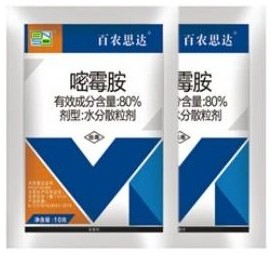
On the Chinese label held by BNSD Agro, cucumber grey mould is controlled with pyrimethanil 80% WDG at 30–45 g/667 m² as a foliar spray (667 m² = one mu ≈ 1/15 ha). As always, the destination-market label governs in your own country.
Pyrimethanil is an anilinopyrimidine fungicide, FRAC group 9, with a mode of action that blocks the pathogen’s penetration of host tissue (inhibition of methionine biosynthesis — general classification). Two label-relevant properties make it a natural grey mould tool in protected crops:
- Penetration blocker. Applied ahead of infection, it stops Botrytis entering the tissue — the correct timing being protectant passes ahead of humid, overcast periods rather than curative rescue sprays on established rot.
- Vapour effect. The active has a vapour-phase component, so in the still air of a cucumber house deposits continue to act from the leaf surface into the surrounding canopy space — useful in the dense, hard-to-wet canopies where grey mould does its worst.
The pack ladder suits smallholder dosing: 10 g sachets packed 800 per carton, with 100 g and 500 g packs above them, so a 30–45 g per mu rate is measured in sachets rather than by guesswork.
Program Timing: Where and When to Spray
- Target the infection courts. Direct the spray at flowers, young fruit, the base of the plant and pruning wounds — not just the upper canopy. Thorough wetting of fruit contact points matters more than volume on the leaves.
- Trigger on weather, not on symptoms. Start a protectant pass ahead of forecast cool, overcast, humid spells and after pruning or harvest rounds that create fresh wounds; repeat at the interval stated on the label.
- Work clean. Remove infected flowers, fruit and leaves from the house in sealed bags — they are the spore factory. Do this dry; handling wet, sporulating tissue spreads inoculum.
FRAC 9 Rotation
Group 9 is a single-site mode of action, and Botrytis is notorious for building resistance under repeated use. Standard resistance-management practice (general knowledge) applies:
- Limit consecutive group 9 applications per crop cycle — a common working rule is no more than two before switching to an unrelated group.
- Rotate with partners of different FRAC groups as registered locally; multi-site contact protectants are the classic rotation partners because resistance to them develops slowly.
- Never extend rates or intervals beyond the label to “stretch” a failing product — a slipping group 9 program is a resistance signal, not a dose problem.
Environmental Control: The Other Half of the Program
No fungicide outperforms a wet house. The cultural half (general knowledge):
- Ventilate. Heat-and-vent cycles on cold mornings clear condensation; dead-air corners are where grey mould establishes first.
- Irrigate early in the day so leaf surfaces dry before night, and prefer drip over overhead wetting inside the house.
- Open the canopy. Pruning for airflow also removes the senescent tissue Botrytis colonises — two jobs in one pass.
- Close the wound window. Apply a protectant spray after major pruning rounds rather than leaving wounds open through a humid night.
Where to Get It
Pyrimethanil 80% WDG sits in the fungicide export range of BNSD Agro alongside the other cucumber-house actives; the full list is on the fungicides catalogue. For samples, registration documents or OEM packing, contact BNSD Agro.
FAQ
What causes grey mould in protected cucumbers?
The fungus Botrytis cinerea, which infects through senescing petals, wounds and dying tissue under cool, very humid conditions — overcast weather, condensation and still air inside cucumber houses. Dense canopies and late-day irrigation make the environment more favourable; removing infected tissue and managing humidity attacks the cause.
What is the label rate for pyrimethanil 80% WDG?
On the Chinese label held by BNSD Agro, cucumber grey mould is registered at 30–45 g/667 m² as a foliar spray, with 10 g sachets supporting accurate smallholder dosing. Registrations and rates differ by country — always apply the destination-market label in your own market.
Why does pyrimethanil suit cucumber houses?
Two reasons: it blocks the pathogen’s penetration of tissue when applied ahead of infection, and it has a vapour-phase effect that keeps working in the still air of a dense canopy — exactly where grey mould pressure is highest and coverage is hardest.
How should pyrimethanil be rotated?
Treat it as FRAC group 9: cap consecutive uses (a common rule is two per cycle), then rotate to an unrelated group or a multi-site protectant as registered locally. If a program that used to work starts slipping, read it as resistance pressure and change the group — not the dose.
WhatsApp / WeChat: +86 199 0636 5856