
Tank mixing saves passes across the field and widens the spectrum of one operation — but a bad mix can cancel both benefits and leave an expensive cleanup. This guide covers the basics every operator should know: how to check compatibility before committing a tank, the order in which products go into the water, the pH traps that catch people out, and why manufacturers offer pre-mixed two-active products as a safer alternative. The combination products cited are registered items from the BNSD Agro (Shandong Bainong Sida Biotechnology Co., Ltd.) range.
Start with the Jar Test
Before any field-scale tank mix, test the exact combination in a jar (general practice):
- Use a clear glass jar and the same water source the sprayer will use — hardness and temperature change the outcome.
- Add water and each product at roughly the proportional rates of the planned tank, in the intended order, stirring between additions.
- Watch the mix for several minutes to half an hour: separation, clumps, flakes, gel formation or unusual heat all mean the combination is not compatible.
The jar test cannot confirm agronomic suitability — only the label can do that — but it screens out the physical failures that clog nozzles and settle out in the tank.
The Mixing Order: Powders, Then Suspensions, Then Emulsions
Once compatibility is confirmed, products go into a half-filled tank with agitation running, in an order that lets each formulation fully disperse before the next one arrives:
- Water first. Fill the tank roughly half full and start agitation.
- WDG and WP products (including water-soluble bags). Dry formulations need the most water contact time; add them as a slurry if recommended and let them disperse completely.
- SC and other suspension concentrates. These flowables disperse into the working suspension.
- EC, micro-emulsion (ME) and other emulsion products last among the crop-protection items.
- Adjuvants and surfactants go in at the end, then the tank is topped up to volume.
Never mix concentrated products together in a small container before adding to the tank — the one exception is pre-slurrying a WDG in a little water, as the label may direct. Do not let a mixed tank stand for hours before spraying; mix only what will be applied the same day.
The pH and alkalinity trap
Many active ingredients degrade steadily in alkaline solution, so a mix that looks fine can quietly lose active while the tank stands. The standing cautions: avoid combining pesticides with strongly alkaline materials, and treat lime sulphur and copper-based mixtures as incompatible with most partners unless the label explicitly allows it. One pair worth naming outright: mineral oil and lime sulphur must never be mixed — the combination is a documented phytotoxicity risk (general agronomy knowledge).
When a Pre-Mixed Two-Active Product Is the Better Answer
Much of what operators attempt in the tank already exists as a factory-made combination — with a registered ratio, tested stability and a single label. A pre-mix removes the jar test, the ordering question and the ratio error in one step. The two-active products registered in the BNSD Agro range (company information):
| Product | Formulation | Registered uses (Chinese label) |
|---|---|---|
| 300 g/L difenoconazole + propiconazole | EC | Wheat sheath blight 20–30 mL/667 m²; rice sheath blight 20–25 mL/667 m² |
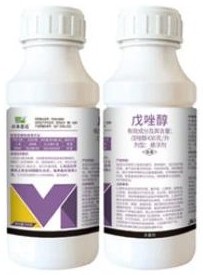
| 400 g/L tebuconazole + prochloraz | oil-in-water emulsion (EW) | Wheat Fusarium head blight 30–40 mL/667 m²; banana leaf spot 1000–3000× |
| 30% pyraclostrobin + tebuconazole | SC | Wheat powdery mildew and rust 20–40 mL/667 m²; pepper anthracnose 60–70 mL/667 m² |
| 11.6% emamectin + chlorantraniliprole | SC | Diamondback moth 5–10 mL/667 m² |
| 10.5% abamectin + pyridaben | EC | Apple red spider mite 2500–3500× |
| 22% thiamethoxam + lambda-cyhalothrin | SC | Wheat aphids 5–7 mL/667 m²; tea leafhopper 5–7 mL/667 m² |
| 45% kasugamycin + oxine-copper | SC | Peach bacterial shot hole 2000–3000× |
The pattern is worth noting: manufacturers pair actives that belong together agronomically — a systemic triazole with a protectant or a second-site partner, a knockdown pyrethroid with a systemic neonicotinoid, an antibiotic with a copper partner for bacterial diseases. The full fungicide combinations are listed in the fungicides catalogue. For the complete range, samples or OEM packing, contact BNSD Agro.
Pre-mixes do not make tank mixing obsolete — a drone or ground operation still mixes PGRs, fertilizers and single-active insecticides every day. The rule of thumb: where a registered combination product covers the need, use it; reserve custom tank mixes for the combinations no registered product covers.
FAQ
What is the correct order for tank mixing?
With the tank half full and agitating: WDG and WP products first, then suspension concentrates (SC), then emulsion formulations (EC/ME), and adjuvants last, before topping up to volume. Dry formulations need the longest contact with water to disperse fully, which is why they go in first.
How do I test compatibility before tank mixing?
Run a jar test with the same water the sprayer uses: add each product at roughly proportional rates in the planned mixing order, stir, and observe for 15–30 minutes. Clumping, gelling, flakes, separation or heat mean the combination is physically incompatible. The jar test checks physics, not agronomy — registered uses still come from the label.
Can mineral oil be mixed with lime sulphur?
No. Mineral oil and lime sulphur must never be combined — the mixture is a well-known phytotoxicity risk, which is why mineral-oil labels carry explicit sulphur-mixing warnings. The same alkalinity logic extends more broadly: keep pesticides away from strongly alkaline tank partners unless the label explicitly permits it.
Why buy a two-active pre-mix instead of tank mixing myself?
A registered pre-mix fixes the ratio at factory tolerance, carries stability testing on the combination, and comes with one label and one liability line. Tank mixing two separate products leaves the ratio to the operator and compatibility to chance. Where a combination product exists for your target — for example 400 g/L tebuconazole + prochloraz EW for Fusarium head blight — it is the more reproducible choice.
WhatsApp / WeChat: +86 199 0636 5856