
Plant virus diseases are the most honest problem in crop protection: once a plant is infected, there is no chemistry that cures it. That single fact explains why immunity elicitors exist and how they must be sold — not as a curative, but as a risk-reduction layer in a program built on prevention. Amino-oligosaccharin is the elicitor most widely registered in China, and this guide explains what it actually does, the registered tomato use on the Chinese label, how to pair it with vector control, and where it does not belong. The full range sits on the insecticides catalogue, and samples or registration documents are available through the contact page.
What Is Amino-oligosaccharin?
Amino-oligosaccharin is an oligosaccharide molecule of microbial origin — derived from chitin, the structural polysaccharide of fungal cell walls. That origin is the point: chitin fragments are exactly what a plant’s immune system evolved to notice as the signature of an attacking pathogen. Applied to the crop, amino-oligosaccharin mimics that attack signal:
- It raises the plant’s own defence response. Treated tissue activates its innate defence machinery — the production of pathogenesis-related proteins, antimicrobial phytoalexins and structural reinforcements — as if infection had begun, before it actually has. The plant is “primed”: when a real pathogen arrives, the response is faster and stronger.
- It works on the plant, not the pathogen. The elicitor has little direct killing activity against viruses, which are not independently alive and have no metabolism to poison. Its entire value flows through the crop’s own physiology.
- Systemic acquired resistance context. Elicitors sit in the same conceptual family as the plant’s own signalling cascade that spreads after a local infection, hardening tissue that was never directly treated.
This mode of action places amino-oligosaccharin outside the conventional fungicide and insecticide categories — it is a biostimulant-adjacent crop protection tool, and buyers should classify and market it accordingly.
Honest Positioning: What an Elicitor Is Not
A conservative framing protects both the distributor and the grower, and it should be stated plainly:
- It is not a cure. No product cures a plant-virus infection once systemic; a registered elicitor reduces disease expression and spread risk but cannot reverse an established infection.
- It is not a substitute for registered disease control. Fungal and bacterial diseases need registered fungicides and bactericides; a virus-pressure program needs vector control, sanitation and resistant varieties. The elicitor is one layer — a support — never the foundation.
- Effects are protective and probabilistic. Primed plants show lower disease incidence and severity under pressure; they do not become immune. Setting expectations at the point of sale is part of the product’s correct use.
Positioned this way, amino-oligosaccharin is a defensible, label-backed program component. Positioned as a “virus killer”, it will disappoint every time.
Registered Use and Chinese Label Rates
| Product | Registered target (Chinese label) | Label rate | Packs |
|---|---|---|---|
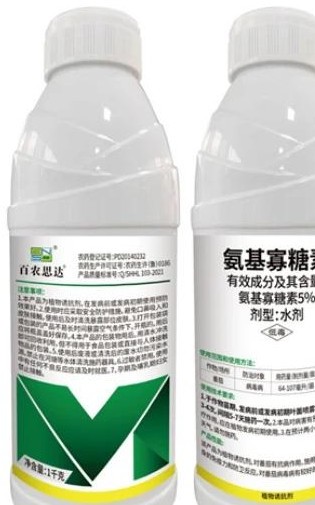
| Amino-oligosaccharin 5% AS (aqueous solution) | Tomato viral disease | 64–107 g/667 m² | 1 kg×12, 5 kg×4 |
All rates are Chinese registration label rates; 667 m² equals one mu, roughly 1/15 hectare. In your own market the destination label governs — permitted crops, rates and application intervals follow the registration in your jurisdiction, and the numbers above are a positioning reference. Our guide to reading a Chinese pesticide label explains how the two documents relate.
The aqueous solution (AS) formulation suits the product’s role: a clear, easily dissolved liquid that integrates cleanly into transplant-onward spray rounds in tomato and other solanaceous programs.
The Program Layer That Makes It Work: Vector Control
Plant viruses move with their vectors, which makes a virus-pressure program a vector-control program with an elicitor running alongside. On the Chinese label, the portfolio pairs directly with:
- Whitefly control — bifenthrin 2.5% EW at 30–40 mL/667 m² (tomato whitefly, Chinese label). Whiteflies transmit geminiviruses such as TYLCV in tomato.
- Thrips control — thiamethoxam 25% WDG at 10–20 g/667 m² (welsh onion thrips, Chinese label). Thrips spread tospoviruses, the most economically damaging virus group in vegetables.
- Aphid control — acetamiprid 70% WDG at 1.5–2.5 g/667 m². Aphids transmit non-persistent viruses rapidly and need early, well-timed suppression — see the aphid control product guide.
Which of these uses are legal in your market follows the destination registrations; the vector-selection logic is universal. The wider vector picture is covered in the whitefly control guide and thrips control guide, and the full tomato structure in the tomato crop protection program.
Around those products sit the cultural layers that decide the outcome: sanitation and rogueing of infected plants, resistant varieties where available, reflective or ultraviolet-blocking mulches against vectors, and clean transplant sources. The elicitor multiplies the value of this foundation; it cannot replace it.
Program Placement: When to Run the Elicitor
- Start before infection pressure, not after symptoms. Priming is preventive by definition — the defences must be raised before the pathogen arrives. In tomato programs this means beginning at the nursery or transplant stage and repeating per the label interval.
- Keep it running through the high-risk windows. Vector pressure peaks with temperature and crop flush; the elicitor layer stays in the rotation while vectors are active.
- Compatible with the spray round. Elicitors are generally mixable with common insecticides and fungicides, but confirm compatibility per the destination label and the tank mixing guide.
Sourcing Amino-oligosaccharin 5% AS: Buyer Checks
- Content released by HPLC against the registration standard. Oligosaccharin content is a registered value; at BNSD Agro every batch is analysed by HPLC or GC and released against the registration standard before shipment (company practice).
- Physical clarity of the AS. An aqueous solution should be clear, free of sediment and microbial growth through the shipping route’s temperature cycles — any turbidity is a rejection flag.
- Pack integrity for liquid biologically derived products. 1 kg×12 and 5 kg×4 packs need clean, sealed, tamper-evident bottles; biological products reward careful, dry, shaded storage.
- Documents in the supplier’s own name. Pesticide registration certificate, production licence and batch traceability, verifiable against the registration database.
- Destination registration first. Elicitor registrations vary widely between jurisdictions — confirm the product’s status and permitted claims in your market before positioning it.
FAQ
What is amino-oligosaccharin and how does it work?
It is a microbial-origin oligosaccharide (chitin-derived) that acts as a plant immunity elicitor: it switches on the crop’s own defence responses before a pathogen arrives, so the plant reacts faster and more strongly to real infection pressure. It works on the plant, not directly on pathogens.
Does amino-oligosaccharin cure virus-infected plants?
No. Nothing cures a systemic plant-virus infection. The elicitor is a preventive support layer that reduces disease expression and spread risk under pressure — it must be positioned that way and run alongside vector control, sanitation and resistant varieties.
What is the registered use of amino-oligosaccharin 5% AS on the Chinese label?
Tomato viral disease at 64–107 g/667 m², packed in 1 kg×12 and 5 kg×4. Crops, rates and intervals in your market follow the destination registration and label.
What should amino-oligosaccharin be paired with in a virus-pressure program?
Vector control against the insects that spread the viruses — whitefly, thrips and aphid products per your market’s registrations — plus sanitation, resistant varieties and clean planting material. The elicitor is the defence layer on top of that foundation, never a substitute for it.
WhatsApp / WeChat: +86 199 0636 5856