
Ask ten growers which aphidicide is best and you will get ten answers, because the honest answer is that no single active is best: aphids are controlled by matching a registered active to the crop, the colony’s position on the plant and the resistance history of the block. This guide walks through that matching process using the aphid registrations on file at BNSD Agro (Shandong Bainong Sida Biotechnology Co., Ltd.), from cucumber houses to wheat fields to peach orchards.
Aphid Biology in Brief
Three traits of aphid biology decide what a product must do:
- Colonies sit on growing points and leaf undersides. Wingless females cluster on tender shoots, buds and the underside of young leaves — exactly where spray droplets penetrate least. A product with systemic uptake reaches tissue a contact spray cannot.
- Reproduction is explosive. In mild weather most aphids reproduce without mating, producing live young that are themselves born pregnant. A colony can multiply several-fold in a week, which is why early, well-timed treatment beats rescue spraying.
- The damage is indirect as much as direct. Sap-sucking stunts growth; honeydew feeds sooty mould that downgrades produce; and aphids transmit plant viruses as they probe. On crops sold on appearance — cucumber, peach — honeydew alone can cause loss.
Because colonies hide inside curled leaves and dense heads, effective aphid control usually combines contact knockdown with systemic movement into new growth. The crop matches below reflect that logic.
Crop-by-Crop: Registered Matches
The table lists the aphid uses registered on the Chinese labels held by BNSD Agro. All rates are Chinese registration label rates; 667 m² = one mu ≈ 1/15 ha. In your own market, always follow the destination-market label — registrations and rates differ by country.
| Crop | Product | Chinese label rate |
|---|---|---|
| Cucumber | Acetamiprid 70% water-dispersible granule (WDG) | 1.5–2.5 g/667 m², foliar spray |
| Cabbage and other brassicas | Imidacloprid 70% WDG | 1.5–2 g/667 m², foliar spray |
| Wheat | Thiamethoxam + lambda-cyhalothrin 22% suspension concentrate (SC) | 5–7 mL/667 m², foliar spray |
| Peach | Flonicamid + bifenthrin 15% SC | 4000–5000× dilution spray |
| Cotton | Acetamiprid 70% WDG | 1.5–2.5 g/667 m², foliar spray |
Cucumber: acetamiprid 70% WDG
Acetamiprid is a neonicotinoid in IRAC group 4A with contact, stomach and systemic action. The Chinese label rates it at just 1.5–2.5 g per 667 m² — a consequence of the 70% active content, which puts roughly one gram of pure active on a mu. The pack ladder is built for this arithmetic: 4 g sachets packed 1000 per carton suit smallholder retail, while 100 g jars serve cooperative-scale sprayers. On cucumber, where colonies sit under leaves and inside new curls, the systemic component matters as much as the contact kill.
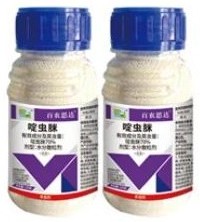
Brassicas: imidacloprid 70% WDG
Cabbage aphid is arguably the hardest aphid to spray: colonies pack deep between waxy, cupped leaves where droplets never land. Imidacloprid (also IRAC 4A, systemic, contact and stomach action) is registered in China at 1.5–2 g/667 m² as the 70% WDG. The same systemic property that carries the active into new growth is what reaches colonies buried in the head. The 2 g sachet, packed 1000 per carton, keeps dosing accurate at these tiny rates.
Wheat: thiamethoxam + lambda-cyhalothrin 22% SC
Wheat aphids concentrate on ears and flag leaves late in the season, and the damage window is short. The 22% SC combination pairs thiamethoxam (4A, systemic residual) with lambda-cyhalothrin (IRAC 3A, fast contact knockdown), registered in China at 5–7 mL/667 m² for wheat aphids (also tea leafhopper on the same label). Marketed under the name “Ruika” (company information), it is the natural fit for growers who need both speed and residual in a single pass.
Peach: flonicamid + bifenthrin 15% SC
Orchard labels are typically written as dilution sprays, and the Chinese label for this 15% SC reads 4000–5000× dilution against peach aphids. The pairing is rotation-friendly by design: flonicamid, a selective feeding blocker (IRAC group 9C, general classification), stops aphids probing and feeding within hours, while bifenthrin (3A pyrethroid) adds contact knockdown. Two unrelated modes of action in one application reduce selection pressure on either.
Rotation: IRAC 4A Stewardship
Note the pattern in the table: three of the five matches are group 4A neonicotinoids. That is where a rotation plan matters most. Standard IRAC guidance (general knowledge) applies:
- Never follow a 4A application with another 4A product against the same aphid generation.
- Cap the number of 4A applications per crop cycle and rotate with unrelated groups — pyrethroids (3A), feeding blockers (9C), and other groups as registered locally.
- Where a block has a history of neo-nicotinoid failures, assume resistance and reposition the program rather than raising the rate.
Mixtures like the peach 15% SC (9C + 3A) and the wheat 22% SC (4A + 3A) are built for exactly this reason: the second mode of action protects the first.
Pollinator caution. Group 4A actives are highly toxic to bees. Never spray a flowering crop, spray in the evening when pollinators are least active, and prevent drift to flowering weeds and neighbouring hives — per the bee-protection clauses of the destination label.
Sourcing and Next Steps
For importers and distributors, aphid actives are classic small-pack SKUs: the sachet ladders (4 g, 2 g) are what make gram-level rates accurate in smallholder hands. The full export range of insecticide and acaricide formulations is listed in the insecticides catalogue. For samples, registration documents, COA or OEM packing on any of the products above, contact BNSD Agro.
FAQ
Which aphid insecticide is best?
There is no universal answer — the best aphidicide is the one registered on your crop with a mode of action the local population has not been overexposed to. On the Chinese labels held by BNSD Agro: acetamiprid 70% WDG on cucumber and cotton, imidacloprid 70% WDG on brassicas, a 22% thiamethoxam + lambda-cyhalothrin SC on wheat, and a 15% flonicamid + bifenthrin SC on peach. Always follow the destination-market label.
Why are the rates so low — just grams per mu?
Because the formulations are highly concentrated. 1.5–2.5 g of a 70% WDG delivers roughly 1–1.8 g of pure active per 667 m², which is the normal dose range for systemic neonicotinoids. This is also why accurate weighing matters: sachet packs are the safest way to dose these products in the field.
How do I prevent aphid resistance?
Treat mode-of-action groups as a budget. Do not chain group 4A applications within one aphid generation, cap total 4A uses per crop cycle, and rotate to unrelated groups. Combination products such as the flonicamid + bifenthrin 15% SC or the thiamethoxam + lambda 22% SC carry two groups in one pass and slot naturally into a rotation plan.
Can one aphid product be used across all these crops?
No. Registrations are crop-specific: the same active may be registered on cucumber but not on peach in a given market, and rates differ per crop. Before positioning any product, check the crop list on the destination-market label — a Chinese registration does not authorize use elsewhere.
WhatsApp / WeChat: +86 199 0636 5856