
Tomatoes compress three very different threats into one crop: a leaf-spotting fungus, systemic viruses with no chemical cure, and the insect that carries those viruses from plant to plant. Each responds to a different class of product, applied at a different moment. This guide sets out a program built from the Chinese registration labels held by BNSD Agro (Shandong Bainong Sida Biotechnology Co., Ltd.) — mancozeb for early blight, an immunity elicitor against viral disease and bifenthrin for whitefly — with the timing logic that holds the three together.
One Crop, Three Kinds of Science
Early blight is a fungal disease you prevent. Viral disease is a systemic infection you can only manage — through the plant’s own defences and through vector control. Whitefly is an insect you suppress, and suppressing it is itself part of virus management. A tomato program therefore assigns each threat its own product class and its own window in the season, rather than cycling one “strong” product through the whole cycle.
Early Blight: Mancozeb as the Protectant Anchor
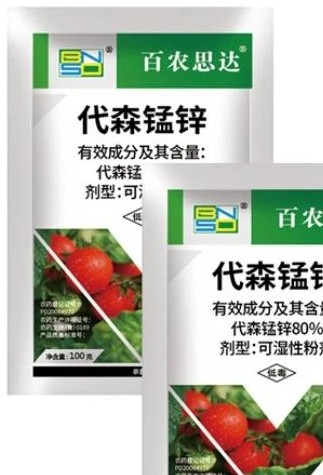
The Chinese label for mancozeb 80% wettable powder (WP) registers tomato early blight at 153.75–197.5 g/667 m².
Early blight (Alternaria solani) shows first on the older leaves — brown lesions with the concentric “target” rings that give the disease its other name — and climbs the plant, causing progressive defoliation if left unchecked. Mancozeb is a multi-site protectant fungicide (FRAC group M3): it works only as a deposit on the leaf surface before infection takes hold. That shapes the whole program:
- Start protectively, from the early vegetative stage, before lesions appear on the lower canopy;
- Repeat at the label interval while warm, humid weather keeps infection pressure high;
- Treat it as the resistance anchor — multi-site chemistry carries low resistance risk, so other actives rotate around it rather than replace it.
Viral Disease: Eliciting Defence Instead of Chasing a Cure
The Chinese label for amino-oligosaccharin 5% aqueous solution (AS) registers tomato viral disease at 64–107 g/667 m². Amino-oligosaccharin is an immunity elicitor: it switches on the plant’s own defence responses, which is how the label positions it against viral disease.
The framing matters, because no registered chemistry cures a tomato plant once a virus has systemically colonised it. Virus management rests on three legs: healthy, clean seedlings; suppression of the vector (the whitefly, below); and elicitors that prime the plant’s defences through the vector-pressure period. The elicitor covers the “plant side” of that triangle. Spray on a program through the season, starting before or at the first sign of vector pressure, at the label rate and interval.

Whitefly: Suppress the Vector, Slow the Virus
The Chinese label for bifenthrin 2.5% oil-in-water emulsion (EW) registers whitefly control at 30–40 mL/667 m².
Whiteflies (Bemisia tabaci) are the classic tomato virus vector — they pick up and transmit viruses such as tomato yellow leaf curl virus in minutes of feeding, which is why vector suppression is inseparable from viral disease control. Three practical points:
- Coverage. Adults and nymphs sit on leaf undersides; spray aiming only at the top of the canopy wastes most of the dose.
- Formulation. An EW (oil-in-water emulsion) carries the pyrethroid in an aqueous phase with low solvent odour, suited to crops grown near occupied greenhouses and settlements.
- Rotation. Bifenthrin is IRAC group 3A, and whitefly generations are short. Cap the 3A count per cycle and rotate with other groups as registered locally, or the knockdown you rely on will fade.
The Season Program at a Glance
| Growth stage | Main threat | Program anchor | Chinese label rate |
|---|---|---|---|
| Transplanting – early vegetative | Virus entry via vectors; first Alternaria infections | Amino-oligosaccharin 5% AS | 64–107 g/667 m² |
| Vegetative – first flower cluster | Early blight establishing on lower leaves | Mancozeb 80% WP | 153.75–197.5 g/667 m² |
| Flowering – fruiting | Whitefly build-up and on-farm virus spread | Bifenthrin 2.5% EW | 30–40 mL/667 m² |
| Ongoing warm, humid spells | Recurring early blight cycles | Mancozeb 80% WP, repeated per label | 153.75–197.5 g/667 m² |
Application and Rotation Notes
- Mancozeb is preventive: once lesions show, it protects the leaf area that remains, not the lesions themselves.
- The elicitor and the vector program are complements, not alternatives — dropping one leg of virus management undermines the other two.
- Bifenthrin’s IRAC 3A should not follow 3A within a whitefly generation; mancozeb’s M3 multi-site profile makes it the season-long fungicide backbone.
- All rates above are Chinese registration label rates (667 m² = one mu, ≈ 1/15 ha). Follow the destination-market label in your own country for registered uses, rates and intervals.
The fungicide line behind the early blight program is in the fungicides catalogue; the whitefly products are listed in the insecticides catalogue. For label documents, samples or OEM packing, contact BNSD Agro.
FAQ
Does mancozeb cure existing early blight lesions?
No. Mancozeb is a contact protectant: it prevents new infections on treated leaf surfaces but does not eradicate established lesions. The program logic is to protect the canopy before and between infection windows, then prune out heavily diseased lower leaves per agronomic practice.
Does amino-oligosaccharin kill the virus directly?
No. It is an immunity elicitor — it activates the tomato plant’s own defence responses, which is how the Chinese label positions it against viral disease. Pair it with vector suppression and clean planting material for the full effect.
Why choose an EW formulation for whitefly control?
The EW is an oil-in-water emulsion: the active is carried in tiny oil droplets dispersed in water, giving low solvent odour and good leaf spreading. That suits tomatoes grown close to housing or in shared greenhouse blocks, where spray odour is a real constraint.
How often should each product be applied?
At the interval the destination-market label specifies, adjusted to infection and vector pressure: mancozeb protectively through humid spells, the elicitor through the vector-pressure period, bifenthrin when whitefly counts rise — within the rotation caps set for each mode of action.
WhatsApp / WeChat: +86 199 0636 5856