
Thrips are the smallest pest most growers ever lose yield to. At a millimetre or two long they hide inside flowers, leaf sheaths and curled leaf edges, rasp the surface off the tissue beneath, and leave silvering, distortion and — on some crops — virus infections that cost more than the feeding itself. Because the insect hides so well, product choice and spray technique must work together. This guide sets out the thrips registrations held by BNSD Agro (Shandong Bainong Sida Biotechnology Co., Ltd.), which are built on water-dispersible granule (WDG) systems for alliums and cucurbits.
Thrips Damage in Brief
Three habits define thrips control (general entomology knowledge):
- Rasping, hidden feeding. Thrips pierce cells and empty their contents, leaving silvery patches with black specks of frass. Young leaves expand distorted; on alliums, feeding deep in the leaf sheath is invisible until the scar tissue shows above.
- Sheltered positions. Adults and larvae crowd into flowers, leaf axils and the tight sheaths of onion leaves — micro-sites a standard overhead spray wets poorly.
- A soil leg in the life cycle. Many thrips species drop to the soil to pupate, so new adults emerge from the ground for days after a spray, which is why repeat passes per generation are normal practice.
On several crops thrips also transmit tospoviruses, which raises the value of keeping populations low early rather than knocking them down late.
Registered WDG Options by Crop
The table lists thrips uses on the Chinese labels held by BNSD Agro. Rates are Chinese registration label rates; 667 m² = one mu ≈ 1/15 ha. Always follow the destination-market label in your own country.
| Crop | Product | Chinese label rate |
|---|---|---|
| Chieh-qua (fuzzy gourd) | Thiamethoxam 70% WDG | 4–5 g/667 m², foliar spray |
| Onion (Welsh onion) | Thiamethoxam 25% WDG | 10–20 g/667 m², foliar spray |
| Cucumber | Acetamiprid 70% WDG | 1.5–2.5 g/667 m², foliar spray |
All three actives are neonicotinoids in IRAC group 4A — systemic, contact and stomach action, which matters because thrips feeding sites are so well sheltered.
Chieh-qua: thiamethoxam 70% WDG
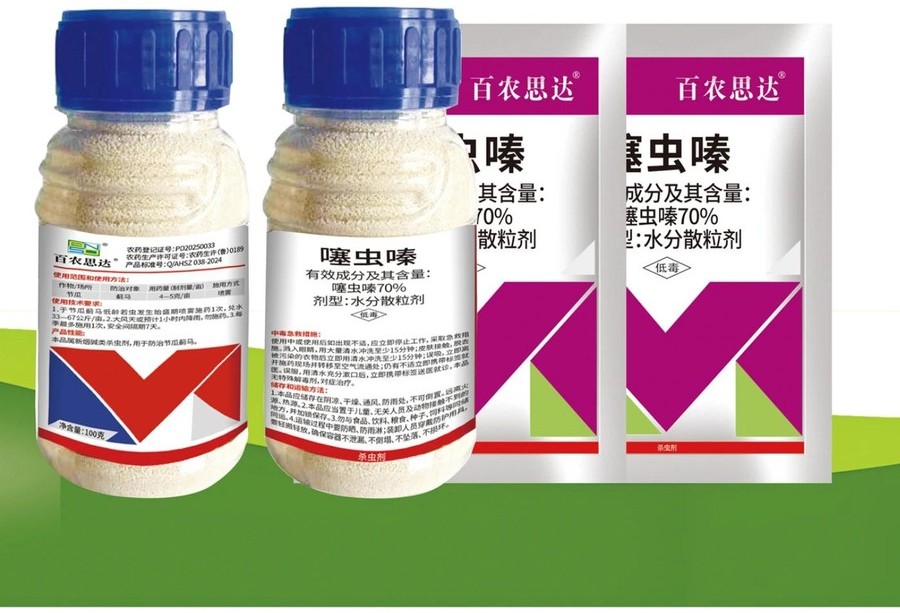
Chieh-qua and other cucurbit flowers are classic thrips harbours. The 70% WDG is the high-content workhorse: at 4–5 g per 667 m², the 4 g sachet packed 1000 per carton puts retail dosing within a sachet or two per mu, minimising weighing error at these gram-level rates. The WDG formulation stores without freezing damage and disperses dust-free — the properties buyers test when sourcing a granule.
Onion: thiamethoxam 25% WDG
Welsh onion leaves are upright, waxy and tightly sheathed — droplets slide off and thrips sit inside the sheath. The Chinese label answers with a higher gram rate on a lower-content formulation: thiamethoxam 25% WDG at 10–20 g/667 m². The same product label also carries garlic and chive root-maggot drench uses, so one SKU covers both the foliar thrips job and the allium soil-pest program — a practical consolidation for allium-growing regions. Against the waxy leaf surface, a good wetting spray volume and pressure aimed into the leaf axils are part of the rate.
Cucumber: acetamiprid 70% WDG
On cucumber the same acetamiprid 70% WDG registered for aphids (1.5–2.5 g/667 m²) also covers thrips on the Chinese label. One sachet-based SKU therefore handles the two most common sucking pests of the cucumber house — a useful simplification for retail channels and for growers alternating between aphid and thrips pressure.
Coverage Technique: Spraying for a Hidden Insect
Because thrips sit where sprays do not naturally land, technique carries extra weight:
- Direct the spray into the shelter zones. Flowers, leaf axils and allium sheaths need explicit targeting — angled nozzles, sufficient pressure and enough water volume to push droplets into the crevices.
- Expect repeat passes. With pupation in the soil, a single application rarely clears a generation; plan a follow-up pass against newly emerged adults, per label intervals.
- Mind the flowers and the bees. Thrips treatments often coincide with flowering. IRAC 4A actives are highly toxic to bees: never spray a crop in bloom, spray in the evening, and follow the bee-protection provisions of the destination label.
- Rotate the group. All three registered options here are 4A. Within one thrips generation, do not chain 4A on 4A; cap 4A uses per crop cycle and rotate to unrelated IRAC groups as registered locally. Where thrips populations carry known 4A resistance, position these products accordingly and monitor efficacy.
Sourcing Notes for Importers
The thrips program is a study in the WDG format: high active content, sachet ladders for gram-accurate smallholder dosing, and stable storage through hot and humid shipping routes. The full export range of insecticide and acaricide SKUs is listed in the insecticides catalogue; for samples, registration documents or OEM packing, contact BNSD Agro.
FAQ
What is the best insecticide for thrips on onion?
On the Chinese label held by BNSD Agro, thiamethoxam 25% WDG is registered against welsh onion thrips at 10–20 g/667 m², and the same label carries allium root-maggot drench uses. Because onion leaves shed spray and thrips hide in the sheath, thorough coverage into the leaf axils matters as much as the product choice. Always follow the destination-market label.
Why use WDG formulations for thrips control?
WDG carries high active content (70% on thiamethoxam), stores without freezing or solvent issues, and dissolves dust-free. At gram-level rates like 4–5 g per mu, the sachet pack ladder is what makes field dosing accurate. The format is equally practical for exporters: less freight per kilogram of active.
Why do thrips come back after spraying?
Two reasons. First, thrips pupate in the soil, so adults continue to emerge for days after a spray — a follow-up pass is standard. Second, sprays miss the sheltered micro-sites (flowers, sheaths, leaf curls) where survivors rebuild the population. Coverage technique plus a planned second pass, per label intervals, addresses both.
Can I rotate these thrips products with each other?
No — thiamethoxam and acetamiprid are both IRAC group 4A, so rotating between them gives no resistance-management benefit. Within a generation use one 4A product, then rotate to an unrelated group for the next, as registered locally. Combination products and other-mode-of-action options extend the rotation where labels allow.
WhatsApp / WeChat: +86 199 0636 5856