
Aphids are the sucking pest that never quite leaves a grower’s season: they colonise flush growth, excrete honeydew that turns into sooty mould, transmit viruses, and bounce back after every broad-spectrum spray that kills their natural enemies alongside them. Flonicamid occupies a distinct niche in that battle, and the way it is best used — in a two-mode combination — is exactly what buyers should understand before quoting it. This guide explains how flonicamid works, why the registered 15% flonicamid + bifenthrin SC is a deliberate construction rather than a marketing bundle, and where it fits in a rotation. The full range sits on the insecticides catalogue, and samples or registration documents are available through the contact page.
What Is Flonicamid?
Flonicamid is a pyridinecarboxamide insecticide classified in IRAC group 9B — the selective feeding blockers. Its mode of action is unlike anything else in the aphid toolbox:
- Feeding stops within about an hour. Flonicamid rapidly inhibits probing and feeding behaviour. Aphids stop puncturing plant tissue and stop excreting honeydew almost immediately after exposure — well before any mortality shows.
- No knockdown, by design. Flonicamid is not a contact poison that kills on the spot. Mortality follows over the following days as starved aphids fail to reproduce and develop, so a spray assessed the next morning by “are they dying” will under-rate it.
- Selective profile. Because it targets pest feeding behaviour rather than the nervous system broadly, it is comparatively compatible with beneficial insects relative to broad-spectrum materials — a genuine asset in programs that still rely on natural enemies.
That last property — the feeding stop — is the strategic point. An aphid that is not probing is an aphid no longer spreading non-persistent viruses or pumping honeydew onto the leaf below. In crops where the damage is the honeydew or the virus rather than the direct feeding (cucurbits, potatoes, citrus flush, stone fruit), stopping the feeding is most of the win.
Why Flonicamid Alone Looks “Slow”
The classic grower complaint about flonicamid is that “nothing happened.” What actually happened is that the knockdown expectation was applied to a molecule that was never built for it. A pure feeding blocker leaves live aphids on the plant for days, the colony visual persists, and confidence in the product collapses even though the feeding damage stopped within the hour.
This is not a defect to argue away — it is the reason the combination product exists. Pair a feeding blocker with a fast contact-knockdown active and each covers the other’s blind spot: the knockdown clears the visible population now, the feeding blocker protects the crop from the moment of spraying and keeps pressure off the residue of the colony that the knockdown spray missed.
The Two-Mode Combination: 15% Flonicamid + Bifenthrin SC
| Product | Registered target (Chinese label) | Label rate |
|---|---|---|
| 15% flonicamid + bifenthrin SC | Peach aphid (Myzus persicae) | 4000–5000× dilution |
All rates are Chinese registration label rates; the destination label governs which uses and rates apply in your market.
The construction is a textbook two-mode pairing. Flonicamid (IRAC 9B) stops probing and feeding within the hour — the virus- and honeydew-protection half. Bifenthrin (IRAC 3A, pyrethroid) is a contact and stomach insecticide with strong knockdown and a repellent edge — the visible-clearance half that satisfies the grower walking the row the next morning. A suspension concentrate carries both in one pour, one pass, one invoice.
The peach aphid is a fitting registered target because it is the hardest of the common aphids: polyphagous, resistant-prone across multiple mode-of-action groups, and an efficient virus vector. Against that pest profile, the “stop feeding + knock down” construction is not luxury — it is how the two halves of the problem actually get covered.
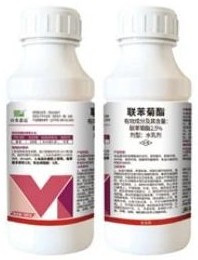
The same bifenthrin chemistry appears elsewhere in the portfolio as a standalone 2.5% EW (registered for tomato whitefly at 30–40 mL/667 m² on the Chinese label), which matters for buyers assembling programs: one knockdown active, multiple vector targets. For the wider aphid picture, see our aphid control product guide.
Timing: When to Deploy the Combination
- At threshold, before the visual collapse. Aphid populations build exponentially; the right window is the first threshold crossing on flush growth, not the moment the crop looks curled and sooty.
- Before the virus has moved. Feeding inhibition protects the crop from the hour of application, but no product un-transmits a virus. In virus-pressure crops the program starts with early vector control — see the whitefly control guide and thrips control guide for the other two virus vectors.
- With adequate water volume and coverage. Both modes need to reach the colony: bifenthrin on contact, flonicamid through ingestion and contact with treated surfaces. Aphids feed on the undersides and inside curled leaves — spray to the colony, not to the canopy top.
- Per the destination label. Dilution rates, intervals and pre-harvest intervals follow the label registered in your market.
Rotation: Keeping 9B Working
Flonicamid is a single-site material and must be managed like one. Practical rules:
- Cap consecutive group 9B applications; rotate with unrelated groups — IRAC 4A neonicotinoids (acetamiprid, thiamethoxam), IRAC 9A pymetrozine, IRAC 23 spirocyclics, or group 3 pyrethroids where the label allows.
- Treat the combination SC as one application of both groups it contains (9B + 3A) when planning the season’s budget.
- The general principles are set out in our resistance management guide, and tank-mix compatibility rules in the tank mixing guide.
Sourcing a Flonicamid Combination SC: Buyer Checks
- Content released by HPLC against the registration standard. Both actives, both declared — a combination product is two registered contents, not one.
- Suspension stability after dilution. A two-active SC must stay uniformly suspended for the whole spray job without hard bottom cake.
- No crystallisation through temperature cycling — flonicamid solubility and SC stability must survive the shipping route’s cold and hot extremes.
- Documents and pack format. Registration certificate, production licence and batch traceability in the supplier’s own name; export pack formats agreed in the contract.
- Destination registration first — confirm the combination (not just each active) is registrable in your market.
FAQ
How fast does flonicamid work?
Flonicamid stops aphid probing and feeding within about an hour of exposure, so honeydew output and virus transmission risk drop almost immediately. Mortality is slower — the population declines over the following days, which is why it is paired with a knockdown partner.
Why is flonicamid sold as a combination with bifenthrin?
The two modes cover each other’s gaps: flonicamid (IRAC 9B) stops feeding and protects the crop from the hour of spraying; bifenthrin (IRAC 3A) delivers fast contact knockdown of the visible colony. On the Chinese label the 15% flonicamid + bifenthrin SC is registered against peach aphid at 4000–5000× dilution.
What can flonicamid be rotated with?
Rotate with unrelated mode-of-action groups: 4A neonicotinoids, 9A pymetrozine, 23 spirocyclics and others, keeping consecutive 9B applications to a minimum. The combination SC counts as one use of both its groups.
What should buyers check when sourcing flonicamid products?
Destination registration for the combination, HPLC-released content for both actives, suspension stability and no crystallisation through the shipping route, clean documents in the supplier’s own name, and pack formats agreed in the contract.
WhatsApp / WeChat: +86 199 0636 5856