
Every acaricide in a distributor’s portfolio carries the same long-term liability: mites breed fast, and repeated chemistry selects for resistance. Horticultural spray oil is the exception — a physical mode of action that no mite has ever evolved around. That is why mineral oil keeps its place in modern citrus programs even in markets flooded with acaricide molecules. This guide explains how the physical mode works, the registered citrus use on the Chinese label, the mixing and temperature cautions that decide whether oil is safe on the crop, and where it slots into rotation. The full range sits on the insecticides catalogue, and samples or registration documents are available through the contact page.
How a Physical Mode Works
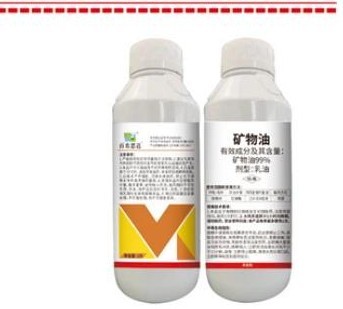
Mineral oil 99% EC is a highly refined paraffinic oil formulated as an emulsifiable concentrate, so it mixes into the spray tank and deposits as a thin oil film across leaves, fruit and the pests sitting on them. Its activity is mechanical, not biochemical:
- Suffocation. The oil film plugs the spiracles and egg-shell pores of mites, scale insects, whiteflies and their eggs, cutting off gas exchange. Eggs are a particular strength: oils penetrate and smother the egg stage that most synthetic acaricides handle poorly.
- No target site, no resistance. There is no receptor to mutate and no enzyme to over-produce. Resistance — the defining failure mode of every site-specific acaricide group — does not develop against a film of oil.
- Secondary effects. The film also interferes with pest feeding and oviposition, and can loosen the waxy cover of scale insects, exposing them to the environment and to co-applied materials.
The same physics that makes oil effective makes it unforgiving of mistakes: a film thick enough to smother a mite, applied in the wrong temperature window, can also affect the leaf. That is why the label cautions below are not formalities.
Registered Use and Chinese Label Rates
| Product | Registered target (Chinese label) | Label rate | Packs |
|---|---|---|---|
| Mineral oil 99% EC | Citrus red spider mite | 150–300× dilution, once per season | 1 L×12, 4 L×4 |
All rates are Chinese registration label rates; the destination label governs legal use in your market.
Two details in that row carry program consequences. First, the once-per-season limit on the Chinese label: this is a strategic product, not a repeat spray, so the season’s single application should be scheduled where it does the most work — typically the early-season window when overwintering populations, eggs and the first mite cohorts coincide, and the crop can still carry a full oil film safely. Second, the 150–300× dilution band: oil efficacy depends on deposit thickness, so the spray water volume per hectare matters as much as the dilution number. Translate both into destination-label terms before building a schedule, and confirm the once-per-season condition applies in your market’s registration too.
Mixing Cautions: Where Spray Oil Goes Wrong
Oil is one of the most tank-sensitive materials in the catalogue, and the cautions are consistent across every producing country’s guidance:
- Never mix with sulphur or lime sulphur — and keep them days apart. Oil and sulphur combinations are a classic phytotoxicity pairing; the safe practice is to separate the applications by a matter of days in either direction. Our citrus pest control program guide covers the citrus program context in detail.
- Avoid high-temperature spray windows. Spraying oil in midday heat — particularly above roughly 30 °C — risks leaf burn. Spray in the cooler part of the day and make sure the tree is not water-stressed.
- Do not improvise tank mixes. Oil changes how droplets deposit and how other actives contact the leaf; unless the destination label or registration explicitly permits a combination, treat oil as a solo pass. General compatibility rules are set out in our tank mixing guide.
- Complete coverage, right droplet size. Suffocation needs a continuous film; poor coverage leaves islands of survivors. Conversely, run-off wastes oil and increases phytotoxicity risk — the registered dilution band is the balance point.
Rotation Value: The Resistance-Break in an Acaricide Program
In a citrus mite program built around site-specific acaricides, oil plays a distinct strategic role. The Chinese-label citrus portfolio pairs it with chemical options such as bifenazate + etoxazole 45% SC (registered for citrus red spider mite at 6000–8000× dilution, active across mite life stages with ovicidal activity). The sequencing logic:
- Oil hits eggs and suffocates what is present — a mode no chemical acaricide duplicates — which clears the generation that would otherwise re-seed the population after a chemical spray.
- Chemical acaricides then rotate through their groups under normal IRAC discipline, with the oil pass acting as a resistance-break between chemistry blocks. The principles are set out in our resistance management guide and the mite-specific notes in the spider mite control guide.
- The once-per-season label limit fits this role exactly — one well-placed oil pass per season is the intended pattern, not a deficiency.
Sourcing Mineral Oil 99% EC: Buyer Checks
- Refining quality, not just content. Horticultural oils are judged on refinement — a properly refined paraffinic base with low unsulphonated residue (high UR value) is what separates crop-safe oil from industrial oil. Ask for the specification, not just “99%”.
- Emulsion stability after dilution. The EC must form a uniform milky emulsion in the tank and stay there; separation during a spray job delivers uneven film and patchy control.
- Content and identity by GC. Hydrocarbon profile confirms a consistent, specification-conforming base oil batch to batch. At BNSD Agro every batch is analysed by HPLC or GC and released against the registration standard before shipment (company practice).
- Pack integrity. 1 L×12 and 4 L×4 bottles need leak-proof seals for Class-appropriate transport; oil is low-hazard freight but still a liquid bulk line item — confirm pack testing.
- Documents and destination registration. Registration certificate, production licence and traceability in the supplier’s own name; and confirm the oil’s registered uses and dilution guidance in your own market before quoting.
FAQ
How does mineral oil control mites and scales?
Physically: the sprayed oil deposits as a thin film that plugs the spiracles of motile mites and scales and the pores of their eggs, suffocating them. Because there is no biochemical target site, resistance does not develop against this mode.
How often can mineral oil 99% EC be used on citrus?
The Chinese label registers citrus red spider mite at 150–300× dilution, once per season. Check whether your destination registration carries the same once-per-season condition and schedule the single pass where it delivers most value — typically the early-season generation.
Can mineral oil be mixed with sulphur or lime sulphur?
No. Oil and sulphur are a classic phytotoxicity combination; keep the two applications days apart in either direction, and avoid spraying oil in high-temperature windows regardless of what else is in the tank.
What else can a horticultural spray oil contribute in a program?
Beyond the registered mite target, the physical mode is traditionally valued against scale insects, whiteflies and eggs across many crops — but which uses are legal in your market is decided solely by the destination label.
WhatsApp / WeChat: +86 199 0636 5856