
Spider mites reward inattention with explosions. A colony missed on the leaf undersides in early summer can bronze a whole orchard block within weeks, and the sprays that worked last season may disappoint this one because mite populations evolve resistance faster than almost any other pest group. Spider mite control therefore has two halves: choosing an acaricide that covers the stages actually present, and rotating modes of action so the choice keeps working next year.
This guide covers the mite biology that drives those decisions, then three acaricides from BNSD Agro’s (Shandong Bainong Sida Biotechnology Co., Ltd.) Chinese registration labels — a bifenazate + etoxazole suspension concentrate (SC) for citrus, an abamectin + pyridaben emulsifiable concentrate (EC) for apple and a 99% mineral oil EC — with label rates and an IRAC rotation framework.
Know the Mite Before You Spray
Spider mites are arachnids, not insects, and the distinction decides the shopping list: most ordinary insecticides do not touch them, and a true acaricide is needed. Their life cycle runs from egg through a six-legged larva and two nymphal stages to the adult, and under hot, dry conditions a generation can complete in roughly a week — which is why populations compound fastest exactly when crops are most stressed. Eggs, larvae and adults coexist in the same colony, feeding on cell contents on the leaf underside; damage shows first as stippling, then bronzing, and heavy colonies spin protective webbing.
Three implications follow for any spider mite control program:
- Eggs are half the population. A product with no ovicidal activity leaves the next generation already hatching behind you.
- Coverage is underside coverage. Colonies live and feed where spray droplets least want to go.
- Start before webbing. Once webbing forms, it shields the colony from droplets and the population is already past its cheapest control point.
Three Acaricides, Three Modes of Action
45% Bifenazate + Etoxazole SC: Citrus Red Mite, All Stages
On the Chinese label, this suspension concentrate is registered against citrus red spider mite at a 6000–8000× dilution spray. The two actives are deliberately complementary: etoxazole (IRAC group 10B) is a mite growth inhibitor with ovicidal and larvicidal activity, while bifenazate (IRAC group 25) contributes activity on the mobile stages. Together they cover the colony from egg to adult — the “all stages, ovicidal” position on the label — which is precisely what a stand-alone product often fails to do when egg banks and mobile mites overlap.
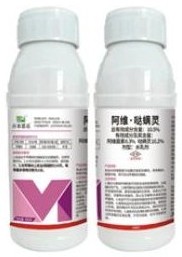
10.5% Abamectin + Pyridaben EC: Apple Red Spider
Registered on apple red spider mite at 2500–3500×, this EC pairs abamectin (IRAC group 6) with pyridaben (IRAC group 21A) — two unrelated modes of action in one pass. Abamectin moves into the leaf tissue after application, adding residual activity against mites feeding on treated surfaces, while pyridaben provides fast knockdown of mobile stages.
99% Mineral Oil EC: the Physical-Mode Anchor
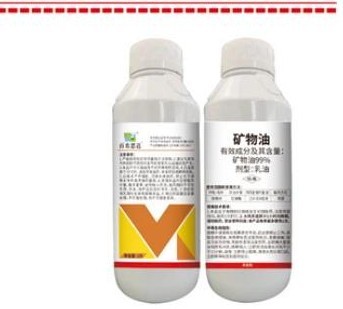
Mineral oil works differently from every receptor-active acaricide: at 150–300× on citrus mites it kills by physically smothering eggs and adults. There is no target site for resistance to latch onto, which makes it a uniquely stable rotation partner. Two label-driven cautions: it is positioned for roughly once per season, and it must never be mixed with sulphur sprays — including lime sulphur — or applied close to them, as the combination burns foliage. High-temperature days carry the same phytotoxicity risk, so oil goes on in cooler hours with thorough coverage.
IRAC Rotation at Program Level
The three products span unrelated IRAC groups, which is what makes a season-long rotation possible:
| Product | IRAC group | Registered use (Chinese label) | Label rate | Role in rotation |
|---|---|---|---|---|
| 45% bifenazate + etoxazole SC | 25 + 10B | Citrus red mite, all stages | 6000–8000× | Ovicidal pass that clears egg banks |
| 10.5% abamectin + pyridaben EC | 6 + 21A | Apple red spider | 2500–3500× | Knockdown on mobile stages |
| 99% mineral oil EC | Physical mode | Citrus mites | 150–300× | Resistance-free anchor, once per season |
Standard IRAC practice applies: do not follow one mode of action with another from the same group within a mite generation, cap the number of applications per group and per season, and treat mixtures with different active groups as one way to widen the rotation rather than a licence to spray more often.
Application Notes That Decide Efficacy
- Water volume first. Underside coverage is the rate-limiting step; a lower dilution with poor coverage loses to a correct dilution applied thoroughly.
- Monitor with a lens. A hand lens on sampled leaves turns “spray on schedule” into “spray at threshold,” which saves applications and slows resistance.
- Mind the weather. Avoid the hottest hours, especially with oils; follow pre-harvest intervals and bee-safety provisions on the destination label.
All rates above are Chinese registration label rates. Registered crops, doses and dilutions differ by country — always follow the destination-market label.
Sourcing and OEM Notes
Bainong Sida holds 70 ICAMA registrations with about 60 pending, releases each batch against the registration standard by HPLC/GC, and offers more than eight formulation types in OEM packs from 10 mL to 40 kg. The acaricide and insecticide range is listed in the insecticides catalogue; for samples, documents or private-label packing, contact the export team.
FAQ
What is the most effective treatment for citrus red spider mite?
On the Chinese labels held by Bainong Sida, the registered options are 45% bifenazate + etoxazole SC at 6000–8000× — covering all mite stages including eggs — and 99% mineral oil EC at 150–300× as a physical-mode, once-per-season pass. Effectiveness depends on underside coverage and on rotating modes of action between generations. Your destination-market label governs.
Why do spider mites come back so fast after spraying?
Two reasons. A short life cycle means surviving survivors rebuild numbers within days in hot weather, and any eggs not covered by an ovicidal product hatch into a fresh generation. Products that cover all stages, applied with thorough underside coverage, are what break that cycle.
Can mineral oil be mixed with other pesticides?
As a rule, no with sulphur products — mineral oil must never be mixed or sequenced close to lime sulphur or other sulphur sprays, as the combination is phytotoxic. For anything else, follow the destination label’s mixing provisions and jar-test first.
How should acaricides be rotated?
Across IRAC groups, not brands: for example, a bifenazate + etoxazole (25 + 10B) pass on citrus, a mineral oil pass outside the sensitive period, and no group repeated within the same mite generation. Cap the applications per group per season and keep the multi-site, physical-mode option as the anchor.
WhatsApp / WeChat: +86 199 0636 5856