
Garlic spends more months in the ground than almost any other vegetable crop, on a shallow root system, guarding an underground bulb that every soil pest can find. Add the thrips that live in the leaf axils all season and the leaf diseases that arrive with spring humidity, and the garlic grower’s season becomes a three-front campaign: below the soil, in the axils, on the leaf. This garlic pest control program organizes all three fronts into one timeline, with the Chinese label rates that anchor each pass. For maggot biology and drench technique in depth, see our allium root maggot control guide.
The Season at a Glance
Rates below are Chinese registration label rates (667 m² = 1 mu ≈ 1/15 ha); the destination market’s registration and label always govern final recommendations.
| Stage | Target | Product and Chinese label rate |
|---|---|---|
| At planting to establishment | root maggot (drench) | thiamethoxam 25% WDG, 180–360 g/667 m² drench |
| At planting to establishment | root maggot (drench, alternative) | 26% lambda-cyhalothrin + clothianidin SC, 2000–4000× dilution drench |
| At planting (granule option) | root maggot | 1% bifenthrin + clothianidin GR, incorporated at planting (Chinese registration: chive/garlic maggots) |
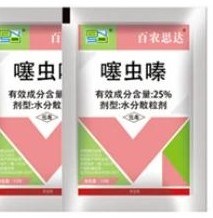
| Growing season | thrips | thiamethoxam 25% WDG, 10–20 g/667 m² (Chinese registration: welsh onion thrips — see note below) |
| Spring onward | leaf diseases | fungicides per destination label (see leaf care section) |
Root Maggot: The Drench at the Root Zone
Root maggots — the larvae of delia and related flies — lay eggs at the base of garlic plants, and the larvae tunnel into bulbs and roots. Damage shows as yellowing, stunted plants and bulbs with feeding galleries at harvest: another pest that must be met where it feeds, below the soil surface.
The BNSD Agro (Shandong Bainong Sida Biotechnology Co., Ltd.) catalog offers two Chinese-label drench paths on thiamethoxam chemistry:
- Thiamethoxam 25% WDG at 180–360 g/667 m² as a root drench. Thiamethoxam is a systemic neonicotinoid (IRAC 4A); applied as a drench, it moves into the root zone and protects the developing bulb from inside the soil environment. The wide 180–360 g band allows the rate to match soil type, infestation history and application timing — the destination label sets how that choice is exercised.
- 26% lambda-cyhalothrin + clothianidin SC at 2000–4000× dilution as a drench. The same two-group pairing used elsewhere in this series: a pyrethroid (IRAC 3A) for contact activity plus a neonicotinoid (IRAC 4A) for systemic cover, at a dilution rate the destination label governs.
Drench technique is the difference between a rate and a result. The liquid has to reach the root zone — sufficient water volume per 667 m², applied to moist soil, targeted at the plant base rather than the leaf. Follow the drench with normal irrigation only as the label allows, so the active stays where the larvae are.
Where the operation prefers granules, 1% bifenthrin + clothianidin GR (1 kg × 20 bags; Chinese registration: chive and garlic maggots) covers the same maggot complex at planting, incorporated into the root zone. It is the same insecticide-fertilizer-adjacent logic used in the peanut and tuber granule programs.
Thrips in the Leaf Axils
Garlic thrips shelter in the leaf axils and rasp the leaf surface, leaving silvery streaks that reduce the functional leaf area feeding the bulb. The catalog reference for thrips control is the same thiamethoxam 25% WDG: the Chinese label registers 10–20 g/667 m² for welsh onion thrips — the onion-thrips complex on alliums — and garlic thrips pressure is comparable in field practice.
The honest framing for buyers: the 10–20 g figure is the Chinese welsh onion label rate, shown here as the use pattern and dose band for this SKU; any garlic-specific recommendation must come from the destination market’s own label. In rotation terms, thiamethoxam (IRAC 4A) should alternate with other groups across the long garlic season — see the thrips control product guide for the rotation logic.
Leaf Care Through the Spring Window
From spring onward, fungal leaf diseases press the canopy while the bulb is swelling. Purple blotch and downy mildew are the classic garlic leaf diseases in most regions (general agronomy), and both are managed preventively: keep the canopy functional until the bulb finishes swelling, because every lesion on a leaf is photosynthesis the bulb never receives.
This program deliberately does not name specific leaf-disease products for garlic: fungicide choices must follow the destination label, where registrations for garlic leaf diseases differ widely between markets. The general rules that do transfer:
- Start protective sprays before symptom spread, driven by humidity and rainfall rather than by lesions.
- Rotate FRAC groups across the spring window — the same discipline as any long-season crop.
- Tank-mix hygiene applies: verify compatibility before combining disease and insect passes.
FAQ
When should the root maggot drench be applied?
At planting through establishment, when eggs and first-instar larvae are present at the plant base. The drench must reach the root zone, so water volume and placement matter as much as the rate: 180–360 g/667 m² of thiamethoxam 25% WDG or 2000–4000× of the 26% lambda + clothianidin SC, per the Chinese label — and per the destination label for final use.
Is the thrips rate for garlic or for welsh onion?
The 10–20 g/667 m² rate is the Chinese registration for welsh onion thrips on thiamethoxam 25% WDG. It is presented here as the dose band and use pattern for the SKU; garlic thrips recommendations must rest on the destination market’s own registration and label.
Can the drench and the granule be used together?
They are alternative placements for the same target, not additive treatments: the granule is incorporated at planting, the drench is applied as a liquid to the root zone. Choose one primary placement per the label, and rotate modes of action across the season rather than stacking the same chemistry.
What covers leaf diseases on garlic?
This program’s leaf-care section is intentionally label-driven: protective FRAC-group rotation in the spring window, with products selected from those registered for garlic leaf diseases in the destination market. Registration status varies too much between markets for a catalog claim to substitute for a local label.
To review the insecticide line or discuss a garlic program for your market, message the export team.
WhatsApp / WeChat: +86 199 0636 5856