
Allium crops are attacked from two directions at the same time. Below ground, root maggot larvae tunnel through the roots and developing bulbs of garlic, chive and onion, opening wounds that rot organisms finish off. Above ground, onion thrips rasp the leaves from deep inside the leaf sheaths. A program that treats these as one generic “insect problem” fails at both; a program that matches each pest to the right delivery method — drench, granule or foliar spray — holds the line. This guide sets out the registered use patterns and Chinese label rates on file at BNSD Agro (Shandong Bainong Sida Biotechnology Co., Ltd.), together with the timing and rotation logic that makes those rates work.
Two Pest Complexes, Two Delivery Problems
Root maggots: the hidden feeder
Root maggots are the larvae of small flies that lay eggs at the base of allium plants and in soil cracks. Emerging larvae move straight to the roots and the bulb. Because virtually the entire damaging life stage is spent below ground and inside plant tissue, contact sprays aimed at the canopy barely touch it. The effective options place the active ingredient where the larvae feed: a soil drench washed into the root zone, or a granule dissolved and carried down with irrigation.
Onion thrips: the sheltered feeder
Onion thrips feed by rasping the leaf surface and sucking up the exudates, leaving silvery patches and withered leaf tips. They shelter deep between the leaf sheath layers, which is why spray coverage and timing matter as much as the product itself. Pressure builds quickly in hot, dry weather, and thrips are also recognised virus vectors in alliums — so suppression protects more than leaf area.
Garlic Root Maggot: The Drench Program
The Chinese registration labels held by BNSD Agro give garlic growers two drench routes:
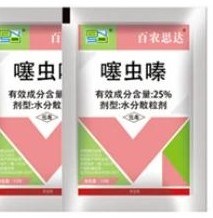
- Thiamethoxam 25% water-dispersible granule (WDG) — 180–360 g/667 m², applied as a root drench;
- 26% lambda-cyhalothrin + clothianidin SC — 2000–4000× dilution, applied as a drench.
Thiamethoxam is a systemic IRAC group 4A neonicotinoid: absorbed by the roots, it moves through the very tissue the larvae are attacking. The lambda + clothianidin combination pairs the group 4A soil activity of clothianidin with a fast-acting pyrethroid (IRAC group 3A) — two modes of action in one pass.
Timing decides whether a drench works at all. Apply at the egg-laying and early hatch window, while larvae are still mobile in the soil, and use enough water volume to carry the dose into the top layer of the root zone. Once larvae have tunnelled into the bulb, no label rate retrieves the crop.
Chive Maggot: The Tightest Turnaround in the Allium Sector
Chive is cut and regrown in short cycles, which restricts what can be used and when. The Chinese labels cover three routes:
- Thiamethoxam 25% WDG — 180–240 g/667 m², root drench;
- Clothianidin 48% SC — 40–50 mL/667 m², drench;
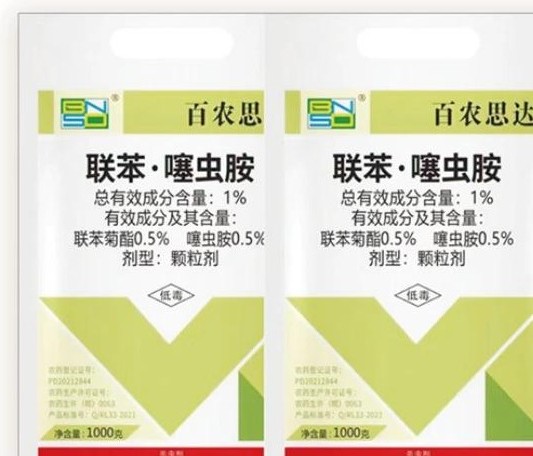
- 1% bifenthrin + clothianidin granule (GR) — a water-soluble granule that dissolves in about 30 seconds, packed 1 kg × 20 bags.
The granule format exists for a practical reason: a water-soluble granule with rapid dissolution can be applied to beds without spray equipment and then moved into the soil with irrigation. Rates and application details follow the destination-market label.
Drench or Granule? A Decision Table
| Field situation | Better fit | Why |
|---|---|---|
| Standing crop with active maggot pressure | Drench: thiamethoxam 25% WDG or clothianidin 48% SC | Places the dose directly into the root zone where larvae feed |
| No spray equipment, limited labour | 1% bifenthrin + clothianidin GR | Dissolves in about 30 seconds; applied with a basic spreader and irrigation |
| Two modes of action wanted in one pass | 26% lambda-cyhalothrin + clothianidin SC drench | IRAC 3A + 4A combined in a single product |
| Preventive program before peak egg-lay | Either route, per local label positioning | The dose must already be in the root zone before larvae hatch |
Onion Thrips: The Foliar Program
For thrips above ground the delivery flips to foliar spraying, at a fraction of the drench dose:
- Thiamethoxam 25% WDG — 10–20 g/667 m², foliar spray (the Chinese label registers this use for Welsh onion thrips);
- Bifenthrin emulsifiable concentrate (EC) + thiamethoxam 25% WDG co-pack — a paired pack covering thrips and soil-pest programs on onion and garlic.
Note the dose gap: the same 25% WDG runs at 10–20 g/667 m² on foliage but at 180–360 g/667 m² as a garlic drench. One molecule, entirely different label rates — which is why product positioning must follow the label of the destination market, never a rule of thumb.
Resistance, Bees and Application Notes
- Count your 4A applications. Thiamethoxam, clothianidin and the lambda + clothianidin mixture all contain IRAC group 4A actives. Do not follow a 4A drench with another 4A product in the same pest generation, and cap total 4A uses per crop cycle, rotating with other groups as registered locally.
- Protect pollinators. Group 4A actives are highly toxic to bees. Never treat a flowering crop, avoid drift to flowering plants, and follow the bee-safety provisions of the destination label.
- Water volume decides drench performance. A drench that soaks only the surface crust never reaches the larvae.
- All rates above are Chinese registration label rates (667 m² = one mu, ≈ 1/15 ha). Registration scopes and rates differ by country — always follow the destination-market label.
The drench and co-pack products sit in the insecticides and acaricides catalogue; the water-soluble granule range is listed on the granules page. For label documents, samples or OEM packing, contact BNSD Agro.
FAQ
Can I use the thrips spray rate of thiamethoxam 25% WDG for root maggot drenching?
No. The Chinese label sets 10–20 g/667 m² for foliar thrips control and 180–360 g/667 m² as a garlic root drench — more than a tenfold difference for the same product. Only the registered drench rate places enough active in the root zone, and the destination-market label governs locally.
When should a root maggot drench be applied?
At the egg-laying and early egg-hatch window, before larvae reach the bulb. Larvae that have already tunnelled into plant tissue are far harder to reach, because the product must be absorbed and translocated rather than contacting the pest directly.
Is the 1% bifenthrin + clothianidin GR really water-soluble?
Yes. The product specification calls for dissolution in about 30 seconds, and it is packed 1 kg × 20 bags for field handling. Application rate and method follow the destination-market label.
How do I rotate these products for resistance management?
Thiamethoxam, clothianidin and the lambda + clothianidin SC all include IRAC 4A actives, so they share one counter: record total 4A applications per crop cycle, cap that number, and rotate with unrelated groups (for example IRAC 3A or 6 products, as registered locally) between pest generations.
WhatsApp / WeChat: +86 199 0636 5856