
By the time a patch of stunted, yellowing plants appears above ground, the insects that caused it have been feeding below the surface for months — and no rescue spray reaches them there. White grubs, wireworms and their root-feeding relatives are the classic argument for preventive, soil-directed control, and mediated-fertilizer granules answer that argument by putting the insecticide exactly where the pest lives, in the same pass as the base fertilizer.
This guide reviews the biology that makes soil pests so punishing, then walks through the BNSD Agro (Shandong Bainong Sida Biotechnology Co., Ltd.) mediated-fertilizer granule line: 0.16% chlorantraniliprole + clothianidin GR on peanut, maize and tuber NPK carriers, 1% bifenthrin + clothianidin GR, and thiamethoxam 3% GR — with placement guidance for planting.
Damage You See Too Late
White grubs are the C-shaped larvae of scarab beetles — chafers and their relatives. They live in the soil for one to several years, gnawing roots, pruning young plants and, on peanut, hollowing pods; on root crops the feeding scars cut grade-out at harvest even when the plant looked tolerable all season. Wireworms are the tough, wire-like larvae of click beetles, persisting in soil for several years and attacking germinating seeds and boring into tubers — the reason a replanted field suddenly shows gaps.
The shared features that shape control:
- Everything happens underground. Above-ground symptoms — patches of wilting, uneven stands, unexplained stunting — appear long after populations are established.
- Life cycles span seasons. A population surviving one season on uncontrolled hosts re-emerges to damage the next crop, so prevention compounds in value.
- Foliar sprays misfire. A larva feeding on a root two to ten centimetres down never touches a leaf-deposited insecticide; the product has to be in the root zone.
Why Granules — and Why Mediated Fertilizer
A granule can be spread, drilled or banded into the soil where foliar coverage cannot reach. The mediated-fertilizer format goes one step further: the granule carrier is itself an NPK fertilizer, so a single broadcast operation at planting delivers the crop’s base nutrition and its soil-pest protection together — one pass, one product, one labour cost instead of two.
The Line, Crop by Crop
0.16% Chlorantraniliprole + Clothianidin GR: the Peanut–Maize–Tuber Trio
The active pairing covers two axes: chlorantraniliprole (IRAC group 28) is the diamide specialist against lepidopteran and root-feeding larvae, while clothianidin (IRAC group 4A) adds systemic neonicotinoid activity on soil and early sucking pests. The Chinese registration supplies this GR in three NPK carriers, each matched to a crop’s base-fertilizer needs, in 40 kg bags:
- Peanut — NPK 12-18-15, sulphate-based: registered against white grubs; the sulphate carrier suits peanut’s nutrient preferences.
- Maize — NPK 28-8-6: the soil-pest protection at planting for maize, with a high-nitrogen base for early vigour.
- Potato, sweet potato, ginger — NPK 15-9-21, sulphate-based: a potassium-led carrier for tuber and rhizome crops, whose quality responds to potassium and sulphate nutrition.
1% Bifenthrin + Clothianidin GR: the Allium Block
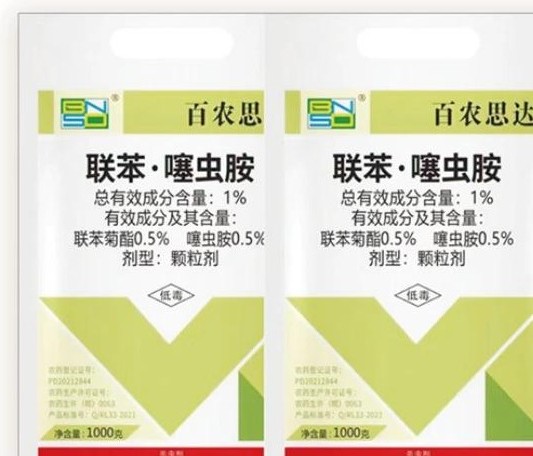
Registered on chive and garlic root maggots, this granule pairs the pyrethroid bifenthrin (IRAC group 3A) with clothianidin (IRAC group 4A) — contact knockdown plus systemic uptake in the moist root zone where maggot eggs hatch. It is packed in 1 kg bags, 20 per carton, a convenient format for row-by-row treatment of allium beds.
Thiamethoxam 3% GR: Sugarcane
Thiamethoxam (IRAC group 4A) granule is registered on sugarcane stem borer and is applied at cane planting, protecting the sett and early shoots through their most vulnerable weeks. Packs are 2.5 kg bags, six per bundle.
Placement at Planting
Placement decides efficacy for every soil-pest granule:
- Broadcast and incorporate for root-zone coverage across the whole bed — the standard pattern for white grub control on peanut, worked into the moist topsoil before or at ridging.
- Band or in-furrow at sowing for seedling protection with less product; keep the seed-to-granule separation stated on the destination label.
- Mind moisture. Both actives need soil moisture to release and move; dry surface placement waits for rain and wastes protection weeks.
- Calibrate the spreader. A 40 kg bag covers a known area only at a verified output rate — measure it, do not estimate it.
Crop-by-Crop Summary
| Crop | Granule | NPK carrier | Chinese label reference |
|---|---|---|---|
| Peanut | 0.16% chlorantraniliprole + clothianidin GR | 12-18-15 (sulphate) | White grubs |
| Maize | 0.16% chlorantraniliprole + clothianidin GR | 28-8-6 | Soil pests at planting |
| Potato / sweet potato / ginger | 0.16% chlorantraniliprole + clothianidin GR | 15-9-21 (sulphate) | Mediated-fertilizer use |
| Chive / garlic | 1% bifenthrin + clothianidin GR | Carrier granule | Root maggots |
| Sugarcane | Thiamethoxam 3% GR | Carrier granule | Stem borer |
All rates and uses above are Chinese registration label references; registered crops, pests and rates differ by country — always follow the destination-market label.
The Nutrition Bonus, Stated Honestly
The NPK in a mediated fertilizer is a real fertilizer contribution to the base-dressing plan — not a free lunch. Agronomists account for the 12-18-15, 28-8-6 or 15-9-21 as part of the season’s nutrient budget and adjust straight fertilizer accordingly. Done that way, the granule line saves a pass and a labour cost while keeping the nutrition plan intact.
Sourcing and OEM Notes
The granule line is part of BNSD Agro’s insecticide-fertilizer category, packed from 1 kg retail to 40 kg farm bags, with OEM carriers and actives to order. The full range is on the insecticide-fertilizer granules page; for samples, registration documents or private-label packing, contact the export team.
FAQ
What is the most effective treatment for white grubs?
Prevention at planting. Because white grubs feed underground for one to several years, the effective window closes once they are established. A soil-directed granule such as 0.16% chlorantraniliprole + clothianidin GR — registered on the Chinese label against white grubs on peanut with an NPK 12-18-15 sulphate carrier — places the actives in the root zone where the larvae feed. Rescue treatments after symptoms appear are rarely satisfactory.
Can wireworms be controlled after planting?
Wireworms survive several years in soil, and their damage is noticed too late for foliar products to matter. Control is preventive: a granule banded in the seed furrow or incorporated before planting puts the insecticide against germinating seed and young tubers where wireworms attack. Follow the destination-market label for crops and rates.
What is a mediated-fertilizer granule?
It is a pesticide-fertilizer combination product: the granule carrier is an NPK fertilizer (for example 28-8-6 for maize) that carries the insecticide actives — here chlorantraniliprole and clothianidin. One application at planting delivers base nutrition and soil-pest protection together, saving a separate pass.
Where should granules be placed at planting?
Two patterns: broadcast and incorporate into the moist topsoil for whole-bed root-zone coverage, or band beside / below the seed row for directed seedling protection. Keep the seed contact separation required by the destination label, and ensure soil moisture so the actives release into the root zone.
WhatsApp / WeChat: +86 199 0636 5856