
Quotations, product labels, registration dossiers and container bookings all arrive speaking their own shorthand. If you buy crop protection products from China, a working vocabulary is the cheapest quality-control tool you own: it lets you check a specification line by line, ask the right question at the right moment, and spot the wording that does not add up. This glossary gathers the terms that matter most in day-to-day importing, grouped the way you will actually meet them — on the label, in the regulation, in the document set, in the contract and in the field.
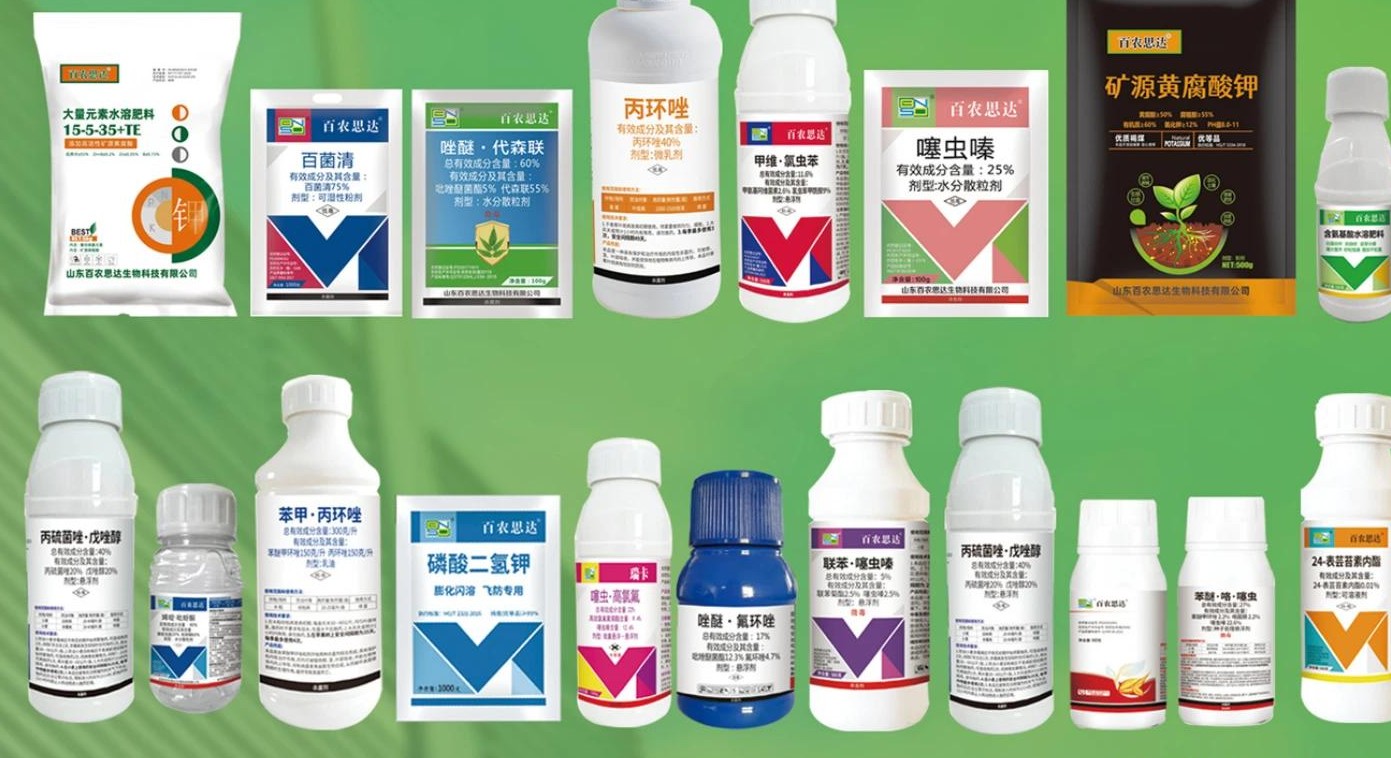
Formulation Codes: What the Letters After the Active Ingredient Mean
The formulation code follows the active ingredient and content on every label and every quotation — “thiamethoxam 25% WDG” and “thiamethoxam 25% SC” are different products with different registrations. The twelve codes below cover the large majority of what moves in this trade:
| Code | Full name | In one line |
|---|---|---|
| SC | Suspension concentrate | Solid active ingredient finely suspended in water; pourable, low dust, common for foliar work |
| WDG | Water-dispersible granule | Dry granules that disperse in water; low dust, easy dosing and handling |
| WP | Wettable powder | Powder dispersed in the spray tank; simple and economical, more dust than WDG |
| EC | Emulsifiable concentrate | Active ingredient in organic solvent, emulsifying on dilution; strong foliar coverage |
| EW | Emulsion in water (oil-in-water) | Solvent-reduced alternative to EC; milder odour, gentler on the crop |
| SL | Soluble concentrate | Active ingredient fully dissolves in water; no particles in the tank |
| ME | Micro-emulsion | Active ingredient in micro-fine oil droplets; clear or opalescent, low odour |
| AS | Aqueous solution | Ready water solution of a water-soluble active ingredient or its salt |
| GR | Granule | Dry granules applied to soil or water surface, no tank mixing needed |
| OD | Oil dispersion | Active ingredient suspended in an oil phase, diluted with water; suited to low-volume and drone spraying |
| SP | Water-soluble powder | Powder that dissolves completely in the spray tank |
| CS | Capsule suspension | Active ingredient sealed in micro-capsules for slower, longer release |
For how these types compare in the field and in the factory, see our comparison of pesticide formulation types: SC, WDG, EC and EW.
Regulatory Terms
| Term | What it means |
|---|---|
| ICAMA | The Institute for the Control of Agrochemicals, China’s pesticide regulatory authority — the body behind Chinese pesticide registrations (certificate numbers commonly prefixed “PD”) |
| Registration | Product-specific, holder-specific authorization to make and sell a defined active ingredient, content and formulation in a defined territory; a Chinese registration authorizes sale in China only |
| PHI | Pre-harvest interval — the days between the last application and harvest, stated on Chinese labels as 安全间隔期; see our PHI guide |
| MRL | Maximum residue limit — the legal maximum pesticide residue, in mg/kg, tolerated in or on a food commodity in a given market |
Quality Documents
| Term | What it means |
|---|---|
| COA | Certificate of analysis — the batch-specific quality record (purity, content, relevant physical parameters) that should match the label and your contract specification; how to read one is covered in our COA guide |
| MSDS | Material safety data sheet (also called SDS) — the standardized document describing a product’s hazards, safe handling, storage, transport classification and first-aid measures |
Trade and Shipping Terms
| Term | What it means |
|---|---|
| FOB | Free on board — an Incoterm under which the seller delivers the goods cleared onto the vessel at the named port; the buyer arranges and pays the ocean freight |
| CIF | Cost, insurance and freight — an Incoterm under which the seller covers cost, marine insurance and freight to the named destination port |
| T/T | Telegraphic transfer — payment by bank wire; the standard arrangement in this trade, with an advance balance against shipment (BNSD Agro, for example, works on T/T with 50% advance) |
| MOQ | Minimum order quantity — the smallest order a supplier will accept for a given product and pack; it varies by product and is typically higher for OEM runs than for stock items |
| DG | Dangerous goods — pesticides ship under UN hazard classes, most commonly Class 6.1 (toxic) or Class 3 (flammable liquid), which dictates packaging, documentation and the forwarder you need |
| LCL | Less than container load — your goods share a container with other shippers’ cargo; the usual choice for trial and mixed orders |
| FCL | Full container load — a container dedicated to your goods; the usual choice for repeat volume |
Field and Technical Terms
| Term | What it means |
|---|---|
| a.i. | Active ingredient — the component of the product that actually controls the pest, disease or weed; everything else in the pack is formulation |
| mu / 667 m² | The Chinese land unit used on registration labels — one mu equals 667 m², about 1/15 of a hectare; converting rates correctly matters, and our dose calculation guide walks through it |
| FRAC | Fungicide Resistance Action Committee — the body assigning the group numbers on fungicide labels that drive resistance-management rotation |
| IRAC | Insecticide Resistance Action Committee — the equivalent body for insecticides and acaricides; rotate between IRAC groups, not between brand names |
Putting the Vocabulary to Work
Twenty-nine terms cover most of what you will meet between a first quotation and a delivered container. Use them actively: ask every candidate supplier to state content, formulation code, registration number and toxicity band in the same words on the label, the COA and the contract. A supplier whose paperwork speaks this language consistently — and who can explain any term in it — is usually a supplier worth auditing. If you are building a program and want to test that consistency on real products, our team is one message away via the contact page.
Frequently Asked Questions
What does SC mean on a Chinese pesticide label?
SC stands for suspension concentrate: a liquid formulation in which the solid active ingredient is finely ground and suspended in water. It pours, mixes with low dust and is one of the most common modern formulation types for foliar fungicides and insecticides.
What is ICAMA?
ICAMA is the Institute for the Control of Agrochemicals, the authority that administers pesticide registration in China. Chinese registration certificate numbers — commonly prefixed “PD” — are issued under this system, and a supplier should be able to produce the certificate matching any number on a label.
What is the difference between a COA and an MSDS?
A COA is batch-specific: it reports the analytical results for the exact production lot you are buying and should match the label and your contract. An MSDS is product-generic: it describes hazards, handling, storage, transport classification and first aid, and does not change from batch to batch. You need both in the import file.
How big is one mu?
One mu is 667 m², roughly 1/15 of a hectare (about 0.067 ha). Chinese registration label rates are expressed per mu or per 667 m², so converting to your local units is the first step in any dose calculation.
WhatsApp / WeChat: +86 199 0636 5856