
Two products can carry the same active ingredient and still behave very differently in the field. The difference is usually the formulation: the physical system — solid or liquid, water-based or solvent-based — that carries the active ingredient into the tank and onto the crop. For importers, understanding pesticide formulation types determines biological performance, shelf life, freight cost, worker safety and which crops your label can cover.
This guide compares the types buyers meet most often — SC, WDG, EC, EW, plus WP, SL, CS and GR — and how to match them to your crops, climate and equipment.
Why Formulation Choice Matters
The active ingredient decides what a product can do; the formulation decides how reliably it does it, and at what total cost. Five dimensions should drive the decision:
- Efficacy and crop safety. Particle size, wetting and spreading, leaf retention and rainfastness all depend on the formulation system. A well-built suspension can outperform a weak one at the same dose.
- Shelf life and storage. Water-based liquids need frost protection; dry forms tolerate heat and humidity better; emulsions live or die by their emulsifier package.
- Shipping cost. Liquid formulations are mostly water by weight; dry granules carry far more active ingredient per kilogram, cutting the shipping cost per unit of AI.
- Worker safety. Fine powders expose operators during measuring and mixing; solvent-rich liquids raise inhalation and flammability questions; low-dust, water-based systems are the easiest to handle safely.
- Crop and market fit. Markets develop firm habits — granules in paddy, suspensions in row crops — and equipment from knapsacks to drones rewards certain forms.
The Main Formulation Types Explained
SC — Suspension Concentrate
A suspension concentrate micronizes the solid active ingredient and holds it in water with dispersants, wetting agents and thickeners. It is the workhorse formulation for much of the modern fungicide and insecticide range.
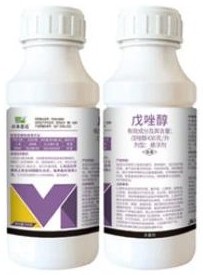
Pros: water-based, so low odour and low flammability; no dust; fine particles give good coverage; simple to pour and measure; accepts a wide range of active ingredients. Cons: the suspension must stay stable across its shelf life — sedimentation and crystal growth are the classic failure modes — and liquid packs need protection from freezing in cold-season logistics. BNSD Agro’s flagship tebuconazole 430 g/L SC is a representative high-load SC fungicide.
WDG — Water-Dispersible Granule
A WDG (often called a dry flowable) is made as a wet paste, then granulated and dried; the granules disperse back into a suspension the moment they hit the tank. In the WDG vs SC comparison, both are water-based systems at the point of use — the difference is what you ship.
Pros: virtually dust-free compared with wettable powders; high active-ingredient load means less packaging and lower freight per unit of AI; free-flowing granules resist caking in humid heat; they suit pre-measured packs. Cons: the technology bar is higher — air-milling and granulation demand genuine process control — and disintegration speed in the tank separates good products from mediocre ones. BNSD’s thiamethoxam 70% WDG shows the high-load end of this category.
EC — Emulsifiable Concentrate
An EC dissolves the active ingredient in an organic solvent together with emulsifiers; poured into water it forms the spray emulsion directly. It remains the classic choice for many insecticides and herbicides.
Pros: simple, long-established manufacturing; the active ingredient is fully dissolved, which typically delivers fast uptake and reliable knockdown; excellent shelf life. Cons: the high solvent load means flammability (most ECs ship as dangerous goods), stronger odour, greater phytotoxicity risk on sensitive crops, and exposure to rising solvent costs. The SC vs EC pesticide difference in one line: SC swaps solvent for water, gaining handling safety and crop gentleness while demanding tighter physical stability.
EW — Oil-in-Water Emulsion
An EW disperses the active ingredient — usually dissolved in a small oil phase — as droplets inside a water-continuous system. Compared with an EC it carries far less organic solvent, which lowers odour, flammability and operator exposure, and it is gentler on sensitive crops. The trade-off is stability: an EW is harder to formulate than an EC and needs a robust emulsifier system to survive storage.
WP — Wettable Powder
A WP mills the active ingredient with clay carriers and wetting agents into a powder that disperses in water. It is cheap to produce, stores well and carries high loads, which keeps it relevant in price-driven markets. Its weakness is dust: fine powders expose operators during measuring, which is why many markets have migrated from WP to WDG.
SL — Soluble Liquid
An SL contains an active ingredient that is genuinely soluble in water — typically a salt — so the spray liquid is a true solution with nothing to settle out. It is simple to make and use, but by definition only suits water-soluble actives.
CS — Capsule Suspension
A micro-encapsulated CS suspends tiny polymer capsules of active ingredient in water. Encapsulation enables controlled release, longer residual activity, reduced operator toxicity and lower phytotoxicity. It is the most technically demanding liquid suspension type, and the price reflects that.
GR — Granule
Granules place the active ingredient directly on soil or into paddy water with no mixing at all: no spray water, minimal drift and targeted placement near roots. The category also meets nutrition, as in BNSD’s Sida Guard mediated fertilizer — a 0.16% chlorantraniliprole + clothianidin GR carrying NPK 28-8-6, 12-18-15 or 15-9-21 in 40 kg bags — alongside the company’s 1% bifenthrin + clothianidin water-soluble GR. The costs are bulk and low active load, so freight per unit of AI is higher.
Formulation Comparison at a Glance
| Formulation | Physical form | Active load | Dust | Solvent load | Storage & freight | Typical fit |
|---|---|---|---|---|---|---|
| SC | liquid | moderate–high | none | water-based | protect from frost | field crops, orchards; fungicides and insecticides |
| WDG | dry granule | high | minimal | none | dense; heat- and humidity-stable | broad-acre crops, high-load products |
| EC | liquid | moderate | none | high | flammable, dangerous goods | fast-uptake, price-sensitive uses |
| EW | liquid | moderate | none | low | water-continuous | horticulture, sensitive crops |
| WP | powder | high | high | none | light and cheap | price-driven markets |
| SL | liquid | high (soluble AIs) | none | none | simple | water-soluble salts |
| CS | liquid | varies | none | low | stable | controlled-release programs |
| GR | solid | low | none | none | bulky | soil and paddy application |
Matching Formulation to Crop, Climate and Application
By crop. Waxy, hard-to-wet foliage rewards formulations engineered for spreading and retention; soil pests often suit granules; paddy rice remains the natural home of GR.
By climate. In hot, humid destinations, dry forms such as WDG hold their physical state better than liquids that can separate or degrade. Where winter logistics risk freezing, buyers specify dry granules or plan protected storage for liquids.
By application method. Drone and UAV spraying favors fine, stable suspensions at low volumes — which is why SC and WDG products dominate UAV programs — while dusty WPs can clog screens and nozzles. Knapsack and tractor spraying accept the widest range.
One Supplier Across All Formulation Types
Sourcing several formulation types from one plant simplifies QC, documentation and logistics. BNSD Agro (Shandong Bainong Sida Biotechnology Co., Ltd.) states that it operates SC, WDG, WP, EC, EW, ME, SL, AS, GR, OD and SP formulation lines, including six air-mill WDG/WP lines, two SC lines and five EC/SL lines, with a new 8,000 t/a digitalized WDG plant commissioned in 2025 (company information). Its export portfolio spans 99 SKUs across fungicides, insecticides, herbicides, granules and crop nutrition.
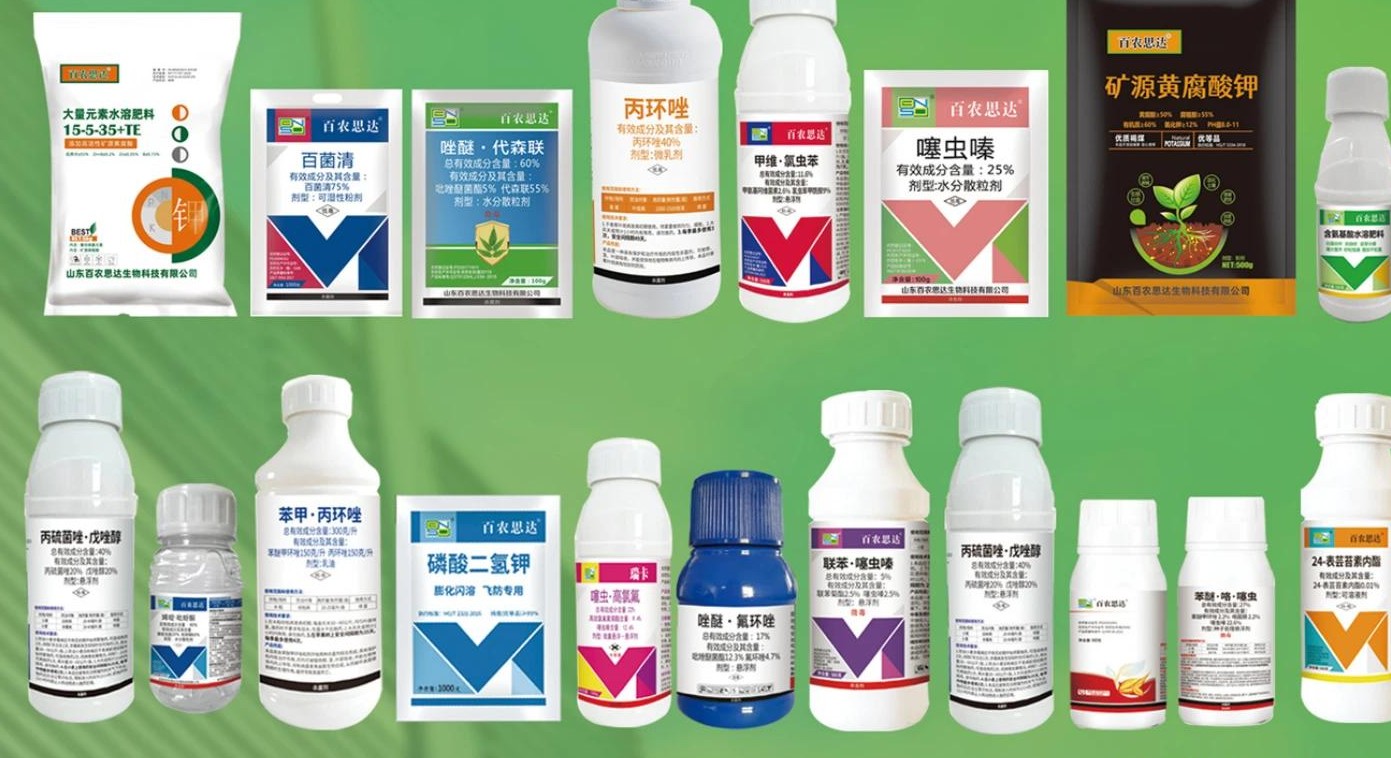
The company anchors each family with flagships: tebuconazole 430 g/L SC and prothioconazole + tebuconazole 40% SC among fungicides; thiamethoxam 70% WDG and Ruika 22% thiamethoxam + lambda-cyhalothrin SC — recognized in Shandong as a “Lu Chain Premium Product” — among insecticides. Buyers building an own-brand range can source any of these formulation systems through the company’s OEM service.
FAQ
Which is better, WDG or SC?
Neither is universally better. WDG wins on freight density, hot-climate storage stability and dust-free handling of high active loads; SC wins on simple pour-and-measure handling and often on cost at moderate loads. Judge per active ingredient, per pack size and per destination climate.
Why do EC products still sell so widely?
They are inexpensive to manufacture, keep for years and deliver fast uptake. Where solvent regulation, crop sensitivity or dangerous-goods freight are not decisive, EC stays competitive.
Are WDG products suitable for drone spraying?
Quality WDGs disperse fast and are widely used in UAV programs. Ask for disintegration and anti-foam data, and run a jar test with your own spray water before scaling up.
Does formulation type affect shelf life?
Yes. Dry forms tolerate heat and humidity well; water-based liquids need frost protection; emulsion systems depend on emulsifier stability. Always confirm the stated shelf life and the storage conditions it assumes, in writing.
WhatsApp / WeChat: +86 199 0636 5856