
Tea is harvested for its youngest tissue, sold on appearance and liquor quality, and shipped to some of the strictest residue-testing markets in the world. Those three facts compress the entire tea garden pest control question into one insect and one discipline: control the small green leafhopper without leaving a residue problem behind. This guide covers both — the two Chinese label options for tea leafhopper insecticide programs, and the export MRL awareness that separates professional tea programs from risky ones. For the insect biology, our leafhopper control guide covers the category in depth.
Why the Small Green Leafhopper Sets the Program
The small green leafhopper is the key sucking pest of tea across most of Asia. Adults and nymphs feed on tender flush — exactly the tissue that gets plucked — causing leaf curling, tip burn and the characteristic “hopper burn” discoloration that downgrades made tea. Populations build through multiple overlapping generations in warm weather, and because flush is removed every plucking round, the pest keeps recolonizing the newest growth. A tea garden therefore does not ask “how do we eliminate leafhoppers once?” but “how do we keep flush clean through round after round of plucking?” — which is a program question, not a product question.
Two Chinese Label Options for Leafhopper
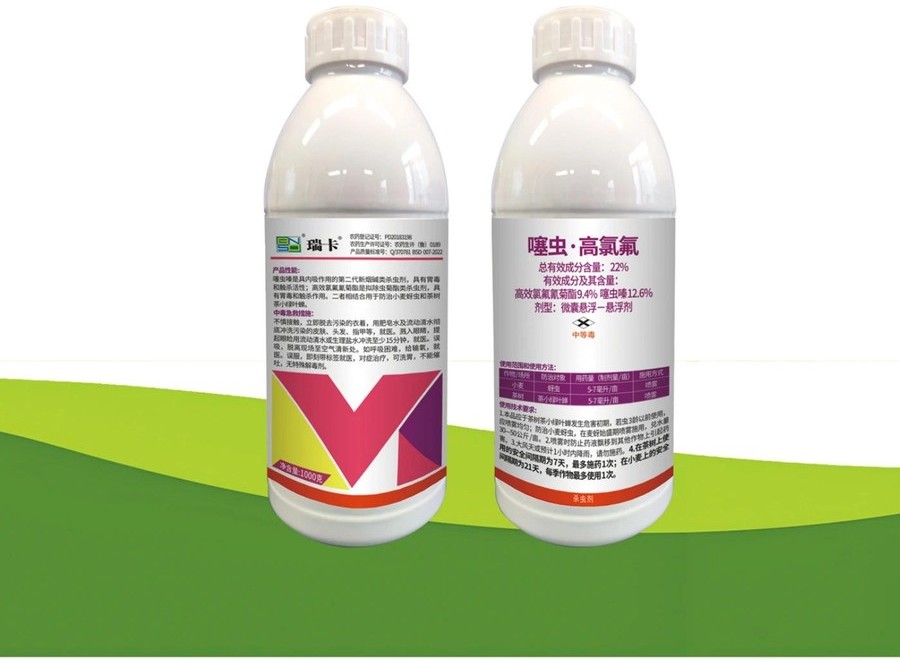
Both options from BNSD Agro (Shandong Bainong Sida Biotechnology Co., Ltd.) pair a neonicotinoid (IRAC 4A) with a pyrethroid (IRAC 3A) — two modes of action in the same pass, which is also the built-in resistance-management story.
| Option | Composition | Chinese label target and rate |
|---|---|---|
| Single SKU | 22% thiamethoxam + lambda-cyhalothrin SC | tea small green leafhopper, 5–7 mL/667 m² |
| Co-pack | bifenthrin 100 g/L EC + thiamethoxam 25% WDG (two bottles, one tank) | tea small green leafhopper, 20–25 mL/667 m² combined |
The single 22% SC keeps the grower operation simple — one bottle, one dose band. The co-pack format gives the distributor flexibility: the same two SKUs also serve other crops on their own Chinese labels (jujube mirid bug, onion thrips, garlic root maggot, rice planthopper, chive maggot), so the co-pack can be assembled from stock without a dedicated SKU. Both interpretations of the tea registration are shown; the destination market’s label always governs final rates. The wider line is listed under insecticides.
Timing Sprays at Flush Windows
Leafhopper management in tea is mostly timing. Well-established practice for flush-feeding leafhoppers:
- Target the nymph peak, not the adults. Nymphs dominate the damaging population between plucking rounds and are the stage that responds best to a well-timed spray.
- Spray soon after a plucking round. With most tender tissue removed, the spray lands on the remaining population rather than on crop that is about to leave the field — better contact, less active on harvested leaf.
- Watch the regrowth. Fresh flush after each round is the recolonization point; scout it and hold the next spray for the early nymph stage of the following generation.
- Rotate the mode of action. With several generations per season, IRAC rotation matters more in tea than in single-harvest crops — alternate the 4A + 3A pairing with whatever other groups hold registrations in the destination market.
Plucking Intervals and Pre-Harvest Discipline
Tea has one of the shortest “harvest-to-table” cycles of any crop: the leaf enters processing within hours of plucking. That makes the pre-harvest interval (PHI) a plucking-interval decision, not an abstract compliance number:
- Plan the last spray against the plucking calendar. Work backwards from the next plucking round so the interval between spray and pluck respects the product’s PHI on the destination label.
- Keep spray records per block. Which product, which rate, which date — the record is what lets a buyer defend a shipment.
- Never shortcut the interval. A block sprayed too close to plucking puts residue risk on the whole lot, not just on one round.
Export MRL Awareness for Tea
Tea is among the most residue-scrutinized commodities in international trade, and some destination markets apply very strict maximum residue limits (MRLs) to tea. No numbers are quoted here on purpose — MRL values are market-specific and periodically revised. The professional approach, per general export practice:
- Know the destination MRL list before choosing actives. The buyer — the importer is the local registrant — should map which actives have acceptable limits in their market before the season starts.
- Respect PHI to respect MRL. The pre-harvest interval is the practical tool that connects field practice to residue compliance.
- Chinese registration is not destination authorization. A Chinese label listing tea leafhopper at 5–7 mL/667 m² demonstrates the use pattern; the destination market’s own registration and MRL framework decide what may be recommended and sold there.
- Test against the market’s MRLs. Shipment-level residue testing against the destination list is the standard closing step.
Our MRL guide for exporters places this in the wider import workflow.
FAQ
What rate does the Chinese label give for tea leafhopper?
Two options: 22% thiamethoxam + lambda-cyhalothrin SC at 5–7 mL/667 m², or the bifenthrin 100 g/L EC + thiamethoxam 25% WDG co-pack at a combined 20–25 mL/667 m². These are Chinese registration label rates (667 m² = 1 mu ≈ 1/15 ha); the destination market’s label governs final recommendations.
Why pair a neonicotinoid with a pyrethroid for leafhopper?
The pairing covers two modes of action in one pass: the neonicotinoid (IRAC 4A) works systemically and stops feeding, while the pyrethroid (IRAC 3A) gives fast knockdown of the exposed population. Two groups also slow resistance selection across the many leafhopper generations a tea season allows.
When is the best moment to spray in a plucking cycle?
Early in the interval after a plucking round, at the young-nymph stage: most tender tissue has been removed, spray lands on the residual population, and the PHI clock starts immediately after spraying rather than against imminent plucking.
How should a buyer plan around tea MRLs?
Choose actives against the destination market’s MRL list first, then respect the PHI on every block and keep spray records per block. The importer should confirm which products hold local registration before the season; Chinese registration alone does not authorize use in the destination market.
To review insecticide specifications or discuss a tea program for your market, message the export team.
WhatsApp / WeChat: +86 199 0636 5856