
Leafhoppers are small enough to overlook and damaging enough to price. On tea, the small green leafhopper feeds on the young flush — exactly the shoots the plucker wants — leaving curled, discoloured leaves and stunted growth; on rice, grapes and vegetables, leafhoppers cause hopperburn and, worse, transmit plant viruses. Because they reproduce quickly and recolonize from neighbouring plots, leafhopper control works best as a ready program rather than a reactive scramble.
This guide sets out two such programs from the BNSD Agro (Shandong Bainong Sida Biotechnology Co., Ltd.) Chinese registration labels: a single 22% thiamethoxam + lambda-cyhalothrin SC pass, and a bifenthrin EC + thiamethoxam WDG co-pack — with timing logic for flush windows and MRL notes for tea exports.
Small Insects, Outsized Damage
Leafhoppers are piercing-sucking insects. Adults and nymphs feed on plant sap from the leaf underside and young stems, and their damage reads in three layers:
- Direct feeding damage. Saliva injures plant tissue as they feed; on many crops this shows as leaf curling, yellowing, and marginal browning known as hopperburn. On tea, feeding on the tender flush curls and shrivels the shoots, cutting both yield and the quality a buyer grades.
- Virus transmission. Several leafhopper species are vectors of crop viruses and phytoplasmas, which turns a tolerable infestation into a disease-management problem.
- Population speed. Eggs are laid in tissue, nymphs emerge within days in warm weather, and mobile adults fly in from adjacent vegetation — so a clean field does not stay clean.
Program One: Two Modes in One Pass
22% Thiamethoxam + Lambda-cyhalothrin SC
The Chinese label registers this suspension concentrate on tea leafhopper at 5–7 mL per 667 m². The pairing is the textbook two-mode design: thiamethoxam (IRAC group 4A, neonicotinoid) is systemic, taken up into the plant tissue and killing the piercers that feed on it; lambda-cyhalothrin (IRAC group 3A, pyrethroid) adds contact knockdown on the adults that are the hardest stage to catch with a systemic alone. One pass therefore covers nymphs feeding on treated tissue and adults landing on the canopy.
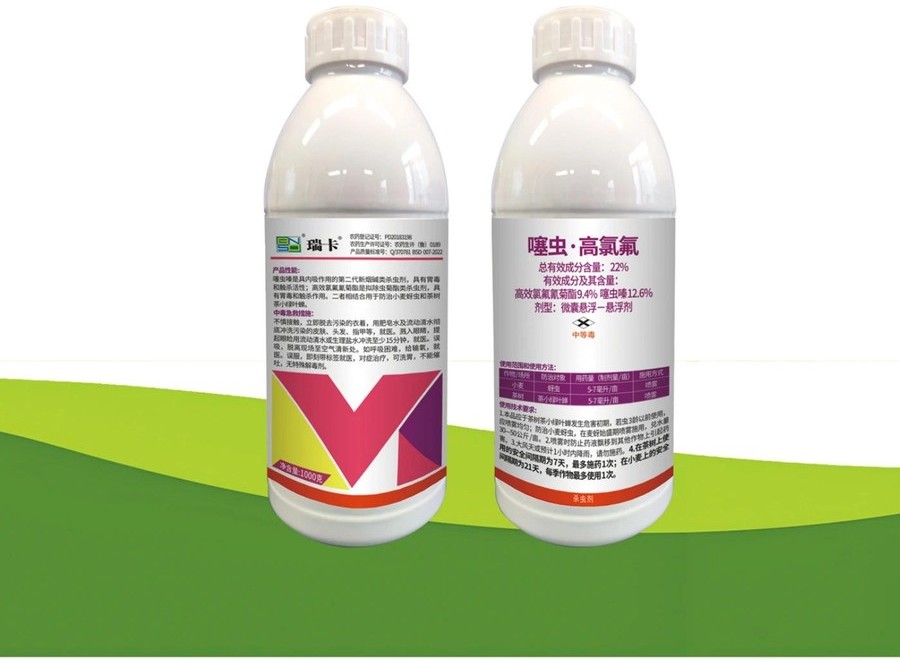
The rate is deliberately small — five to seven millilitres per 667 m² is among the most concentrated-use products in any tea programme — which makes dosing accuracy and good spray water the two levers that matter.
Program Two: the Co-pack
Bifenthrin EC + Thiamethoxam 25% WDG Co-pack
The second option is a co-pack: bifenthrin 100 g/L EC and thiamethoxam 25% WDG packed together as one procurement item, with a tea leafhopper reference of 20–25 mL per 667 m² of the combined use on the co-pack program. The agronomic logic differs slightly from the single-mixture SC: the grower or technician can tune the ratio between the contact pyrethroid and the systemic neonicotinoid to the field — heavier adult pressure, more pyrethroid; dense flush and nymph pressure, more neonicotinoid — while buying and storing one SKU. The same co-pack covers jujube mirid bug, onion thrips, garlic root maggot, rice planthopper and chive maggot per the Chinese label, which is why distributors like it: one item, many crops.
| Program | Products | Chinese label reference | Rate | Best fit |
|---|---|---|---|---|
| Two-mode SC | 22% thiamethoxam + lambda-cyhalothrin SC | Tea leafhopper | 5–7 mL/667 m² | One-pass standard control |
| Co-pack | Bifenthrin 100 g/L EC + thiamethoxam 25% WDG | Tea leafhopper | 20–25 mL/667 m² | Tunable ratio, multi-crop SKU |
All rates above are Chinese registration label rates; registered crops and rates differ by country — always follow the destination-market label.
Timing at Flush Windows
Leafhopper programs live or die on timing, and on tea the calendar is set by the flush cycle:
- Spray before the next flush, not after the damage. Nymphs hatch into each new wave of tender shoots; a pass applied at the nymph stage, as the flush breaks, protects the very shoots that carry the crop’s value.
- Scout the underside. A quick sweep or tap-count of nymphs on flush shoots turns the schedule into a threshold decision and prevents pointless applications.
- Cover the underside. Nymphs sit on leaf undersides; spray to runoff at adequate water volume, morning or evening when adults are less flight-active.
- Keep the rotation honest. With both IRAC 4A and 3A already in these programs, avoid adding more of the same groups back-to-back within a leafhopper generation; alternate with unrelated groups per the destination label.
MRL Notes for Tea Exports
Tea is among the most residue-sensitive commodities traded. For export-oriented gardens: know the destination market’s maximum residue limits before choosing products, respect the pre-harvest interval stated on the label, keep spray records per block, and plan the last application far enough before plucking rounds that residues have time to decline. Where a market has no established MRL for an active, treat that product as a compliance risk, not just an agronomic one.
Sourcing and OEM Notes
Bainong Sida holds 70 ICAMA registrations with about 60 pending and offers OEM packing from 10 mL to 40 kg. The SC and the co-pack components are listed in the insecticides catalogue; for samples, label documents or co-pack customization, contact the export team.
FAQ
What is the best insecticide for tea green leafhopper?
On the Chinese labels held by Bainong Sida, the registered option is 22% thiamethoxam + lambda-cyhalothrin SC at 5–7 mL/667 m² — a systemic neonicotinoid plus contact pyrethroid in one pass — with a bifenthrin EC + thiamethoxam 25% WDG co-pack at 20–25 mL/667 m² as the tunable alternative. Timing at the nymph stage and underside coverage decide the result. Your destination-market label governs.
Why do leafhoppers come back so soon after spraying?
Adults recolonize from surrounding vegetation within days, and eggs already laid in tissue hatch after the spray’s contact effect has faded. Control therefore means timing passes to nymph hatches at flush windows and rotating modes of action, not chasing adults after they land.
What does hopperburn look like?
Leaf margins yellow and brown, leaves curl downward, and shoots on tea flush curl and shrivel. By the time hopperburn is visible the population has been feeding for a week or more — which is why scouting nymphs on the leaf underside is the better trigger than waiting for symptoms.
What should tea exporters check before spraying?
The destination market’s MRL list for each active, the pre-harvest interval on the label, and the gap between the last spray and the next plucking round. Keep per-block spray records so residue questions can be answered with documents, not guesses.
WhatsApp / WeChat: +86 199 0636 5856