
When you compare products from a Chinese pesticide manufacturer, one element on the label tells you more about the product’s handling, transport and operator-safety story than any brochure: the toxicity band. For an importer it does double duty. It is a quick screen of where a product sits on the hazard spectrum, and it is a consistency check — the band, the active ingredient and the freight booking should all tell the same story. This guide explains the pesticide toxicity classes used on Chinese labels, how they are assigned, why most modern export portfolios cluster in the lower bands, and how the Chinese classification relates to the signal words your destination market uses.
The Five Toxicity Classes on a Chinese Label
Chinese pesticide regulation places every product into one of five acute toxicity classes, printed on the label in Chinese:
| Chinese band | English | General profile |
|---|---|---|
| 微毒 | Slight toxicity | Very low acute hazard; typical of microbial and bio-pesticide products and of some highly diluted formulations |
| 低毒 | Low toxicity | Low acute hazard; the band where most conventional modern formulations sit |
| 中等毒 | Moderate toxicity | Meaningful acute hazard; demands careful handling and protective-equipment language on the label |
| 高毒 | High toxicity | Serious acute hazard; increasingly restricted or phased out in many markets |
| 剧毒 | Extreme toxicity | Highest acute hazard class; subject to the strictest controls and rarely seen in export portfolios |
How a product is assigned to a class
The classification rests on standard acute toxicity studies — oral, dermal and inhalation — in test animals. The classic banding for acute oral LD50 (rat) runs: above 5,000 mg/kg body weight is 微毒 (slight); 501–5,000 mg/kg is 低毒 (low); 51–500 mg/kg is 中等毒 (moderate); 6–50 mg/kg is 高毒 (high); and 5 mg/kg or below is 剧毒 (extreme). The final class takes the most severe of the tested routes, so a product can land in a higher band on the strength of its dermal or inhalation data even when the oral figure looks benign.
How the band appears on the pack
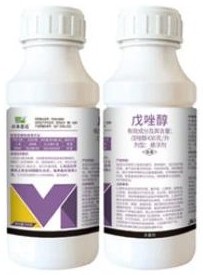
The toxicity mark is a black lozenge printed near the foot of the label. For the three upper classes — 剧毒, 高毒 and 中等毒 — the class wording is printed in red, and the extreme class additionally carries the skull-and-crossbones symbol. 低毒 products show the mark without wording, while 微毒 products show the wording without the mark. One further detail worth knowing: where a formulation is made from a high- or extreme-toxicity technical material but the formulation itself tests into a lower class, the label also states the technical material’s class in brackets.
The band never stands alone. Read together with the registration number, the content and formulation code, and the precautions paragraph, it completes the picture — our field guide on how to read a Chinese pesticide label walks through every element in order.
Why Modern Portfolios Cluster in the Lower Bands
Look across a current export catalog and a pattern emerges: the low toxicity pesticide bands dominate. Three forces drove this. First, many of the older high-toxicity chemistries have been restricted or phased out in major markets, so export-oriented manufacturers moved away from them. Second, modern active ingredients — the neonicotinoids, diamides and most triazole and strobilurin fungicides, for example — were developed with substantially lower acute hazard to users than the products they replaced. Third, formulation technology matters: the same active ingredient can carry a friendlier profile as a water-based SC or EW or as a granule than as a solvent-loaded EC.
Most products across the BNSD Agro export portfolio carry the 低毒 (low toxicity) or 微毒 (slight toxicity) band, which reflects that broader industry shift. For a buyer, the practical meaning is simpler warehouse rules, lighter protective-equipment requirements for spray operators and an easier conversation with regulators and grower customers — without assuming anything about your own market’s classification.
From Chinese Classes to Destination Signal Words
Here is the distinction importers get wrong most often: the Chinese toxicity class is not a destination-market classification. Your market’s authority assigns its own hazard classification from its own data and thresholds, and prints its own signal language on the retail pack. Different systems look different — the United States framework, for instance, uses the signal words Caution, Warning, Danger and Danger–Poison, international hazard guidance uses colour-banded schemes, and many jurisdictions combine hazard statements with pictograms. The same active ingredient can quite legitimately sit in the low toxicity class in China yet carry a stronger signal word elsewhere, because classification thresholds, tested routes and formulation-specific data differ between systems.
So treat the classes as two separate things:
- The Chinese band is your sourcing signal. It tells you the acute hazard profile of the product as registered at source, and it should be consistent with the dangerous-goods class your forwarder uses when booking the shipment — our guide to dangerous-goods shipping for pesticides explains that side.
- Your destination signal word is a regulatory decision. It comes out of your own registration and local label law, never out of a translation of 微毒 or 低毒.
What Importers Should Do With Toxicity Information
- Build your portfolio toxicity profile. Ask for the band of every product in your program, not just each one individually. A portfolio dominated by the lower bands simplifies transport, storage, training and regulatory dialogue across the whole range.
- Strengthen your operator-safety story. For distributor tenders and grower training, a low-toxicity band plus clear first-aid language is a genuine selling point — especially for crops with high operator contact such as tea, vegetables and fruit.
- Use the band as a consistency check. Band, active ingredient, formulation and freight class should corroborate each other. A mismatch is one of the red flags that separates a real manufacturer from a repacker.
- Do not over-read it. Toxicity class describes intrinsic acute hazard, not risk. Risk depends on exposure — rate, formulation, protective equipment and re-entry intervals — which is why the label’s precautions section matters as much as the band itself.
Frequently Asked Questions
What are the five pesticide toxicity classes on a Chinese label?
From lowest to highest: 微毒 (slight toxicity), 低毒 (low toxicity), 中等毒 (moderate toxicity), 高毒 (high toxicity) and 剧毒 (extreme toxicity). They are assigned from acute oral, dermal and inhalation toxicity studies and shown on the label with a black lozenge mark and, for the upper classes, red wording.
Is low toxicity in China the same as low toxicity in my market?
Not automatically. Each regulatory authority classifies products under its own thresholds and data requirements, and signal words such as Caution, Warning and Danger belong to your destination market’s system. Use the Chinese band as a sourcing and consistency signal; your own registration determines what prints on your local pack.
Does a low toxicity class mean the product is risk-free?
No. The class describes the intrinsic acute hazard of the product, while risk is hazard combined with exposure. Concentration, formulation, application method, protective equipment and re-entry intervals all shape real-world risk, which is why the precautions and first-aid sections of every label must be followed regardless of band.
Why do some labels show a toxicity class in brackets next to the main one?
When a formulation is made from a high- or extreme-toxicity technical material but the finished formulation tests into a lower class, Chinese labelling practice requires the technical material’s class to be stated in brackets. It is a transparency detail — and a sign you are looking at a properly produced label.
WhatsApp / WeChat: +86 199 0636 5856