
Most fertilizers are chosen for what they add. Mono-potassium phosphate — MKP — is chosen just as much for what it leaves out: no nitrogen, no chloride, no filler, only phosphorus and potassium in their most direct form. That purity is why, across vegetable greenhouses and orchards, 0-52-34 has become the standard spray at the moments that decide a crop’s value: flowering, fruit set and ripening. This guide covers the chemistry behind that role, the specification on the bag, the foliar rate, and the sourcing checks that separate a true MKP grade from a look-alike blend.
The Chemistry of a Pure Source
MKP is potassium dihydrogen phosphate (KH₂PO₄) — a single salt in which one molecule carries both nutrients. Dissolved in water, it releases phosphate and potassium ions with nothing else attached. Two consequences follow, and both matter most at stage transitions:
- No nitrogen. At flowering and fruit fill, extra nitrogen pushes shoots and leaves at the expense of flowers and fruit. A phosphorus-potassium source with zero nitrogen feeds the transition without restarting vegetative growth — the reason 0-52-34, not a balanced grade, is the foliar standard from bud stage onward.
- No chloride. Muriate of potash is the cheapest potassium source, but it brings chloride along, which chloride-sensitive crops and already-saline soils tolerate poorly. MKP delivers its potassium chloride-free (general chemistry), which is why it dominates in high-value crops, foliar programs and protected cropping.
A pure single salt is also predictable in the tank: it dissolves cleanly, leaves little residue, and behaves the same from batch to batch — properties that show up later in the spray line and the drip filter.
Reading the 0-52-34 Specification
The three numbers run on the oxide convention used on fertilizer labels worldwide: 0% nitrogen, then phosphate and potash declared as P₂O₅ and K₂O. The BNSD Agro (Shandong Bainong Sida Biotechnology Co., Ltd.) specification declares P₂O₅ ≥52% and K₂O ≥34%, with the nitrogen slot empty by design. The zero is not a gap — it is the product’s identity.
Two properties sit alongside the analysis on the spec sheet: the grade is flash-soluble, meaning it dissolves almost on contact with water, and it is graded for UAV (drone) spraying, where fast, complete dissolution is a working requirement rather than a nicety. Both points return in the sourcing checklist below, because they are the first things a diluted or filler-loaded product fails.
Where MKP Fits in the Season
The registered pattern for 0-52-34 tracks the three windows in which a crop converts vegetative growth into yield:
- Pre-flowering and bloom. Phosphorus is central to flower formation and pollen performance. A foliar pass at 0.2–0.3% going into bloom supports flower set without feeding extra nitrogen into the canopy.
- Fruit set. Young fruit draw heavily on phosphorus and potassium for cell division and early expansion. Foliar MKP bridges the days when soil supply cannot yet keep pace with demand.
- Ripening and fill. Potassium governs sugar transport, colour and firmness. Through the final fill, MKP supports quality — sugar content, skin finish, storage behaviour — rather than more leaf.
The same logic extends to field crops: on peanuts, for example, the on-file use is a 0.2–0.3% MKP foliar spray at pod fill, exactly the phosphorus-plus-potassium moment. Whatever the crop, the selection rule is the same — use MKP when the question is “feed the transition,” not “feed the growth.”
Foliar Application at 0.2–0.3%
The product rate for foliar spraying is 0.2–0.3%, which converts directly: 200–300 g of MKP per 100 L of water, or roughly 32–48 g in a 16 L knapsack. Practical points that protect the rate:
- Dissolve fully before topping up the tank; add MKP to water, not water to MKP.
- Spray in the cooler parts of the day — early morning or late afternoon — so the film stays liquid on the leaf long enough to be taken up (general spraying practice).
- Wet the canopy without runoff; the dose is calibrated for coverage, not drenching.
- The grade’s flash solubility means no settling time and no residue to strain out, which matters as much in a knapsack as in a drone tank.
Flash-Soluble, UAV-Ready
Low-volume UAV programs compress the same dose into a fraction of the water, so any product that dissolves slowly, leaves insoluble residue or blocks fine nozzles becomes a field problem. The 0-52-34 grade carried by BNSD Agro is specified flash-soluble for exactly this use, and the smallest pack format is built for measured dosing at the drone. For formulation choice in drone programs more broadly, see the UAV spraying guide.
Packs and Sourcing Checks
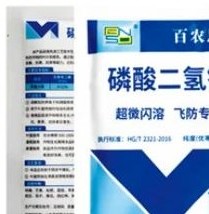
The pack ladder runs 50 g × 200, 500 g × 20 and 1 kg × 10. The 50 g sachets suit retail shelves, smallholders and per-tank drone dosing; the 500 g and 1 kg formats serve cooperative-scale foliar rounds. When comparing suppliers, three checks matter more than the price tag:
- Solubility, demonstrated. Stir a spoonful in a glass of clear water. A true MKP grade dissolves completely, with no grit and no milky suspension. Insoluble filler that survives a glass test will find drip emitters and drone filters.
- Purity and content, documented. Ask for the specification and certificate of analysis, and match them against the declared ≥52% P₂O₅ and ≥34% K₂O. Content that does not match registration paperwork is one of the standard red flags in supplier verification.
- Packaging that protects the salt. Phosphate salts take up moisture from humid air and cake; sealed, moisture-proof inner bags keep the powder free-flowing to the last sachet.
MKP sits inside a wider stage-based nutrition range — the ratios around it are covered in the water-soluble NPK guide. The complete nutrition line, from NPK grades to MKP and potassium phosphite, is listed on the nutrition products page; for specifications, samples or OEM packing, contact BNSD Agro.
FAQ
What is the difference between MKP 0-52-34 and potassium phosphite?
MKP is a phosphate — the conventional phosphorus nutrient form, dry and flash-soluble. Potassium phosphite (0-520-340, liquid) is a distinct chemistry: it supplies potassium and phosphorus nutrition and is widely used for its supporting role against oomycete pressure. MKP is the routine flowering-and-fill tool; phosphite is positioned at stress windows. See the potassium phosphite guide.
Can MKP be tank-mixed with pesticides or other fertilizers?
MKP is compatible with many commonly sprayed products, but mix only what you have tested: run a small jar test with the exact products and water source before a full tank. Do not premix phosphate concentrates with calcium-containing solutions — they precipitate; keep them separate until dilution in the tank (general practice).
Is foliar MKP a substitute for soil potassium fertilization?
No. Foliar sprays correct and support at key windows — bloom, fruit set, fill — but a crop’s bulk potassium demand is met from the soil program. Treat 0-52-34 as the precision tool layered on top of a sound base fertilization plan, not a replacement for it.
Which pack size suits which operation?
50 g × 200 suits retail, smallholders and per-tank drone dosing; 500 g × 20 fits farm-scale foliar rounds and co-op resale; 1 kg × 10 is the working format for larger orchard and greenhouse programs. All three carry the same ≥52% / ≥34% specification.
WhatsApp / WeChat: +86 199 0636 5856