
The label reads 0-520-340 and stops most buyers mid-scroll: over five hundred units of phosphorus and three hundred and forty of potassium, per litre, with no nitrogen at all. That is potassium phosphite — a liquid that belongs to a different chemistry from the phosphate fertilizers the number seems to compare with, and one that behaves differently inside the plant in ways growers use deliberately. It is stocked with nutrition lines, yet it is most often bought for what happens around its nutrition: a fast phosphorus-potassium entry and a supporting role against oomycete pressure. This guide explains the chemistry carefully, the movement inside the plant, the specification of the BNSD Agro (Shandong Bainong Sida Biotechnology Co., Ltd.) grade, and the honest limits of what the product can and cannot do.
Phosphite Is Not Phosphate
The distinction comes down to the oxidation state of the phosphorus atom, and it changes everything downstream:
- Phosphate (P at +5) is the form in standard fertilizers — MKP, MAP, ammonium polyphosphate. The plant’s metabolism is built around it; it is the currency of energy transfer and nucleic-acid chemistry.
- Phosphite (P at +3) is a reduced form with a different molecular geometry. It is not simply “a concentrated phosphate”. The plant absorbs phosphite readily, but converting it into the phosphate the metabolism expects is a slow, limited process — so phosphite should not be counted on as a full substitute for phosphate nutrition.
What phosphite does offer is a different package: potassium and phosphorus delivered in a form that enters tissue quickly, plus the distinctive supporting behaviour described below. In practice, a program treats phosphite as a specialty tool alongside — not instead of — the phosphate sources that carry the season’s phosphorus budget. That framing is the conservative, general-agronomy view, and it is the one a serious supplier should give you.
It Moves Both Ways: Xylem and Phloem
The second difference is transport. Phosphate applied to the leaf or root zone moves mainly upward in the xylem, carried by the transpiration stream — which is why foliar phosphate lands mostly in the leaves nearest the spray. Phosphite is different: it moves in both the xylem and the phloem, meaning it travels upward with the water stream and also redistributes from mature leaves downward and outward to roots, young shoots and developing fruit.
For the grower, that bidirectional movement is the practical selling point. A foliar phosphite pass does not just treat the leaf it lands on; the product distributes through the plant, reaching tissues that a phosphate spray would never touch. This is also why phosphite is a common choice for root-zone problems: applied to the leaf or the soil, it finds its way down to the roots.
The Oomycete Support Role — Phrased Carefully
The reason phosphite earns its place in so many programs is its long-standing, widely documented association with crops under oomycete pressure — the water-mould group of pathogens that includes downy mildews, late blight and Phytophthora root rots. Three sentences of honest framing:
- Phosphite products are widely used alongside oomycete management programs, and growers report strong field performance with them.
- The mechanism of that supporting effect has been studied for decades; it is generally understood to involve both direct activity against the pathogen and stimulation of the plant’s own defence responses.
- A phosphite fertilizer is not a registered fungicide and does not replace one. Where downy mildew or late blight pressure demands crop protection, the registered fungicide program — the dimethomorphs, mancozebs and their class — remains the backbone. Phosphite supports; it does not substitute.
Any supplier who markets phosphite as a fungicide substitute is selling outside the label. Any supplier who positions it as the support tool it is — fast nutrition plus a documented supporting role — is describing the product accurately.
The Specification
BNSD Agro potassium phosphite 0-520-340 is a liquid declaring:
- P₂O₅ ≥520 g/L
- K₂O ≥340 g/L
and packed 1.4 kg per bottle, 15 bottles per carton.
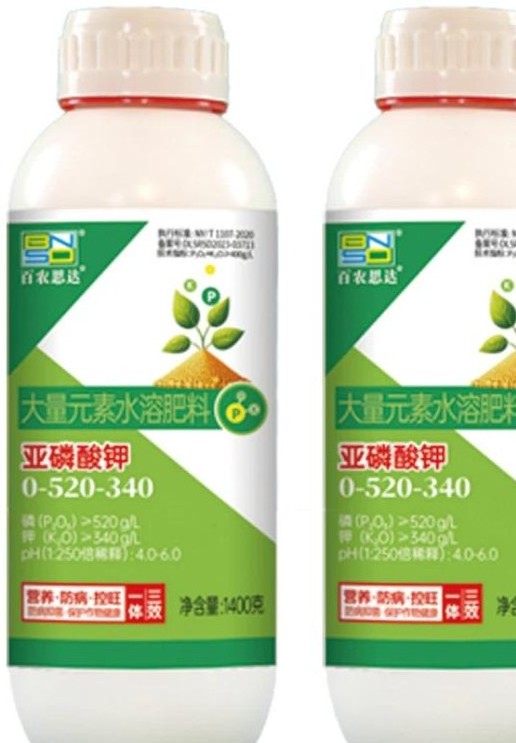
The numbers deserve a note on conventions. The 0-520-340 format follows the N-P₂O₅-K₂O order declared per litre for liquid products — so the zero is nitrogen (there is none), and the 520 and 340 are oxide-equivalent phosphorus and potassium in every litre. At those concentrations, a small measured dose carries a large P and K payload, which is precisely the point: the product is metered low and travels far per litre, and the 15-bottle carton keeps the pack compact for distribution.
Use Notes
- Low doses, well timed. The high analysis means the label rate is small; apply at the labelled rate and interval, matched to the crop stage where a fast P-K entry is wanted — before flowering, through fruit fill, ahead of or alongside oomycete-pressure periods.
- Foliar and fertigation both work. The bidirectional movement makes foliar passes efficient, and drench or drip application carries the product to the root zone directly.
- Mind the acidity. Phosphite solutions are acidic. Check tank-mix compatibility before combining with calcium-rich concentrates or acid-sensitive partners, and jar-test any new combination — or keep a separate pass.
- Keep it in the support lane. Continue the registered fungicide program wherever disease pressure requires crop protection; phosphite runs alongside it, never in place of it.
- All rates above follow the product specification for the Chinese market. Adjust to crop, water analysis and destination-market guidance.
The phosphite sits in the BNSD Agro nutrition line alongside MKP and the water-soluble NPK grades — see the nutrition products page. For specifications, samples or OEM packing, contact BNSD Agro.
FAQ
Is phosphite a substitute for phosphate fertilizer?
No — and treating it as one is the classic mistake. Phosphite is absorbed quickly, but the plant converts it to usable phosphate only slowly and in limited amounts. The season’s phosphorus budget still runs on phosphate sources such as MKP and NPK grades; phosphite is the specialty tool for fast entry and its distinctive supporting role, applied alongside the phosphate program.
Why does the label say 0-520-340 instead of 0-52-34?
Two conventions stack here: liquid products declare per litre rather than per kilogram, and the full N-P₂O₅-K₂O order is kept. So 0-520-340 means zero nitrogen, ≥520 g/L P₂O₅ and ≥340 g/L K₂O in every litre of product. Per-litre declaration is standard for high-analysis liquids, where the density of the product carries part of the story.
Can potassium phosphite replace my downy mildew fungicide program?
No. Phosphite has a widely used supporting role against oomycete pressure and is valued in programs for it, but it is a fertilizer, not a registered fungicide. Where downy mildew, late blight or Phytophthora pressure requires crop protection, the registered fungicide program remains the backbone and phosphite runs alongside it.
What should I check before tank-mixing phosphite?
Phosphite solutions are acidic, so the standard cautions apply: do not premix with calcium-rich concentrates (they can precipitate), jar-test any new combination before field use, and when a mix is unproven, keep a separate pass. Prepared stock solutions should be diluted before other concentrates are added.
WhatsApp / WeChat: +86 199 0636 5856