
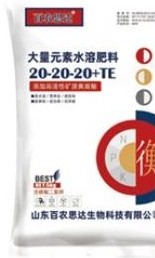
The grade number on a water-soluble fertilizer bag is not marketing — it is the answer to a timing question. Nitrogen drives leaf and stem, phosphorus builds roots and early establishment, potassium governs fruit set, sugar transport and quality. Read the three NPK numbers against the crop’s growth stage and the choice between 20-20-20, 15-5-35 and 12-8-40 makes itself. This guide sets out the water-soluble grades in the BNSD Agro (Shandong Bainong Sida Biotechnology Co., Ltd.) nutrition range, with fertigation rates and the two specialties — monopotassium phosphate and potassium phosphite — that round out a season.
What “Water-Soluble” Means in Practice
A true water-soluble grade dissolves completely, with no filler left to clog drip emitters or settling tanks. That property is what makes fertigation possible: the fertilizer travels with the irrigation water in small, frequent doses matched to crop demand. The grades in this range are fully soluble formulations with added trace elements (the “+TE” on the label), packed in 5 kg and 10 kg bags, applied by fertigation or drench at 5–10 kg/667 m² per pass.
Match the Grade to the Growth Stage
The three headline grades map directly onto the crop’s changing demands:
- Vegetative: 20-20-20+TE or 18-18-18+TE. A balanced 1:1:1 ratio supports canopy and root build-up, when the crop needs nitrogen for leaf area but still supplies evenly for overall structure.
- Fruiting: 15-5-35+TE. Nitrogen is trimmed back and potassium raised as the crop shifts from growing shoots to filling fruit; pushing nitrogen here produces leaf and soft growth at the expense of fruit quality.
- Ripening: 12-8-40+TE. The highest potassium share of the range supports sugar transport, colour and firmness through the final fill.
Stage Selection Table
| Growth stage | Grade | Why this ratio | Rate per pass |
|---|---|---|---|
| Seedling – vegetative | 20-20-20+TE (or 18-18-18+TE) | Balanced NPK builds canopy and roots together | 5–10 kg/667 m² |
| Flowering – fruiting | 15-5-35+TE | Nitrogen trimmed, potassium raised for fruit fill | 5–10 kg/667 m² |
| Ripening – harvest | 12-8-40+TE | Maximum potassium share for quality and transport of sugars | 5–10 kg/667 m² |
Reading the Numbers on the Bag
The three numbers always run in the same order — nitrogen, phosphate (P₂O₅), potash (K₂O) — declared on the oxide convention used on fertilizer labels worldwide. So 20-20-20+TE carries 20% N, 20% P₂O₅ and 20% K₂O by weight plus a trace-element package, and MKP’s 0-52-34 reads as 52% P₂O₅ and 34% K₂O with no nitrogen at all. Once the convention is clear, the stage logic in the table above can be read straight off the label of any grade.
When comparing grades between suppliers, three checks matter as much as the headline ratio:
- Full solubility, documented. “Water-soluble” is a specification, not a description — the product must dissolve completely and pass through drip emitters without residue. Ask for the specification and solubility data, not just the grade name.
- Trace elements listed, chelated where it matters. The “+TE” should state which micronutrients are actually in the pack and in what form; in alkaline water, iron, manganese and zinc hold best in chelated form.
- A packing ladder that fits the farm. 5 kg bags suit smallholders and retail shelves; 10 kg bags reduce packaging cost for cooperative-scale fertigation programs.
With those checks made, grade selection reduces to the stage table — which is the point of a well-built range.
Two Specialties: MKP and Potassium Phosphite
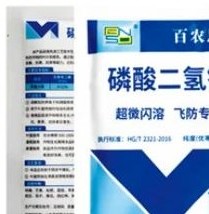
Monopotassium phosphate (MKP) 0-52-34 carries no nitrogen at all — pure phosphorus and potassium. It is flash-soluble (a grade suited to UAV spraying) and applied as a foliar spray at 0.2–0.3%. That combination makes it the standard tool for stage transitions — before flowering and through fruit fill — when you want phosphorus and potassium delivered without pushing vegetative growth.
Potassium phosphite 0-520-340 is a liquid with P₂O₅ at ≥520 g/L and K₂O at ≥340 g/L. Phosphite is a distinct chemistry from phosphate: it supplies potassium and phosphorus nutrition and is widely used for its supporting role against oomycete pressure (general agronomy knowledge). It sits between nutrition and crop protection in a program, which is exactly why it is stocked with the nutrition range.
Fertigation Practice Notes
- Dissolve fully before injection. Prepare the stock solution in water first; never let undissolved powder reach the injection line.
- Small and frequent beats large and rare. Splitting the 5–10 kg/667 m² pass to follow crop demand keeps nutrients in the root zone instead of below it.
- Watch emulsifiable concentrate (EC) in substrates. In soilless growing, each fertigation pass adds to substrate EC; track it and adjust the dose accordingly.
- Do not premix concentrates that precipitate. Calcium-containing and phosphate/phosphite stock solutions are kept separate until dilution, as general practice.
- All rates above follow the BNSD Agro product specifications for the Chinese market (667 m² = one mu, ≈ 1/15 ha). Adjust grades and rates to the crop, the water analysis and destination-market guidance.
The complete water-soluble range — NPK grades, MKP and potassium phosphite — is listed on the nutrition products page. For specifications, samples or OEM packing, contact BNSD Agro.
FAQ
Can 20-20-20 be used right through to harvest?
It can feed the crop, but it fits the vegetative stage best. From fruiting onward the crop’s potassium demand rises while its need for nitrogen falls, which is what the 15-5-35 and 12-8-40 ratios answer — continuing full nitrogen late works against fruit quality.
What does “+TE” mean on the bag?
Trace elements — the micronutrients (iron, manganese, zinc, boron and others) that crops need in small amounts. A water-soluble NPK with TE covers them alongside the major elements, which matters in substrates and drip systems where the soil cannot supply them.
Why is MKP 0-52-34 the standard foliar choice?
It supplies phosphorus and potassium with no nitrogen, at a 0.2–0.3% foliar concentration, and the flash-soluble grade dissolves fast enough for tank and UAV spraying. That makes it the clean way to feed a transition — flowering, fruit fill — without restarting vegetative growth.
How much water-soluble fertilizer should each fertigation pass apply?
The product specification guides 5–10 kg/667 m² per fertigation or drench pass. Within that range, split applications to track crop demand and substrate EC rather than applying the maximum at every pass.
WhatsApp / WeChat: +86 199 0636 5856