
Most wheat is not lost to a single disaster. It leaks yield all season: aphids settling on seedlings in autumn, broadleaf weeds robbing tillers in early spring, mildew climbing the canopy, head blight hitting the flower, and a final aphid peak during grain fill. A proper wheat full season program therefore runs from seed to harvest as one plan, not a series of panicked rescue sprays. This wheat farming guide lays out that plan stage by stage, with the products and rates that carry it in China — and the program logic that transfers to any market. For the disease-focused part of the season, see our companion guide on fusarium head blight, powdery mildew and rust control.
Why a Full-Season Program Beats Reactive Spraying
Each growth stage has its own dominant threat, and each threat has a window that either opens or closes. Seed treatment cannot be added after sowing; fungicides cannot rewind to early anthesis once flowering has passed; herbicides work best while weeds are small. Planning the season in advance also lets a distributor build a complete basket — insecticide, herbicide, fungicide and nutrition — instead of selling one product at a time.
The Season at a Glance
The table below maps the Chinese label products and rates that anchor each stage. Rates are Chinese registration label rates (667 m² = 1 mu ≈ 1/15 ha); always follow the registration and label of the destination market.
| Growth stage | Target | Product | Chinese label rate |
|---|---|---|---|
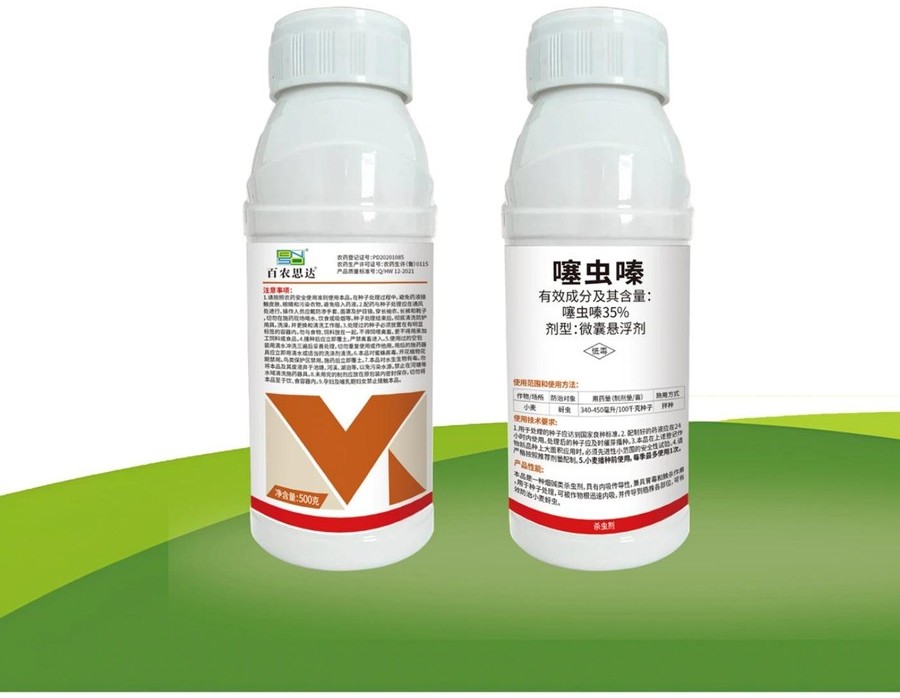
| Seed treatment (before sowing) | aphids | thiamethoxam 35% SC, seed dressing | 340–450 mL per 100 kg seed |
| Green-up to stem extension | broadleaf weeds | fluroxypyr 200 g/L EC | 50–70 mL/667 m² |
| Green-up to stem extension | broadleaf weeds | florasulam + MCPA 40% SC | 40–60 mL/667 m² |
| Jointing to booting | powdery mildew | tebuconazole 430 g/L SC | 15–25 mL/667 m² |
| Flowering (anthesis) | fusarium head blight | pyraclostrobin + tebuconazole 30% SC | 30–40 mL/667 m² |
| Flowering (anthesis) | fusarium head blight | tebuconazole + prochloraz 400 g/L EW | 30–40 mL/667 m² |
| Heading to grain fill | aphids | 22% thiamethoxam + lambda-cyhalothrin SC | 5–7 mL/667 m² |
| Stress windows | regulation, recovery | 24-epibrassinolide 0.01% | 2000–2500× dilution |
Step 1: Start Clean — Seed Treatment Against Early Aphids
The program begins in the bag, not in the field. Thiamethoxam 35% SC is a systemic neonicotinoid (IRAC group 4A) applied as a seed dressing at 340–450 mL per 100 kg seed, registered on the Chinese label against wheat aphids. Early aphid colonies on seedlings are more than a cosmetic issue: aphids are the vector of barley yellow dwarf virus, so suppressing them at establishment protects the stand before any foliar pass is possible.
Practical points for the dressing operation: calibrate the dresser so every seed batch receives the same dose, mix thoroughly for even coverage, and let treated seed dry before sowing. For buyers positioning a seed-treatment SKU, this stage is the natural entry product for the whole program — see the insecticide range.
Step 2: Broadleaf Weed Control in the Vegetative Crop
Once the crop greens up and weeds are small and actively growing, two catalog herbicides cover the broadleaf spectrum on the Chinese winter wheat label:
- Fluroxypyr 200 g/L EC, 50–70 mL/667 m² — a synthetic-auxin herbicide (HRAC group 4) with strong activity on many creeping and hard-to-kill broadleaf weeds.
- Florasulam + MCPA 40% SC, 40–60 mL/667 m² — an ALS inhibitor (HRAC group 2) paired with a classic auxin, widening the weed spectrum in one pass.
Timing discipline matters more than rate: spray while weeds are at the seedling-to-rosette stage and the crop can outgrow the competition. Delayed spraying costs yield that no later product can recover. The wheat-relevant herbicide line is listed under herbicides.
Step 3: Keep the Canopy Green — Powdery Mildew at Jointing
Wheat powdery mildew usually establishes low in a dense canopy during cool, humid spells, then climbs toward the flag leaf through jointing and booting. Tebuconazole 430 g/L SC at 15–25 mL/667 m² is the Chinese label reference for this stage — a single triazole (FRAC 3) that also backs up rust. The flag leaf feeds the grain, so the goal of this pass is simple: keep the upper canopy disease-free heading into flowering.
Step 4: The Flowering Window — Fusarium Head Blight
FHB infects through the open flower, which makes early anthesis the one window that decides the outcome. Warm, humid or rainy flowering weather pushes risk sharply upward, and a missed window cannot be recovered. Two Chinese label options anchor this pass:
- Pyraclostrobin + tebuconazole 30% SC, 30–40 mL/667 m² — QoI + triazole (FRAC 11 + 3), two modes of action in one tank, with the “green leaf” support pyraclostrobin is known for.
- Tebuconazole + prochloraz 400 g/L EW, 30–40 mL/667 m² — triazole + imidazole (both DMIs, FRAC 3), a strong DMI pairing for scab programs.
Both rates sit in the same 30–40 mL band, which simplifies farmer communication: one window, one dose logic, a choice between two resistance-management profiles. Where aphid pressure is building, the same pass can carry the insecticide from Step 5 — the classic “one spray, three protections” tank mix described in detail in our wheat disease program guide.
Step 5: Spring Aphids at Heading and Grain Fill
Aphid populations typically peak from heading through grain fill, exactly when heads and flag leaves are most valuable. The Chinese label workhorse here is 22% thiamethoxam + lambda-cyhalothrin SC at 5–7 mL/667 m²: a neonicotinoid (IRAC 4A) feeding-and-systemic component paired with a pyrethroid (IRAC 3A) knockdown partner. Where a second mode pairing is preferred, 5% bifenthrin + thiamethoxam SC at 30–50 mL/667 m² covers the same target on the Chinese label. Small rates per 667 m² make this SKU economical to ship and easy for farmers to adopt.
Step 6: Stress Regulation at Critical Windows
Cold snaps, drought and waterlogging all take a toll during stem extension and grain fill. 24-epibrassinolide 0.01% at 2000–2500× dilution (Chinese label rate on wheat) supports the crop’s own stress-recovery response at these windows. It is the nutrition-and-regulation component that completes the program basket.
Rotate IRAC and FRAC Groups Across the Season
One season is long enough to select resistance if a single mode of action is repeated. Two simple rules travel to every market:
- Insecticides (IRAC): the program already alternates 4A (thiamethoxam), 3A (lambda-cyhalothrin/bifenthrin) and 28 (diamides, in other crops) — keep successive sprays on different groups wherever the destination label offers options.
- Fungicides (FRAC): alternate FRAC 3 triazole-only passes with FRAC 11 + 3 combinations; avoid back-to-back use of the same single-site group.
Our pesticide resistance management guide expands this logic for whole portfolios.
From SKUs to a Kit
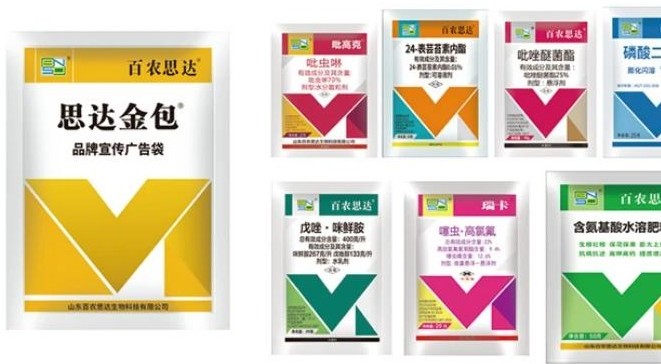
For growers who prefer a packaged answer, the Sida Gold Pack wheat kit from BNSD Agro (Shandong Bainong Sida Biotechnology Co., Ltd.) combines insecticide, fungicide and nutrition components in one box, in manual-application and UAV versions (company information). For a distributor, a kit turns a multi-line program into a single order line — and pulls the individual SKUs along with it.
FAQ
What does a rate “per 667 m²” mean?
One 667 m² is one mu, the standard Chinese field unit, equal to roughly 1/15 of a hectare. To convert a per-667 m² rate to a per-hectare basis, multiply by 15 — for example, 30–40 mL/667 m² corresponds to about 450–600 mL/ha. The final rate is always the destination label’s.
Can the flowering fungicide be mixed with the aphid insecticide?
That combination is exactly the “one spray, three protections” pass: a FHB fungicide, mildew cover and the aphid insecticide in one tank at early anthesis. Verify compatibility with a jar test of the full mix, then apply promptly once prepared.
Are these rates valid in markets outside China?
The table cites Chinese registration label rates to show use patterns and dose bands. Outside China, the destination market’s registration and label govern what may be recommended — Chinese registration is not destination authorization.
Which product starts the wheat program?
The seed treatment: thiamethoxam 35% SC at 340–450 mL per 100 kg seed against early aphids. It is applied before sowing, which is why program planning must start before the season does.
The full product lines behind this program — fungicides, insecticides, herbicides — are available for sampling and registration support. To discuss adapting this wheat full season program to your market, contact the export team.
WhatsApp / WeChat: +86 199 0636 5856