
Thiophanate-methyl occupies a specific place in the fungicide trade: a systemic with a genuinely broad spectrum and decades of field history, paired with the most demanding resistance story of any major group. Buyers who understand both halves of that sentence position the product where it still performs and avoid the markets where it has been burned out. This guide sets out how the molecule works, the Chinese label rate for the BNSD Agro (Shandong Bainong Sida Biotechnology Co., Ltd.) 70% WP, the rotation discipline that FRAC group 1 demands, and the sourcing checks for a wettable powder. The complete range sits on the fungicides catalogue, and samples or registration documents are available through the contact page.
What Is Thiophanate-methyl?
Thiophanate-methyl is registered in FRAC group 1, the benzimidazoles — with a chemical twist. The molecule itself is a thiophanate precursor: after application it is converted inside the plant into carbendazim (MBC), and it is the carbendazim that does the fungicidal work. MBC binds to fungal beta-tubulin, disrupting tubulin assembly and stopping mitosis — cell division — in the growing fungus.
The working profile that follows:
- Systemic, upwardly mobile. Absorbed and translocated in the xylem stream, it protects new growth and reaches tissue a contact spray misses.
- Protectant plus curative. Because it inhibits cell division, it can stop infections that have already started — a phase contact protectants do not have.
- One lethal target site. Everything FRAC group 1 is known for follows from this single point of attack: high potency on susceptible populations, and high resistance risk once a tubulin mutation spreads.
Registered Use and Chinese Label Rate
| Product | Registered target (Chinese label) | Label rate |
|---|---|---|
| Thiophanate-methyl 70% WP | Cucumber powdery mildew | 40–48 g/667 m² |
All rates are Chinese registration label rates; 667 m² equals one mu, roughly 1/15 hectare. Multiply by fifteen for the per-hectare equivalent, and re-express everything against the destination label — registration scope and rates differ country by country, and the figures above are a positioning reference, not a spray recipe for another jurisdiction.
On-target notes: cucumber powdery mildew builds on the upper leaf surface as the familiar white talc dust, driven by warm days with humid nights. The Chinese registration places the 70% WP directly on this target, and the same disease can also be held with a multi-site alternative — the BNSD Agro cucumber program pairs it with thiram 50% WP at 75–150 g/667 m², which matters for the rotation logic below. The powdery mildew fungicide guide compares the whole toolbox.
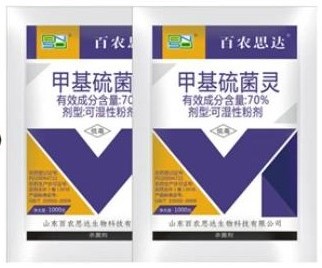
Packaging runs 100 g × 50 packs, 500 g × 20 and 1 kg × 10 bags — retail sachets through farm-scale units on the same ladder.
The Resistance Reality of FRAC 1
No rotation conversation in fungicides is more serious than the one around group 1. A single mutation in the beta-tubulin target can collapse the efficacy of every benzimidazole at once — thiophanate-methyl and carbendazim share the same active form, so resistance to one is resistance to both. And because the group has been used intensively for five decades, resistance is established in many pathogen populations worldwide, from Botrytis in protected crops to various powdery mildews and leaf-spot pathogens in other regions.
The practical consequences for programs and for positioning:
- Cap the applications. Treat group 1 as a limited-use tool — one or two applications per crop cycle, never consecutive. Beyond that, selection pressure rebuilds resistant populations quickly.
- Rotate with unrelated modes. Follow group 1 with multi-site protectants (FRAC M) or single-site groups with different targets — triazoles (FRAC 3), QoI (FRAC 11) — so each generation of spores faces a different barrier. The resistance-management guide sets out the full framework.
- Do not rescue a failing product with dose. Where resistance is established in the local population, raising the rate wastes money and deepens the problem. Local performance history — not the molecule’s reputation — should decide the program.
- Position honestly by market. In markets where group 1 still performs, the 70% WP is a cost-effective systemic backbone. Where it has failed, the same product is still correct chemistry — just not the right rotation slot. Knowing which situation you are in is the buyer’s first job.
Sourcing Thiophanate-methyl 70% WP: Buyer Checklist
- Content released by HPLC against the registration standard. At BNSD Agro every batch is analysed by HPLC or GC and released against the registration standard before shipment (company practice). Content is a registered value, not a marketing range.
- Fineness and suspension quality. The active must be ground fine enough to stay suspended after dilution; coarse powder settles out in the tank and under-doses the top of the spray job.
- Wetting and dispersion. A professional WP wets promptly, disperses without lumps and re-disperses with routine agitation — the three behaviours that separate formulation work from simple powder blending.
- Storage stability. No caking through hot and cold shipping cycles, no content drift over shelf life.
- Documents and pack ladder. Pesticide registration certificate, production licence and batch traceability in the supplier’s own name, with the 100 g-to-1 kg ladder confirmed in the contract.
FAQ
What is thiophanate-methyl 70% WP registered for on the Chinese label?
Cucumber powdery mildew at 40–48 g/667 m². Which uses apply in your market is decided by the destination label — the Chinese registration is a positioning reference, not an authorization for another jurisdiction.
How does thiophanate-methyl relate to carbendazim?
Thiophanate-methyl is a precursor: the plant converts it into carbendazim after application, and the carbendazim is the active form that inhibits fungal mitosis. Because both end at the same beta-tubulin target, resistance to one means resistance to the other.
Why does FRAC group 1 carry a high resistance risk?
It has a single lethal target site — fungal beta-tubulin — so one mutation removes its efficacy entirely. With five decades of intensive global use, group 1 resistance is established in many pathogen populations. Programs must cap consecutive applications and rotate with unrelated modes of action.
What should buyers check when sourcing a thiophanate-methyl WP?
HPLC content release against the registration standard, fine grinding with good suspension after dilution, prompt wetting and lump-free dispersion, storage stability without caking, and clean documents with the pack ladder agreed in the contract.
WhatsApp / WeChat: +86 199 0636 5856