
Snails and slugs are the pest group that conventional insecticide programs simply do not touch: no caterpillar spray, neonicotinoid or pyrethroid has any meaningful effect on a mollusc. In humid vegetable regions — and on cabbage crops in particular — that gap turns into ragged seedlings, slime trails across marketed heads, and rejected export lots. Metaldehyde granules are the established answer, and they behave so differently from every other product in a distributor’s portfolio that they deserve their own sourcing logic. This guide covers how metaldehyde works, the registered use, application technique that actually delivers results, and what to check before ordering. The full range sits on the insecticides catalogue, and samples or registration documents are available through the contact page.
What Is Metaldehyde?
Metaldehyde is a molluscicide — a pesticide class of its own, outside the IRAC insecticide groups because its targets are gastropods, not insects. The 6% granule (GR) formulation is built around a three-part working principle:
- Attractant bait. The granule matrix is formulated to draw snails and slugs to it from a distance, so control does not depend on the mollusc crawling over a treated surface. The pests come to the bait.
- Stomach poison. Ingested metaldehyde is what kills; contact alone does little, which is why bait placement and palatability decide efficacy.
- Dehydration effect. The classic mode description: metaldehyde triggers massive mucus over-production, the mollusc swells and loses body fluid, and dies of dehydration. The morning evidence — dead snails and dried-out slugs — appears slowly, typically overnight rather than within hours.
Two behaviour facts explain most field results. First, molluscs feed actively in darkness and in moisture: at dusk, after rain, under irrigation. A bait applied into that active window meets pests on the move. Second, a dehydrated or sun-dried bait is far less attractive and persistent — moisture management is not an agronomic nicety here, it is the product’s working condition.
Registered Use and Pack Format
| Product | Registered target (Chinese label) | Pack |
|---|---|---|
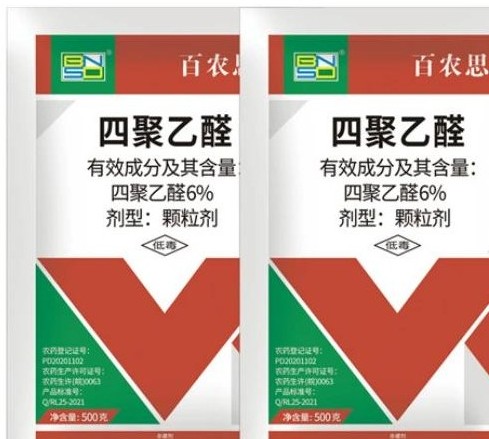
| Metaldehyde 6% GR | Cabbage snails and slugs | 500 g×20 bags |
The registered Chinese target is snails and slugs on cabbage — the crop where mollusc damage is most visible and most commercially costly, since slime trails and feeding holes on wrapped heads destroy the marketable unit itself. Application rate and other registered crops on your market’s label are decided by the destination registration: Chinese registration demonstrates a regulated, auditable manufacturing source, while your own market’s label governs legal use, rates and pre-harvest intervals. Our guide on how to read a Chinese pesticide label explains how the two documents relate.
The 500 g×20 bag pack is a deliberate retail format: one bag covers a manageable plot area for a smallholder, twenty bags seal into a carton, and the moisture-proof bag does double duty as shelf protection — the same property the product needs in the field, it needs in the warehouse.
Application Technique: Getting the Bait Economics Right
Metaldehyde granules fail in the field for one dominant reason: they are treated like a spray instead of like a bait. The technique that works is well established:
- Broadcast at dusk, between the rows. Apply into the evening activity window, placing granules on the soil surface between rows and around the crop base — the routes snails and slugs actually travel — rather than onto the foliage where bait is wasted and residues sit on the marketed plant.
- Scatter evenly; do not pile. Heaps of bait suppress foraging movement and concentrate non-target exposure. An even, light scatter across the baited strip brings the pests out to individual granules.
- Keep the bait dry. Bait that dissolves in rain or standing irrigation water loses attraction and breaks up. Apply ahead of the evening moisture but not immediately before heavy rain, and irrigate before — not after — the baiting round where the schedule allows.
- Re-bait on evidence, not on calendar. After heavy rain or when fresh trails and new feeding appear, a follow-up broadcast maintains the barrier through the vulnerable seedling and head-formation stages.
Baiting works best as one layer of a program rather than the whole program: drainage and row hygiene that remove daytime hiding spots, field sanitation that removes egg-laying debris, and inspection of planting material all reduce the population pressure the bait has to finish off.
Why Resistance Is Rarely the Problem Here
Because metaldehyde is a bait with a physical dehydration outcome rather than a single-site metabolic poison on insects, resistance development — the defining headache of modern insecticide programs — has never become the dominant failure mode for mollusc baits. The dominant failure mode is instead physical: bait that was wet, bait that was piled, bait that was applied at midday when the pests were hidden. That is good news for a distributor building a long-term product, and it concentrates quality attention on the granule itself.
Sourcing Metaldehyde 6% GR: Buyer Checklist
- Uniform, durable granules. Granules must be even in size so broadcast spreaders meter them consistently, and hard enough to survive bagging, transport and light handling without crumbling into dust.
- Bait integrity in humidity. The matrix must hold its structure and attractancy through humid storage — this is both a formulation-quality question and a packaging question; confirm the liner quality of the 500 g bags.
- Attractant consistency batch to batch. The bait matrix and attractant system are the formulation’s real value; a cheap matrix that pests ignore is functionally a zero, whatever the metaldehyde content says.
- Documents in the supplier’s own name. Pesticide registration certificate, production licence and batch traceability, verifiable against the registration database.
- Destination registration first. Confirm molluscicide registration status, permitted crops and any specific bait-application requirements in your market before quoting.
FAQ
How does metaldehyde kill snails and slugs?
It works as an attractant bait plus stomach poison: molluscs are drawn to the granules, ingest the active, and die through mucus over-production, swelling and dehydration. Contact with the granule alone does little — ingestion is what kills, which is why bait placement and palatability matter so much.
When should metaldehyde granules be applied?
At dusk, into the evening activity window when snails and slugs are moving and feeding, broadcast between rows and around the crop base on the soil surface. Keep the bait dry — apply so the granules are not dissolved by rain or irrigation immediately afterwards.
What is metaldehyde 6% GR registered for on the Chinese label?
Snails and slugs on cabbage. Permitted crops, rates and method in your market follow the destination registration and label.
What should buyers check when sourcing metaldehyde granules?
Granule uniformity and durability, bait integrity under humidity, batch-to-batch attractant consistency, clean registration documents in the supplier’s own name, moisture-proof pack format, and the product’s legal status in the destination market.
WhatsApp / WeChat: +86 199 0636 5856