
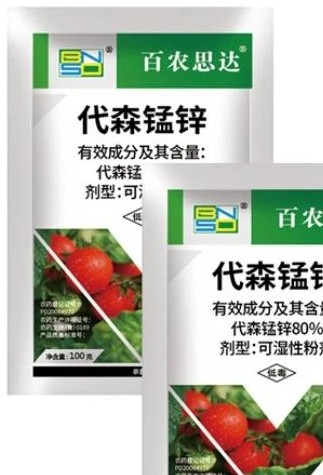
Every disease program in every market still rests on a protectant, and for many growers that protectant is mancozeb. Enquiries to Chinese manufacturers rarely ask whether mancozeb works — the molecule has decades of field history — but they do ask what the registered rate is, how it pairs with single-site systemics, and what separates a properly milled wettable powder from a dusty, low-content repack. This guide answers those questions for the BNSD Agro (Shandong Bainong Sida Biotechnology Co., Ltd.) mancozeb 80% WP, from its multi-site mode of action to the physical checks worth doing before a bulk order. The full portfolio sits on the fungicides catalogue, and samples or registration documents are available through the contact page.
What Is Mancozeb?
Mancozeb is an ethylene bisdithiocarbamate (EBDC) fungicide in FRAC group M3, the multi-site family. Its chemistry is the reason for its staying power: on the leaf surface it decomposes into species that inactivate fungal enzymes at many metabolic points at once — spore germination, respiration and energy transfer among them. A pathogen cannot dodge a material that attacks dozens of targets simultaneously with a single mutation, which is why, after more than half a century of continuous worldwide use, no practically significant resistance has developed. FRAC rates the group as low resistance risk.
Three working properties follow from that chemistry:
- Pure contact protectant. Mancozeb forms a protective deposit on the treated surface and prevents spores from establishing. It has no meaningful systemic movement, so it neither cures established infections nor protects unsprayed tissue.
- Coverage is everything. Because the film works only where it lands, spray quality — coverage of leaf undersides, deposit uniformity — matters as much as the rate itself.
- Timing before infection. A protectant must be on the plant before the pathogen arrives. Programs built around mancozeb are driven by disease-forecast windows and fixed spray intervals, not by waiting for lesions.
Registered Use and Chinese Label Rate
| Product | Registered target (Chinese label) | Label rate |
|---|---|---|
| Mancozeb 80% WP | Tomato early blight | 153.75–197.5 g/667 m² |
All rates are Chinese registration label rates; 667 m² equals one mu, roughly 1/15 hectare. The odd-looking decimals are not a typo — Chinese labels register exact values, and buyers quoting per-hectare programs should convert directly (×15 for the per-hectare equivalent) and then re-express against the destination label. In your own market the destination label governs: registration scope and rates differ country by country, and the figures above are a positioning reference, not a spray recipe for another jurisdiction.
On-target notes: tomato early blight is the Alternaria leaf-spot complex, a disease that builds through the canopy during warm, humid weather. As a protectant, mancozeb is applied on a scheduled interval starting before or at the very first sign of disease, with the deposit renewed as the canopy grows. Local extension guidance sets the interval in each market.
Packaging runs the standard export ladder for retail-to-farm programs: 100 g × 100 sachets, 500 g × 20 bags and 1 kg × 10 bags.
Tank-Mix Partner Logic
Mancozeb’s most valuable commercial role today is as the partner that keeps single-site systemics working. The logic is straightforward: a single-site active such as a triazole (FRAC 3), a QoI strobilurin (FRAC 11), a CAA (FRAC 40) or a phenylamide (FRAC 4) carries a measurable resistance risk on its own; co-formulated or tank-mixed with a multi-site protectant, the pathogen population faces two unrelated barriers at once, and selection pressure on the single-site target drops sharply.
For the registered tomato early blight target, that usually means mancozeb carrying the protective program while a systemic partner adds curative reach into tissue the contact spray missed. Both sides benefit — the protectant covers pathogens the partner misses, and the partner covers infections already under way.
Two practical cautions from general tank-mix chemistry:
- Avoid strongly alkaline tank conditions. EBDC chemistry degrades in alkaline mixes; keep the tank near neutral and follow both product labels.
- Jar-test unfamiliar combinations first. Physical compatibility between a WP and liquid formulation partners should be confirmed in a small jar before the sprayer is filled — the tank-mixing guide walks through the procedure.
Sourcing Mancozeb 80% WP: Buyer Checklist
A wettable powder is judged on its solid-particle quality as much as on chemical content. Four checks separate a professional product from a repack:
- Fines content and dusting. An over-fine dust fraction floats out of the sachet, exposes handlers and deposits unevenly. A properly milled WP has a controlled particle spectrum: fine enough to disperse, without the flour-like fraction that dusts the packing line and the spray operator.
- Wettability and dispersion in water. Poured onto water, a good WP wets without floating clumps and disperses into a uniform suspension that holds through the whole spray job with routine agitation. Lumps, floating powder or a fast-settling bottom layer all point to poor formulation.
- Content released by HPLC against the registration standard. Content is a registered value, not a marketing range. At BNSD Agro every batch is analysed by HPLC or GC and released against the registration standard before shipment (company practice).
- Storage behaviour and documents. The powder must survive hot and cold shipping cycles without caking or content drift, and the supplier should provide the pesticide registration certificate, production licence and batch traceability in its own name, with the pack ladder confirmed in the contract.

FAQ
What is mancozeb 80% WP registered for on the Chinese label?
Tomato early blight at 153.75–197.5 g/667 m². Which uses apply in your market is decided by the destination label — Chinese registration is a positioning reference, not an authorization for another jurisdiction.
Why is mancozeb considered low-risk for resistance?
It is a multi-site protectant (FRAC M3): it inactivates fungal enzymes at many metabolic points at once, so no single-gene mutation can defeat it. After decades of worldwide use there is no practically significant resistance, which is why it remains the standard rotation partner for single-site systemics.
Can mancozeb be tank-mixed with systemic fungicides?
Yes — that is its core role. Pair it with single-site systemics (triazoles, QoI strobilurins, CAA or phenylamide actives) so the program gains a curative phase while the protectant lowers selection pressure on the partner. Avoid strongly alkaline tank conditions and jar-test unfamiliar combinations first.
What should buyers check when sourcing a mancozeb WP?
Fines content and dusting behaviour, wettability and dispersion in water, HPLC content release against the registration standard, storage stability through temperature cycles, and clean documents with the full pack ladder agreed in the contract.
WhatsApp / WeChat: +86 199 0636 5856