
Fertigation — feeding the crop through the irrigation water — is simple in hardware and demanding in scheduling. The drip line reaches every plant; the question is what grade to inject this week. A season-long fertigation schedule answers that by rotating NPK grades as the crop moves from canopy building to fruit fill to ripening, with two specialties — monopotassium phosphate at bloom and potassium phosphite at stress windows — slotted in where the stage turns. This guide lays out the rotation, the rates per pass and the drip-system habits that keep the program clean.
Why One Grade Cannot Serve a Whole Season
Nitrogen demand and potassium demand do not peak at the same time. Nitrogen builds leaf and stem, so it dominates while the canopy is being constructed. Potassium governs fruit set, sugar transport and quality, so its share rises as the crop shifts from growing shoots to filling fruit. A single balanced grade applied all season either starves the early canopy or overfeeds nitrogen into the fruiting phase — soft growth, delayed colouring, diluted sugars. The fix is not more fertilizer; it is a rotation matched to the stage.
The Three-Stage Rotation
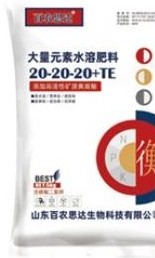
The water-soluble range from BNSD Agro (Shandong Bainong Sida Biotechnology Co., Ltd.) maps directly onto the crop’s demand curve, each grade applied by fertigation or drench at 5–10 kg/667 m² per pass:
- Vegetative stage: 20-20-20+TE (or 18-18-18+TE). A balanced 1:1:1 ratio builds canopy and roots together. The +TE trace-element package covers micronutrients while the root system is still exploring the soil or substrate.
- Fruiting stage: 15-5-35+TE. Nitrogen is trimmed back and potassium raised as the crop commits to fruit. Pushing nitrogen here produces leaf and soft shoots at the expense of fruit quality.
- Ripening stage: 12-8-40+TE. The highest potassium share of the range carries sugar transport, colour and firmness through the final fill.
Season Schedule Table
| Stage | Grade | Purpose | Rate per pass |
|---|---|---|---|
| Seedling – vegetative | 20-20-20+TE (or 18-18-18+TE) | Balanced NPK builds canopy and roots together | 5–10 kg/667 m² |
| Flowering – fruiting | 15-5-35+TE | Nitrogen trimmed, potassium raised for fruit fill | 5–10 kg/667 m² |
| Ripening – harvest | 12-8-40+TE | Maximum potassium share for sugar transport and quality | 5–10 kg/667 m² |
| Bloom window (foliar top-up) | MKP 0-52-34 | Phosphorus and potassium with no nitrogen at flowering | 0.2–0.3% foliar |
| Stress windows | Potassium phosphite 0-520-340 | P/K nutrition with supporting role under oomycete pressure | Per product specification |
Reading the Transitions
The calendar does not switch grades; the crop does. Two signals are enough to steer the rotation:
- First flower buds — the cue to move from the balanced grade to 15-5-35. Waiting until fruit are visible means the nitrogen surplus is already in the plant.
- First colour — the cue to move to 12-8-40, so the potassium wave arrives with the fill rather than after it.
Between signals, keep passes small and frequent. Splitting the 5–10 kg/667 m² allowance to follow crop demand keeps nutrients in the root zone instead of below it — the core habit of any fertigation program.
Two Special Additions: MKP at Bloom, Phosphite at Stress
MKP 0-52-34 is the foliar complement to the drip rotation. At bloom, a 0.2–0.3% spray supplies phosphorus and potassium with no nitrogen at all — the transition fed without restarting vegetative growth. It rides on top of the schedule, not inside it.
Potassium phosphite 0-520-340 (P₂O₅ ≥520 g/L, K₂O ≥340 g/L) is the liquid specialty for stress windows: humid, wet periods when oomycete pressure builds. Phosphite is a distinct chemistry from phosphate — it supplies nutrition and is widely used for its supporting role against oomycete pressure — which is why it sits between nutrition and crop protection in the program. Both specialties and the grades around them are detailed in the water-soluble fertilizer NPK guide.

Drip-System Practice Notes
- Dissolve fully before injection. Prepare a stock solution in water first; never let undissolved powder travel toward the injection point.
- Separate stocks that precipitate. Calcium-containing and phosphate/phosphite concentrates are kept in different tanks until dilution brings them together safely (general practice).
- Small and frequent beats large and rare. More passes at lower dose track the crop’s actual uptake; the 5–10 kg/667 m² per pass is an allowance to split, not a target to exceed.
- Watch EC in substrates. Every fertigation pass adds to substrate salinity; track electrical conductivity and adjust the dose rather than the schedule.
- Flush lines after the round. A clean flush prevents residual solution crystallizing in emitters between passes.
- Rates here follow the BNSD Agro product specifications for the Chinese market (667 m² = one mu, ≈ 1/15 ha); adjust grades and rates to the crop, water analysis and destination-market guidance. For converting rates and tank dilutions, see the dose calculation guide.
The full water-soluble range — 20-20-20, 18-18-18, 15-5-35, 12-8-40, MKP and potassium phosphite — is on the nutrition products page. To assemble a schedule for your crop and market, contact BNSD Agro.
FAQ
How many fertigation passes should I run per week?
There is no fixed number. Frequency depends on the crop, the growing medium and the season — a substrate-grown greenhouse crop drinks and feeds far more often than a field crop on a holding soil. The working rule is the rate per pass: 5–10 kg/667 m², split into as many passes as the system and the crop demand.
Can I save money by running 20-20-20 the whole season?
The saving is an illusion. Continuing full nitrogen through fruiting produces vegetative growth the fruit pays for, and continuing it through ripening works directly against colour and sugar. The rotation costs the same nutrients, spent at the moments the crop can use them.
When exactly should I switch from 15-5-35 to 12-8-40?
At first colour on the earliest fruit. The ripening grade’s high potassium share is meant to arrive with the fill; switching too late leaves the final quality push unsupported. In mixed-age plantings, steer by the majority cohort.
Where do MKP and potassium phosphite fit into the schedule?
MKP 0-52-34 is a foliar top-up at bloom, 0.2–0.3%, feeding the flowering transition without nitrogen. Potassium phosphite 0-520-340 goes in at stress windows — wet, humid stretches when oomycete pressure rises — as nutrition positioned between fertilization and crop protection.
WhatsApp / WeChat: +86 199 0636 5856