
Chlorpyrifos is one of the oldest broad-spectrum insecticides still in international trade, and enquiries for it continue to reach Chinese manufacturers from South and Southeast Asia, Africa and Latin America. But the market picture around this molecule has changed more than for almost any other legacy active, and any honest guide has to start there. This article covers how chlorpyrifos works, the registered use on the current Chinese label, where organophosphates still fit in 2026, and the sourcing checks specific to a 45% emulsifiable concentrate. The full insecticide range sits on the insecticides catalogue, and registration documents or samples are available through the contact page.
What Is Chlorpyrifos?
Chlorpyrifos is an organophosphate insecticide classified in IRAC group 1B — the acetylcholinesterase inhibitors. Like other group 1B actives it binds the enzyme acetylcholinesterase, so acetylcholine keeps stimulating nerve endings and the nervous system over-fires. Three properties describe its field behaviour:
- Contact, stomach and fumigant action. Chlorpyrifos kills on contact with the insect body and through ingestion of treated tissue, and a degree of vapour activity lets it reach insects sheltering in leaf folds, whorls and other enclosed spaces that the spray droplets miss.
- Broad spectrum. Caterpillars, leafhoppers, aphids, soil pests and many others are susceptible, which is why the molecule built its long history across rice, vegetables, maize and orchard crops.
- Short-lived on foliage relative to systemic insecticides. Chlorpyrifos is not systemic; it works as a contact treatment on the surfaces present at spraying, which places a premium on coverage and timing.
Under IRAC guidance the group 1B family carries a high resistance risk, and decades of intensive use have confirmed it in many pest populations. Rotation with unrelated modes of action is not optional for this chemistry — it is the condition of using it at all. The general principles are set out in our resistance management guide.
Where Chlorpyrifos Still Fits: The Honest Market Picture
This is the part a serious supplier will discuss openly. Organophosphates as a family are restricted, and in many markets phased out altogether:
- The EU no longer approves chlorpyrifos, and several other developed markets have withdrawn or heavily restricted it, particularly around food crops and residential use.
- Import regimes increasingly tie maximum residue limits (MRLs) to whether the active is even permitted — spraying a still-registered use against a zero-tolerance MRL at destination is a shipment-ending mistake.
- Meanwhile, in a number of countries across Asia, Africa and Latin America, chlorpyrifos remains registered and in common agricultural use, often as a workhorse in rice and vegetable programs where alternatives are priced out.
The consequence for buyers is straightforward: position chlorpyrifos only where it is still registered, and always against the destination label. A Chinese registration certificate demonstrates that the manufacturing site and product are regulated and auditable; it is not, by itself, authorisation to sell the product in your market. Read the destination registration status and the MRL list first, then build the program. Our guide to reading a Chinese pesticide label explains how the two documents relate.
Registered Use and Chinese Label Rates
| Product | Registered target (Chinese label) | Label rate | Pack ladder |
|---|---|---|---|
| Chlorpyrifos 45% EC | Rice leaffolder | 80–90 mL/667 m² | 100 mL×80 … 1 L×12 |
All rates are Chinese registration label rates; 667 m² equals one mu, roughly 1/15 hectare. Rice leaffolder folds and ties leaves into shelters almost as soon as it hatches, and once inside the fold the larva is protected from most contact sprays — which is precisely where the fumigant component of chlorpyrifos earns its place, reaching larvae through the vapour phase inside rolled leaves. Timing still decides the outcome: spray at the early-instar window when folds are few and small, in sufficient water volume to reach the lower canopy.
The pack ladder runs from 100 mL×80 sachets for smallholder retail up to 1 L×12 bottles for farm-scale and program use, which suits the way rice protection is retailed in most leaffolder markets.
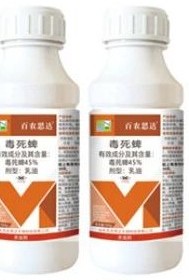
Sourcing Chlorpyrifos 45% EC: Buyer Checklist
An emulsifiable concentrate is active ingredient dissolved in organic solvent with an emulsifier system, so most of its quality signals are physical. Six checks separate a professional EC from a diluted or unstable one:
- Content released by GC against the registration standard. Organophosphates are analysed by gas chromatography; at BNSD Agro every batch is analysed by HPLC or GC and released against the registration standard before shipment (company practice). A vague “or higher” content claim is a red flag on any label.
- Emulsion stability after dilution. Diluted into water, the concentrate must form a uniform milky emulsion that holds for the whole spray job — no creaming, no oil slick on top, no sediment.
- Low-temperature stability. Solvent and active must stay dissolved through cold nights and winter transit; a product that throws out crystals or splits into two phases in the drum will never perform in the field.
- Flash point and DG classification. EC formulations carry organic solvents, which places them in Dangerous Goods Class 3 for transport. Confirm the flash point data and use a DG-certified forwarder — this is a documentation point, not a formality.
- Clean documents in the supplier’s own name. Pesticide registration certificate, production licence and batch traceability, with the certificate number verifiable against the registration database.
- Destination registration first. Before anything else in this list, confirm the product’s legal status and MRL position in your own market and quote against the destination label.
FAQ
Where is chlorpyrifos still registered?
It remains registered for agricultural use in a number of countries across Asia, Africa and Latin America, but it is banned or heavily restricted in many export markets, including the EU. Registration status changes over time, so the only reliable answer is the current registration list of your own destination market — check it before you build a program around this active.
What is chlorpyrifos 45% EC used for on the Chinese label?
The Chinese registration covers rice leaffolder at 80–90 mL/667 m². Which uses apply in your market is decided entirely by the destination label, which may register different crops, pests and rates.
How does chlorpyrifos work?
It is an organophosphate, IRAC group 1B: an acetylcholinesterase inhibitor that over-stimulates the insect nervous system. It acts by contact, by ingestion and, usefully against sheltered pests like leaf-folder larvae, through fumigant (vapour) action.
What should buyers check when sourcing chlorpyrifos 45% EC?
Destination registration and MRL status first; then GC-released content, emulsion stability after dilution, low-temperature stability, correct DG Class 3 shipping papers, and registration documents held in the supplier’s own name.
WhatsApp / WeChat: +86 199 0636 5856