
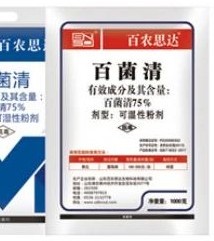
Chlorothalonil is one of the few contact fungicides that has stayed in continuous global use since the 1960s, and buyers keep returning to it for the same reasons: a very broad pathogen spectrum, no meaningful resistance history, and a cost profile that lets programs run protection through a whole season. For importers, the practical questions are the label rate on the Chinese registration, how far the crop breadth actually reaches, and how it rotates with modern systemics. This guide covers all three for the BNSD Agro (Shandong Bainong Sida Biotechnology Co., Ltd.) chlorothalonil 75% WP. The complete portfolio sits on the fungicides catalogue, and samples or registration documents are available through the contact page.
What Is Chlorothalonil?
Chlorothalonil is a chloronitrile fungicide in FRAC group M5, the multi-site family. Like mancozeb in group M3, it acts on the surface of the plant, interfering with several fungal metabolic processes at once and stopping spore germination before infection is established. The multi-site mechanism is the reason chlorothalonil has never produced a practically significant resistance problem: a pathogen cannot escape a material that attacks many targets simultaneously with a single gene change. FRAC classes the group as low resistance risk.
The working profile that follows:
- Contact protectant only. No systemic movement, no curative phase. The deposit must be on the plant before infection, and new growth needs re-treatment.
- Long surface residual. A well-formulated WP holds its protective film through rain and growth flushes better than most contact materials, which is why it anchors interval-based spray programs.
- Wide pathogen spectrum. Downy mildews, leaf-spot and blight pathogens, Botrytis and a range of fruit-rotting fungi are all within its protective reach — subject, always, to what the destination label actually authorizes.
Registered Use and Chinese Label Rate
| Product | Registered target (Chinese label) | Label rate |
|---|---|---|
| Chlorothalonil 75% WP | Cucumber downy mildew | 165–200 g/667 m² |
All rates are Chinese registration label rates; 667 m² equals one mu, roughly 1/15 hectare. For per-hectare planning, multiply by fifteen and then re-express against the destination label — registration scope and rates differ country by country, and the figures above are a positioning reference, not a spray recipe for another jurisdiction.
On-target notes: cucumber downy mildew is an oomycete disease that explodes through greenhouses and open fields under cool, humid conditions, producing water-soaked angular lesions that sporulate on the leaf underside. Protection therefore has to reach the underside of the canopy and start before the weather window opens. A systemic oomycete partner such as a CAA active is the usual curative complement — the BNSD Agro dimethomorph guide covers that side of the program.
Crop Breadth: What the Molecule Does Versus What the Label Says
Chlorothalonil’s biological breadth is genuinely wide — the molecule is protectively effective against a long list of oomycete and fungal leaf pathogens across vegetables, orchards and field crops, which is why it is registered in dozens of countries. But commercial breadth is set by registrations, not by biology. On the BNSD Agro Chinese label the authorized target is cucumber downy mildew; in a destination market the local label may list tomato, potato, banana, peanut, orchard crops or none of these.
The buying implication is direct: position the product by what the destination registration authorizes, and treat the Chinese label rate as the reference point for formulation strength and pricing conversations. Where a local registration is pending, chlorothalonil is typically one of the easier legacy actives to defend in a dossier, given its long global use record — but the registration still has to be done, and BNSD Agro supplies the technical documents, COA and samples that importers need for that process.
Rotating with Systemic Partners
In modern programs chlorothalonil rarely works alone. The standard construction pairs it with a single-site systemic so each component covers the other’s weaknesses:
- Protectant anchor. Chlorothalonil holds the leaf surface between systemic applications and keeps any resistant escapes from building momentum.
- Curative partner. A systemic — CAA or phenylamide for oomycetes, a triazole or QoI for fungal leaf diseases — adds the curative phase the contact material lacks.
- Resistance management. The multi-site component lowers selection pressure on the partner’s single target site. This is the same logic that keeps chlorothalonil in programs built around systemics, and it is why a 75% WP with a tight sachet ladder (20 g × 200 sachets for retail, up to 1 kg × 10 bags for farm scale) fits both smallholder mixes and plantation programs.
Sourcing Notes for the 75% WP
A wettable powder is judged on solid-particle quality as much as chemical content, and three checks are worth running on samples before a bulk order:
- Wettability and dispersion in water. The powder should wet out promptly, disperse without floating clumps and hold a uniform suspension through the whole spray job with routine agitation. Lumps or fast-settling layers point to poor formulation work.
- Content released by HPLC against the registration standard. Content is a registered value, not a marketing range. At BNSD Agro every batch is analysed by HPLC or GC and released against the registration standard before shipment (company practice).
- Pack ladder and documents. The 20 g × 200 retail sachet run through 1 kg × 10 bags, with the pesticide registration certificate, production licence and batch traceability in the supplier’s own name, and the pack sizes confirmed in the contract.
FAQ
What is chlorothalonil 75% WP registered for on the Chinese label?
Cucumber downy mildew at 165–200 g/667 m². Which crops and diseases the product may be sold against in your market is decided by the destination label, not the Chinese one.
Does chlorothalonil cure existing infections?
No. It is a pure contact protectant in FRAC group M5 with no systemic movement. It prevents spore germination on the treated surface and must be applied before infection, with re-treatment as new growth appears.
Why rotate chlorothalonil with systemic fungicides?
The pairing works both ways: the systemic adds curative activity, while the multi-site protectant lowers selection pressure on the systemic’s single target site, slowing resistance development. It is the standard construction for downy mildew and leaf-spot programs.
What crop range can importers expect?
Biologically the molecule is broad, but commercial use follows registrations. Confirm the destination label scope before positioning, and use the Chinese registration as the rate and pricing reference. Technical documents, COA and samples for local registration are available from BNSD Agro.
WhatsApp / WeChat: +86 199 0636 5856