
Anthracnose has a cruel sense of timing. The disease infects quietly in warm, wet weather, sits latent inside green tissue, and then erupts as sunken lesions on fruit just as they approach harvest — when most of the season’s spending is already sunk. Across watermelon, pepper, mango and legume fields, Colletotrichum is the same opponent wearing different clothes, and the programs that hold it are built the same way everywhere: cut the splash-borne infection cycles early, rotate unrelated fungicide groups hard, and never assume a clean-looking crop is a crop without Colletotrichum inside it.
This guide sets out the disease’s biology, two registered anchors from the BNSD Agro (Shandong Bainong Sida Biotechnology Co., Ltd.) fungicide line with Chinese label rates, crop-by-crop notes and the rotation rules that keep both chemistry classes alive.
Anthracnose Biology: Rain Is the Dispersal System
Colletotrichum species overwinter on crop debris, seed and volunteer hosts. When humidity is high and temperatures are warm, the fungus produces spore masses in small fruiting structures on lesions; rain splash — and overhead irrigation acting like rain — physically lifts and redistributes those spores onto new leaves, stems and fruit. Every wetting event is a dispersal event, which is why epidemics advance fastest in showery, warm, humid weather and in dense canopies that stay wet for hours.
Three habits of the pathogen shape the whole program:
- Latent infection. Spores germinate and colonize young green tissue without producing symptoms. The fruit that rots at packing may have been infected weeks earlier.
- Wound-loving but not wound-dependent. Lesions develop readily on intact tissue in humid weather, and wounds from insects or handling accelerate fruit rot.
- Cyclical build-up. Each new lesion produces fresh spores for the next rain to splash onward. Waiting to spray until lesions are visible means spraying into a fully armed dispersal system.
Two Registered Anchors from the Fungicide Line
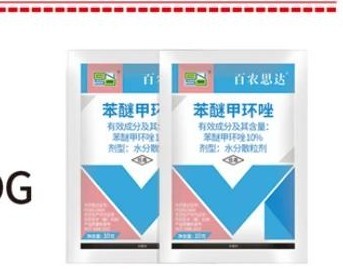
Difenoconazole 10% WDG — the Watermelon Anchor
Difenoconazole is a triazole DMI (FRAC group 3) that blocks ergosterol biosynthesis, giving both protectant and strong curative activity with systemic movement in the plant. On the Chinese label, difenoconazole 10% WDG is registered against watermelon anthracnose at 40–60 g per 667 m². The curative component matters for a disease that hides: an application that arrives as the first infections establish can still suppress lesions before they sporulate.
Pyraclostrobin + Tebuconazole 30% SC — the Pepper Anchor
This suspension concentrate pairs a QoI fungicide (pyraclostrobin, FRAC 11) with a triazole (tebuconazole, FRAC 3) — a protectant with a broad residual plus a curative DMI in one pass. The Chinese label registers it against pepper anthracnose at 60–70 mL per 667 m². For a splash-dispersed disease that hits fruit directly, that combination of protective residual and curative depth is why premixes of this shape anchor pepper programs.
Crop-by-Crop Notes
The disease shows up differently on each crop, and so does the registered tooling:
| Crop | Where anthracnose strikes | Anchor (Chinese label) | Label rate |
|---|---|---|---|
| Watermelon | Fruit rot and fruit-stem (pedicel) rot | Difenoconazole 10% WDG | 40–60 g/667 m² |
| Pepper | Sunken lesions on ripening fruit | Pyraclostrobin + tebuconazole 30% SC | 60–70 mL/667 m² |
| Mango | Fruit infections that stay latent until ripening | Program note — FRAC 3 and FRAC 11 rotation per destination label | Per destination label |
| Legumes | Leaf spots and stem lesions on foliage | Program note — rotate FRAC groups per destination label | Per destination label |
Two rows deserve comment. On mango, field-side control is the whole game: infections land on young fruit in the orchard and detonate after harvest, so the orchard program — not a post-harvest dip — is where resistance-managed FRAC 3 and FRAC 11 passes earn their keep, always under your destination label’s registered uses. On legumes, foliage-level anthracnose spreads by the same splash mechanism, so the same early, protectant-led timing applies; which products are registered is again a destination-label question.
All rates shown are Chinese registration label rates; the products and doses legal in your market are defined by the destination-market label.
Rotation and Cultural Work That Hold the Program
Fungicide rotation decides whether this works next year as well as this year:
- Alternate FRAC groups, don’t stack them. Difenoconazole and tebuconazole are both FRAC 3 — a program using the WDG and the premix is using one group twice. Rotate FRAC 3 passes with FRAC 11 passes and with multi-site protectant anchors, and cap the number of applications per group per season.
- Never lean on one premix. A premix widens the rotation; it is not a licence to repeat the same bottle all season.
- Dry the canopy. Drip irrigation instead of overhead, wider spacing, pruning for airflow and prompt removal of infected debris all cut the splash cycles the disease depends on.
- Break the bridge between seasons. Incorporate crop debris, rotate away from susceptible hosts, and start from clean seed and clean transplants — latent infection travels on planting material.
For how these mode-of-action rules generalize across a whole product catalogue, see our powdery mildew fungicide guide and the pesticide resistance management guide.
Sourcing and OEM Notes
Bainong Sida holds 70 ICAMA registrations with about 60 pending, releases every batch against the registration standard by HPLC/GC, and offers more than eight formulation types in OEM packs from 10 mL to 40 kg. The fungicide anchors above are listed in the fungicides catalogue; for samples, documents or private-label packing, contact the export team.
FAQ
What is the best fungicide for anthracnose?
There is no single best product — there is a best-timed rotation. Difenoconazole 10% WDG (FRAC 3) at 40–60 g/667 m² is registered for watermelon anthracnose and pyraclostrobin + tebuconazole 30% SC (FRAC 11 + 3) at 60–70 mL/667 m² for pepper anthracnose on the Chinese labels. Rotating these unrelated groups, starting protectant applications before wet weather, is what delivers season-long control. Your destination-market label governs registered uses.
Why does anthracnose explode right after rain?
Rain is its dispersal mechanism: spores are packed into lesions and splashed onto new tissue with every wetting event. Warm, humid conditions then let infections establish within hours. A dry spell after the first lesions is the fungus cycling — not a pause.
Can anthracnose be cured once lesions appear?
A curative DMI like difenoconazole can suppress recent infections before they produce spores, but established lesions with sporulating acervuli are no longer curable — they are now spore factories. That is why protectant timing before rainy windows, not rescue spraying, defines a working program.
How should anthracnose fungicides be rotated?
Across FRAC groups: a FRAC 3 pass (difenoconazole or the tebuconazole component), a FRAC 11 pass, and multi-site protectants as anchors, with the number of applications per group capped per season. Remember difenoconazole and tebuconazole are the same group, so the WDG and the premix count together in your rotation plan.
WhatsApp / WeChat: +86 199 0636 5856