
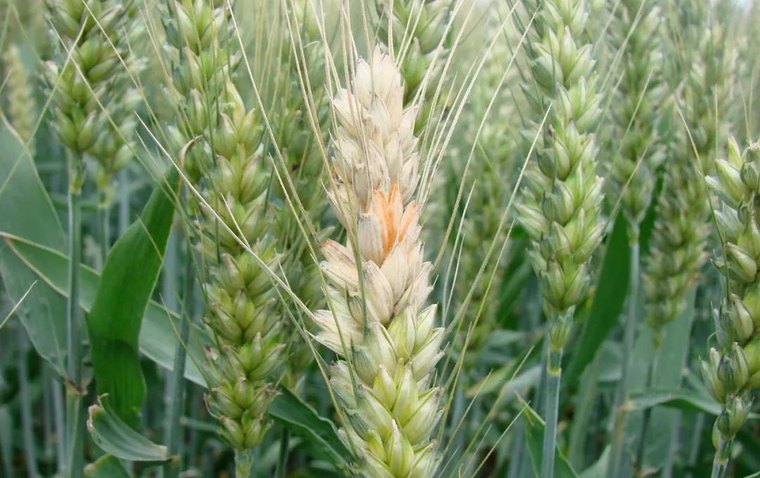
With wheat stripe rust and Fusarium head blight forecast to occur heavily this year, the second spray of the "one spray, three protections" program is the decisive pass, and should be applied at booting to heading stage.
The Ministry of Agriculture and Rural Affairs has warned of heavier-than-normal stripe rust and head blight pressure this season after a warm winter and a wet, humid spring — conditions highly favorable to both diseases. Stripe rust can sweep a whole field within two weeks of an outbreak, while head blight cuts yield and contaminates grain with mycotoxins.
"One spray, three protections" means one application that simultaneously controls key pests and diseases (stripe rust, head blight and aphids), prevents dry-hot wind injury and reduces late lodging. The first spray, at green-up to jointing, targets sharp eyespot, root rot, aphids and wheat mites.
The second, at booting to heading — when wheat shifts to reproductive growth and the ear is at its most fragile — is the yield-protecting pass, and a well-timed spray can add roughly 50 kg of grain per mu.
Three tank-mix formulas are recommended. Basic, for fields with a light disease history: a triazole fungicide (tebuconazole or difenoconazole) plus thiamethoxam-lambda-cyhalothrin, potassium dihydrogen phosphate and brassinolide. Enhanced, where head blight and stripe rust are both historically severe: tebuconazole-prochloraz plus bifenthrin-clothianidin, potassium dihydrogen phosphate and brassinolide.
Comprehensive "four-in-one," for heavy pest and disease pressure: prothioconazole-tebuconazole plus pyraclostrobin, potassium dihydrogen phosphate, brassinolide and bifenthrin-thiamethoxam, controlling stripe rust, head blight, dry-hot wind and aphids in a single pass.
The best window runs from about 80% heading until flowering begins, with daily mean temperatures above 15°C, spraying between 9 a.m. and 4 p.m. in fine weather. Head blight can be prevented but not cured, so spraying must be finished before flowering; if continuous rain sets in at flowering, spray promptly afterward.
Apply 30-50 kg of spray solution per mu, preferably with a powered sprayer, working upward from the lower canopy to wet stems, ears and flag leaves, and respray if rain falls within 6 hours. Rotate active ingredients to slow resistance, add an insecticide as aphid pressure may also run high this year, and add brassinolide last in the tank mix.