
Of all the elements a crop needs, two do the most to decide whether flowers become fruit. Zinc governs the growth machinery that builds healthy leaves and flowering shoots; boron governs pollination itself — pollen viability, pollen tube growth, the retention of flowers and young fruit. Both are needed in amounts so small that a deficiency is easy to miss and expensive to ignore: the crop looks green and healthy while setting a fruit load it never should have accepted. Agronomists call the condition hidden hunger, and zinc and boron are its two most common causes. This guide explains what each element does, presents the two BNSD Agro (Shandong Bainong Sida Biotechnology Co., Ltd.) liquid products built around them, and sets out the timing that makes the difference.
Zinc: The Growth-regulator Micro-element
Zinc’s central role is in the synthesis of auxins — the plant hormones that drive cell elongation and shoot extension. When zinc runs short, that machinery slows and the symptoms are unmistakable in hindsight:
- Little leaf and rosette. New leaves come out small, narrow and crowded, with shortened internodes between them. The canopy never recovers the leaf area it lost during the deficient stretch.
- Reduced shoot growth. Extension growth stalls between nodes; the plant looks “stuck” without turning yellow.
- Yield loss before colour change. Because zinc problems show as growth failure rather than discoloration, the crop can lose canopy and flowering sites while still looking generally healthy.
Zinc shortage is most common in alkaline and calcareous soils, in sandy soils, and in high-phosphorus programs — high available phosphorus is well known to interfere with zinc uptake. That last point matters for fertigation programs: a crop pushed hard with P can induce a zinc shortage that the soil analysis never predicted.
Boron: Pollination and Fruit Set
Boron works at the moments that decide the crop’s fruit load:
- Pollen quality and pollen tube growth. Boron is required for pollen germination and for the pollen tube’s growth down to the ovule. Short boron means pollen that arrives but does not complete the journey — flowers that open, look fine, and drop.
- Flower and fruit retention. Cell-wall formation in young fruit tissue depends on boron; young fruit deficient in boron abort before the grower has any visual warning.
- Tissue quality. Boron also governs cell-wall structure in developing tissue — the reason boron deficiency shows up as cracking, corkiness and malformation in fruit and storage roots.
Boron is the micro-element with the narrowest margin: the gap between deficient and toxic is small compared with any other nutrient. Doses must come from the label, never from guesswork — and uniform application matters as much as the dose itself.
Two Liquid Products, One Job
BNSD Agro supplies the pair as liquids, each packed 1 L per bottle, 12 bottles per carton:
- Sugar-alcohol chelated zinc. Zinc held in a sugar-alcohol (polyol) carrier. Sugar alcohols are themselves mobile in the plant’s transport streams, so the carrier acts as a shuttle: it keeps the zinc available in solution and helps move it into and through the tissue. The formulation is built for foliar uptake, which is exactly how a zinc correction should be delivered.
- Liquid boron, 150 g/L. A high-analysis liquid boron for precise, low-dose application. The declared concentration is what makes the narrow boron margin manageable — a grower or agronomist can meter the exact amount the label calls for instead of estimating from a powder.
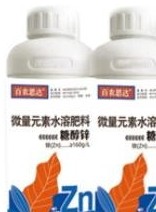
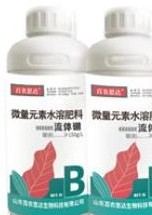
Both being liquids, they measure cleanly, dissolve instantly and pass spray filters without residue — the practical reasons liquids dominate the micro-element shelf in intensive cropping.
Application Notes
- Zinc early, boron at the reproductive switch. Zinc passes fit the early vegetative stage, when shoots and leaf area are being built. Boron passes fit just before flowering and through fruit set, when pollen tubes are growing and young fruit is forming.
- Foliar is the route of choice. Both elements reach the crop fastest and most reliably through the leaf; soil-applied micro-elements are easily tied up, especially in alkaline soils. Follow the label rate and interval.
- Respect the boron margin. Never exceed the label rate with boron, and calibrate the sprayer before the pass — uniformity matters as much as dose for an element this concentrated.
- Watch the P–Zn interaction. In high-phosphorus fertigation programs, keep an eye on zinc even when the soil analysis looks adequate; induced zinc shortage is a known pattern under heavy P.
- Jar-test new tank mixes. Both products mix broadly with mainstream feeds and pesticides, but concentrated calcium or strongly acidic mixes deserve a compatibility check first.
- All rates above follow the product specification for the Chinese market. Adjust to crop, water analysis and destination-market guidance.
Both products sit in the BNSD Agro nutrition line — see the nutrition products page. For specifications, samples or OEM packing, contact BNSD Agro.
FAQ
Why is zinc called the “hidden hunger” element?
Because its deficiency shows as growth failure, not color change. A zinc-short crop keeps its green color while producing small leaves, short internodes and fewer flowering sites — so the yield is being lost while the field still looks healthy. By the time little leaf is obvious, the canopy and flowering sites for that stretch of growth are already gone.
What makes sugar-alcohol chelation different from other zinc forms?
The carrier. In a sugar-alcohol chelate, zinc is held by polyols that are themselves mobile in the plant’s transport system, so the carrier helps move the zinc into and through the tissue rather than just holding it in solution in the tank. For foliar application — the main route for zinc correction — that mobility is the point.
Can liquid boron be applied at flowering itself?
Pre-flowering through fruit set is the window the label program targets, because pollen tube growth and young-fruit retention are the processes boron supports. Apply according to the label rate and interval; with boron, never improvise the dose. If flowering is already underway, a correctly measured pass still supports fruit set and young fruit retention.
How do these two products relate to the Ca-Mg-B-Zn-Fe blend?
The blend is the preventive base pass — balanced levels of five elements including modest zinc and boron. The two liquids are the targeted tools for crops or blocks with a known zinc or boron history, or for the specific windows — early vegetative for zinc, pre-flowering for boron — where a single element deserves a dedicated pass. Programs commonly combine both approaches.
WhatsApp / WeChat: +86 199 0636 5856