
A winter wheat season runs roughly seven to eight months from sowing to harvest — long enough for weeds to flush twice, in autumn and again at the end of winter. That is why single-spray thinking keeps disappointing growers: a field cleaned in November can be green again by March. The practical answer is a program, and this article builds one from two registered BNSD Agro (Shandong Bainong Sida Biotechnology Co., Ltd.) products — fluroxypyr 200 g/L EC and florasulam + MCPA 40% SC — into a stage-by-stage plan with rotation logic. All rates are Chinese registration label rates; in your own market the destination label governs both uses and rates.
Why a Program, Not a Single Spray
Three features of winter wheat make a seasonal plan the only stable answer:
- Two emergence flushes. Summer-sown cereals face one main weed cohort; winter wheat faces an autumn cohort that establishes with the crop and a late-winter cohort that germinates as soils warm. Program design has to answer both.
- A long weed-crop competition window. From tillering to canopy closure, weeds remove water and nutrients the crop cannot spare; early competition is exactly what depresses tiller numbers and final yield.
- Resistance pressure. Repeating one mode of action season after season is how resistant broadleaf populations get selected. A program alternates modes by design, not by improvisation.
The Two-Product Toolkit
BNSD Agro’s winter wheat broadleaf registrations supply the two building blocks:
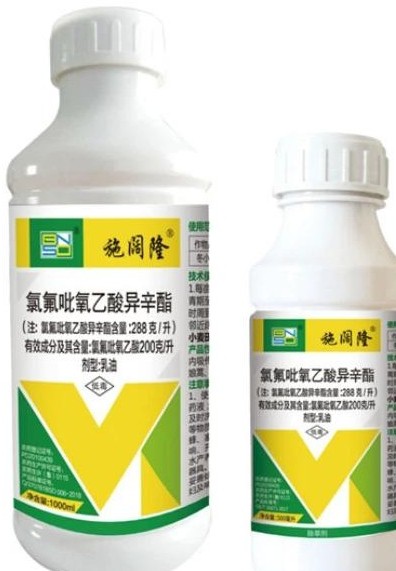
- Fluroxypyr 200 g/L EC — an auxin-mimic, systemic broadleaf herbicide registered for winter wheat annual broadleaf weeds including cleavers, flixweed, lambsquarters and chickweed, at 50–70 mL/667 m² (≈ 750–1050 mL/ha). Export packs: 500 mL × 20 and 1 L × 12 bottles.
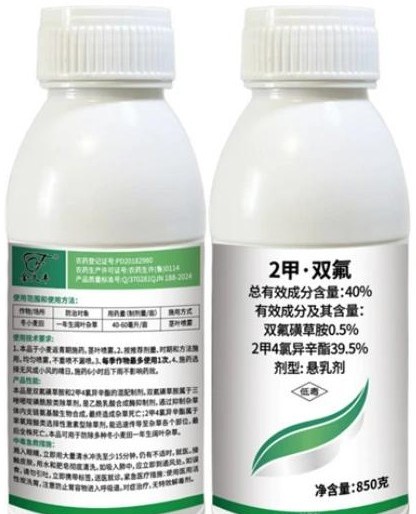
- Florasulam + MCPA-isooctyl 40% SC — a two-mode combination pairing an ALS inhibitor with an auxin, registered for winter wheat annual broadleaf weeds at 40–60 mL/667 m² (≈ 600–900 mL/ha). Export packs: 850 g × 12 and 80 g × 800 sachets.
The two products overlap in target but differ in mechanism: one auxin mode, or ALS plus auxin. That difference is what the rotation in the next section is built on.
Stage-by-Stage Program
| Stage | Weed situation | Product | Label rate (per 667 m²) |
|---|---|---|---|
| Autumn, wheat 3–5 leaf; weeds seedling to rosette (early post-emergence) | Cleavers, flixweed, chickweed, lambsquarters seedlings | Fluroxypyr 200 g/L EC | 50–70 mL |
| Late winter / early spring green-up; overwintered weeds resume growth | Larger overwintered broadleaf weeds and late flushes | Florasulam + MCPA 40% SC | 40–60 mL |
How to run it:
- Scout before each pass. The stage table above assumes the typical pattern; a field walk decides which window actually carries the pressure. In a light-pressure year, one well-timed pass — whichever window the weeds chose — is often enough.
- Treat young weeds. Both products reward the 2-to-6-leaf weed stage with the lower end of the rate range and fast results; overwintered weeds in spring need the upper range and more patience.
- Spray into active growth. Mild temperatures at and after application, actively growing weeds and several rain-free hours afterwards are the three standing conditions for auxin-type performance.
- One broadleaf decision per pass. Do not stack the two products into one tank without a destination-label sanction and a jar test; the program logic is alternation, not accumulation.
Rotation and Resistance Logic
The program alternates mechanisms at two levels:
- Between passes within a season. If fluroxypyr carries the autumn pass, the spring pass (if needed) moves to florasulam + MCPA, adding the ALS mode exactly where pressure persisted.
- Between seasons. Do not let the same mode open every season. Alternating the auxin-only pass with the ALS-plus-auxin pass across years, and capping ALS-inhibitor applications at one per crop cycle, keeps selection pressure off the ALS target — standard resistance-management practice.
- Grass control sits outside this program. Both products are broadleaf-only. Where grass weeds require treatment, use products registered for that purpose locally, and remember that auxin herbicides can antagonize ACCase grass killers in the same tank — sequence the treatments instead.
Integration Beyond the Spray Tank
Herbicides hold the line; the rest of the program reduces the line’s workload:
- Clean seed and machinery. Weed seed moving in contaminated seed lots and harvest equipment re-introduces problems herbicides then have to solve.
- Field edges. Broadleaf weeds seed generously from headlands and boundaries; edge control measurably slows re-infestation of the field centre.
- A competitive crop. Uniform establishment and adequate plant density close the canopy faster and shade out late flushes — cultural control and chemical control compound each other.
- Record what worked. Notes on stage, product, rate and outcome turn next season’s program from a template into a decision.
Destination-Label Guidance
The rates in this program are Chinese registration label rates (667 m² = 1 mu ≈ 1/15 ha; multiply per-mu rates by 15 for per-hectare rates). A Chinese registration does not authorize use elsewhere: importers register products in their own market before sale, and the destination label — its crops, weed spectrum, rates and stage limits — is the only valid instruction for local spraying. BNSD Agro supports buyers with technical documents, COAs and samples for destination registration, and can align pack formats to the local channel.
The complete herbicide range is listed in the herbicides catalogue. For program-size supply, registration support or OEM packing, contact BNSD Agro.
FAQ
Can I tank-mix fluroxypyr with florasulam + MCPA?
The program’s logic is alternation, not accumulation: one broadleaf decision per pass, with the second product reserved for the other window or season. If a local program genuinely requires a combined broadleaf tank mix, it must be sanctioned by the destination label and verified with a jar test before field use.
Which product should go in which window?
The typical pattern: fluroxypyr 200 g/L EC (50–70 mL/667 m²) in the autumn early post-emergence window against seedling broadleaf weeds, and florasulam + MCPA 40% SC (40–60 mL/667 m²) at spring green-up against overwintered weeds. Field scouting overrides the pattern — treat whichever window actually carries the pressure.
Does every field need two passes every season?
No. In a light-pressure year, one pass placed in the window where weeds emerged is usually sufficient; the second product exists for the fields and seasons where scouting shows escapes or a second flush. Two automatic passes every year raise cost and resistance pressure without raising yield.
Are these rates valid outside China?
No — they are Chinese registration label rates, quoted so buyers can compare products on the same basis. In your market, the destination label is the only valid instruction; where the product is not yet registered, BNSD Agro supplies technical documents, COAs and samples to support local registration.
WhatsApp / WeChat: +86 199 0636 5856