
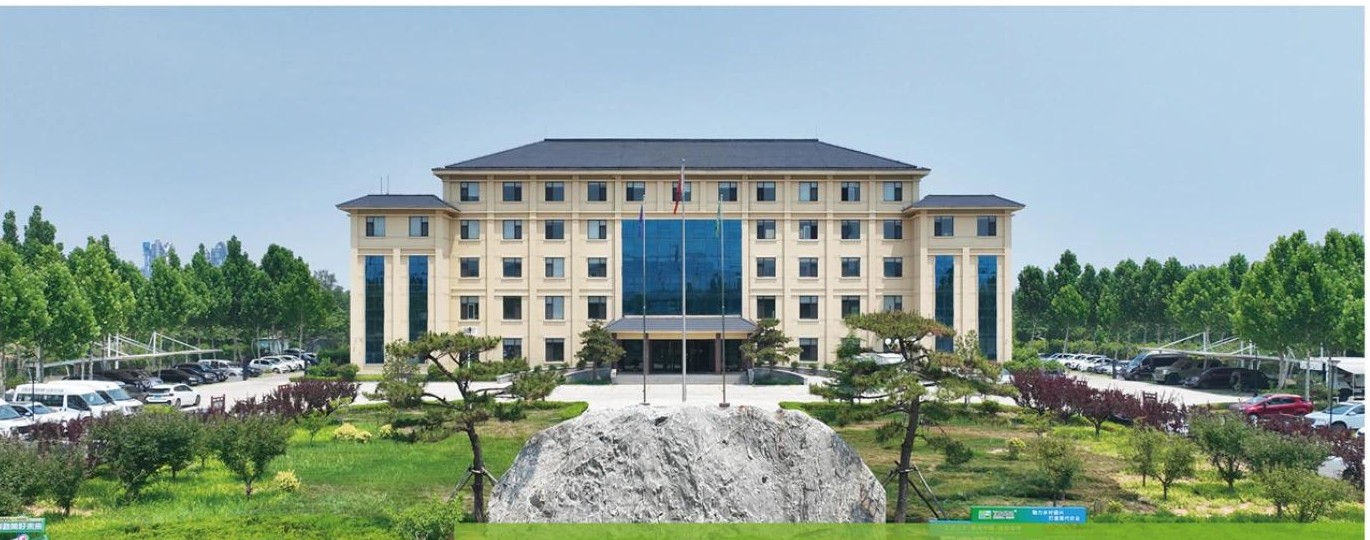
Water dispersible granules (WDG) are often sold on a simple promise: the handling convenience of a dry product with the dispersion behaviour of a liquid. What the label does not show is the process behind that promise. Two WDG products with the same active ingredient and the same declared content can behave completely differently in the tank — one disperses in seconds and stays evenly suspended, the other leaves lumps, dust and grit — and the difference is made in the factory, not in the field. This guide walks through the WDG manufacturing process step by step, explains which controls matter at each stage, shows what process quality looks like once the granules reach a sprayer, and closes with a practical checklist for buyers touring a WDG plant. The illustrations draw on BNSD Agro (Shandong Bainong Sida Biotechnology Co., Ltd.), a Chinese pesticide manufacturer where WDG is a core formulation among more than eight formulation types.
What a WDG Has to Achieve
Before the process, the target. A well-made water dispersible granule must:
- disperse quickly and completely in water, with no lumps and no sieve residue;
- stay in suspension long enough for the sprayer to empty the tank evenly;
- pour and flow as a dry granule with no dust;
- survive storage and transport in humid climates without caking — the classic WDG storage failure discussed in our shelf-life guide.
Each of these properties is built at a specific process step, which is why a WDG supplier is judged on its plant and its process discipline, not only on its laboratory certificates.
The WDG Manufacturing Process, Step by Step
Step 1: Air (Jet) Milling to Fine Particle Size
The active ingredient arrives as a crystalline technical material, far too coarse for a formulation that has to disperse in seconds. In air milling — also called jet milling — compressed air accelerates particles into one another at high velocity, fracturing them to a fine, micron-range particle size without the heat build-up that mechanical milling can introduce. Particle size at this stage drives nearly everything downstream: finer, more uniform particles disperse faster and suspend longer, while a coarse tail shows up later as sediment at the bottom of the spray tank.
Step 2: Blending with Wetting and Dispersing Agents
Fine particles have an enormous surface area and a natural tendency to re-agglomerate. The milled active is therefore blended with a wetting system — surfactants that let water penetrate the granule instantly — and a dispersing system that keeps the particles apart once they are in the tank, along with fillers and disintegration aids. The blending stage must deliver homogeneity at full batch scale: content uniformity between the first bag and the last bag of a production run is a direct function of how well this step is controlled.
Step 3: Granulation
The free-flowing powder is then bound into granules. Several granulation routes exist — extrusion, spray drying, fluid-bed agglomeration among them — and each plant commits to the technology that suits its products. What matters to the buyer is not the name of the technology but the result: a granule that breaks apart quickly in water while remaining mechanically strong enough to survive bagging, stacking, transport and humidity.
Step 4: Drying
Granulation leaves moisture in the granule that must be removed under controlled temperature. Too much heat can stress sensitive actives; too little drying leaves granules that cake into a solid block after a few weeks in a humid warehouse. Drying curves and moisture limits are process-critical parameters, and a factory that cannot show moisture control in its QC records is a factory to be cautious about.
Step 5: Screening and Batch Release
After drying, the granules are screened to the target size fraction; fines are recovered and oversize is reworked. Samples of the finished batch then go to the laboratory for the physicals that define WDG quality — dispersibility, suspensibility, wet sieve residue, moisture — alongside the active content assay. At BNSD Agro, every production batch is tested by HPLC or GC against the product’s registration standard and released only after it passes, before shipment (company information).
| Process step | What it controls | Field symptom when done poorly |
|---|---|---|
| Air milling | Particle size — dispersion speed, suspension | Grit settling in the tank, slow dose delivery |
| Blending | Agent distribution, content uniformity | Lumps on pouring, variation between bags |
| Granulation | Granule strength and disintegration | Dust when pouring, or granules that will not break down |
| Drying | Moisture and storage stability | Caking in the bag after humid storage |
| Screening and release | Size fraction, verified physicals | Sieve residue, inconsistent batches |
What It Takes to Run WDG at Scale
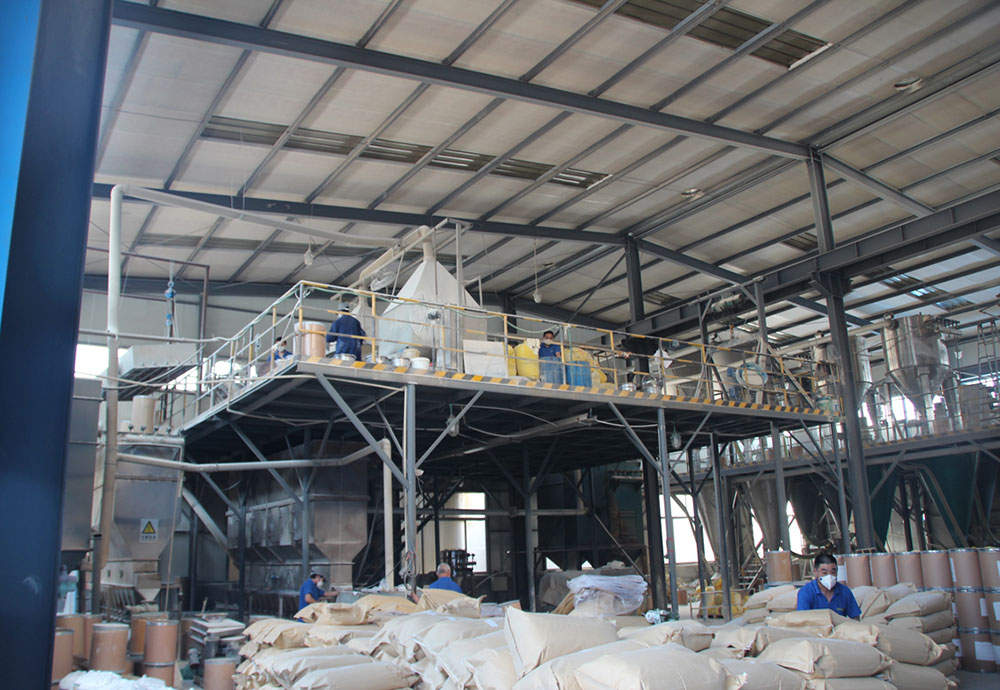
Air milling is capacity-hungry equipment, and WDG is a formulation category where scale and consistency feed each other. BNSD Agro operates six air-mill lines with around 20 tonnes of daily milling capacity and has brought a new 8,000-tonne-per-year digitalized WDG plant on line (company information). For a buyer, the significance is twofold. First, WDG is not a formulation a trading intermediary can reliably “arrange” — it requires real plant behind it. Second, capacity is what keeps lead times honest in peak season, when a distributor’s entire season depends on the container shipping on schedule.
What Process Quality Shows in the Field
Three properties, all visible to anyone with a bucket and a sprayer, trace straight back to the process:
- Dispersion speed. A well-made WDG disperses with light agitation, without clumping or floating crust. Granules that sit at the bottom or form lumps point to a granulation or drying problem, or a poorly matched wetting system.
- Dust-free handling. Pouring should be clean. Dust means weak granules from the granulation step, or excessive fines that screening should have removed — and dust is an operator safety issue as much as a quality signal.
- Suspension stability. After standing, a quality WDG re-disperses with brief agitation and leaves minimal residue in the tank. Poor suspensibility traces back to coarse milling or an under-dosed dispersing system at the blending stage.
This is why a simple dispersion test on a sample, as described in our pesticide sample testing guide, tells you more about a WDG factory than any brochure.
A Buyer’s Tour Checklist
When visiting a WDG plant — or asking an audit firm to do it for you — these are the points worth seeing with your own eyes:
- Air-mill lines actually running, and what particle size they target.
- Blending scale: batch size versus mixer capacity, and how homogeneity is verified.
- Moisture control: drying parameters and the moisture specification in QC.
- Physical testing in the laboratory — ask to see dispersibility and suspensibility results for a current batch, not only content assays.
- Batch traceability from the number printed on the pack back to the production record.
BNSD Agro welcomes plant visits and third-party inspections, including SGS or buyer-arranged inspections before loading (company information). The WDG products built on this process — from thiamethoxam 70% WDG to emamectin benzoate 5% WDG — are on the products page, and company background is on the about page.
FAQ
Why choose WDG over WP or SC?
Compared with wettable powder (WP), WDG is dust-free, pours cleanly, doses more accurately and stores better in humid climates. Compared with suspension concentrate (SC), WDG avoids freeze-thaw damage and ships lighter because it carries no water. The trade-offs are a more demanding manufacturing process and typically a higher price than WP — which is exactly why process quality matters.
What does air milling actually contribute to WDG quality?
Particle size is the foundation of WDG performance. A micron-range, uniformly milled active disperses in seconds, suspends stably and delivers its dose evenly; a coarse or wide-distribution mill base shows up in the field as sediment, sieve residue and uneven results. Air milling achieves this without heat stress on the active.
How can I test a WDG sample myself?
Basic tests need nothing exotic: pour a measured dose into water in a clear container and time how long full dispersion takes; let it stand and check how readily it re-disperses with brief agitation; pour the suspension through a sieve and inspect residue. These simple observations, done side by side across suppliers’ samples, separate well-made granules from weak ones before you commit to an order.
Does the new digitalized WDG plant matter to buyers?
It matters in two practical ways. Digitalized process control means parameters such as milling, blending and drying are recorded and repeatable batch to batch, which is what consistency is made of. And the added 8,000-tonne-per-year capacity means WDG orders are less likely to queue behind other customers when your season peaks.
WhatsApp / WeChat: +86 199 0636 5856