
Few cucurbit diseases punish a wet season the way anthracnose does. On watermelon, the lesions arrive quietly on leaves, then find the vine and finally the fruit — and a field that looked market-ready in week one can lose most of its grade in week three. Importers serving cucurbit-growing regions therefore keep asking Chinese manufacturers for one specific tool: difenoconazole 10% WDG, registered in China for watermelon anthracnose at 40–60 g/667 m². This guide explains how the disease builds, what the registration covers, why the water-dispersible-granule format suits cucurbit programs, and how to sequence the product so it keeps working season after season. The full portfolio sits on the fungicides catalogue, and samples or registration documents are available through the contact page.
How Anthracnose Builds in a Cucurbit Field
Anthracnose of cucurbits is caused by Colletotrichum species, and its epidemiology explains why it feels like it appears overnight:
- Seed- and debris-borne carryover. The pathogen survives on infected crop residue and contaminated seed, so fields with a cucurbit history start the season with inoculum already in place.
- Splash-driven spread. Rain and overhead irrigation move spores from lesion to leaf and from leaf to fruit. Every wetting event is a dispersal event.
- Warm, humid infection windows. Leaf wetness combined with warm temperatures lets lesions expand quickly; under continuous moisture, characteristic pinkish spore masses form in the lesions and the cycle repeats within days.
- Fruit-phase vulnerability. As the canopy closes and fruit sit on the ground, splash from the soil surface reaches the rind directly — which is why late-season fruit rot is the costliest phase.
The practical conclusion: fungicide programs for anthracnose must start protectively, before the fruit set, and keep coverage on through the humid weeks. Waiting for visible fruit lesions means spraying behind the epidemic.
The Registered Tool: Difenoconazole 10% WDG
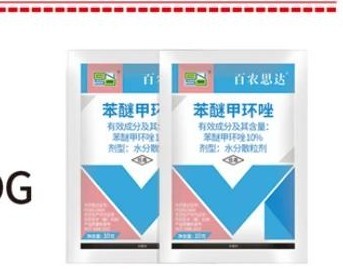
On the Chinese registration held by BNSD Agro (Shandong Bainong Sida Biotechnology Co., Ltd.), difenoconazole 10% WDG carries two label uses:
| Product | Registered target (Chinese label) | Label rate |
|---|---|---|
| Difenoconazole 10% WDG | Watermelon anthracnose | 40–60 g/667 m² |
| Difenoconazole 10% WDG | Sesame stem rot | 50–70 g/667 m² |
All rates are Chinese registration label rates; 667 m² equals one mu, roughly 1/15 hectare, so 40–60 g/667 m² converts to roughly 600–900 g/ha for per-hectare planning. In your own market the destination label governs — registration scope and rates differ country by country, and the numbers above are a positioning reference, not a spray recipe for another jurisdiction.
Difenoconazole is a triazole in FRAC group 3. Its value against anthracnose comes from the family profile: systemic, xylem-mobile movement that reaches new growth, plus curative activity that stops infections which have already penetrated. That three-phase profile — protect, cure, suppress established lesions — is why triazoles anchor anthracnose programs instead of sitting in the tank as insurance.
Why the WDG Format Suits Cucurbit Work
Formulation choice is not cosmetic in this crop, and the WDG format carries three practical advantages:
- Dust-free handling. Unlike wettable powders, water-dispersible granules do not throw dust during measuring and mixing — a real difference for applicators handling product repeatedly through a long cucurbit season.
- Instant dispersing in the tank. The granules disperse immediately in water with minimal agitation, which matters in the larger tank mixes and hard water conditions common in cucurbit districts.
- Sachet-friendly packing for smallholder retail. Granule formats divide cleanly into small sachets, which is how cucurbit fungicides move through village retail channels in most producing regions.
Buyers evaluating a difenoconazole WDG should still apply the physical checks: dispersibility in a glass of water at field temperature, no hard clumping after storage, and content released by HPLC against the registration standard. At BNSD Agro every batch is analysed by HPLC or GC and released against the registration standard before shipment (company practice).
Building the Season Program
A difenoconazole program for watermelon anthracnose works when it is sequenced, not repeated:
- Start at the protectant window. Begin applications before fruit set, when lesions are absent or marginal — the curative strength of a triazole is a safety margin, not an invitation to start late.
- Cap group 3 applications. Under FRAC guidance the DMI family carries a medium resistance risk, so limit total and consecutive group 3 sprays per season and rotate with unrelated modes of action — QoI products (FRAC 11) or multi-site protectants (FRAC M).
- Use registered mixtures to deliver the rotation in one pass. Where labels allow, a QoI + triazole mixture applies two modes of action in the same spray and lowers selection pressure on either target site.
- Manage the environment alongside the chemistry. Rotate away from continuous cucurbit cropping where possible, remove infected debris, orient rows and irrigation to shorten leaf-wetness periods, and avoid working fields while foliage is wet, because mechanical spread moves spores further than rain splash alone.
Applied this way, difenoconazole 10% WDG covers the high-risk fruiting window while the rotation discipline keeps the molecule effective for future seasons.
FAQ
What is the label rate of difenoconazole 10% WDG on watermelon?
On the BNSD Agro Chinese registration, watermelon anthracnose at 40–60 g/667 m² (about 600–900 g/ha). The same product is registered for sesame stem rot at 50–70 g/667 m². Your destination label governs the uses and rates in your own market.
When should anthracnose spraying start on watermelon?
Before fruit set and before lesions appear. Anthracnose spreads by rain splash and expands fastest under warm, humid conditions, so a program that waits for visible fruit damage is already behind the epidemic.
Why choose a WDG instead of a wettable powder?
Water-dispersible granules are dust-free to handle and disperse instantly in the tank, giving cleaner mixing and less operator exposure through a long season — with the same active delivered at the same label rate.
Can difenoconazole be used all season on its own?
No. Follow FRAC guidance for group 3: cap total and consecutive DMI applications per season and rotate with unrelated modes of action, or use a registered QoI + triazole mixture so the rotation happens within each spray.
WhatsApp / WeChat: +86 199 0636 5856