
Nearly every foliar fungicide enquiry to a Chinese manufacturer lands in one of two families: triazoles or strobilurins. They are the two workhorse classes of modern leaf-disease control, they are constantly quoted against each other, and they are most valuable together. This guide compares the two classes as they actually behave in the field — curative systemics against protectant QoIs — lists the triazole and strobilurin products registered by BNSD Agro (Shandong Bainong Sida Biotechnology Co., Ltd.), and explains why the registered mixtures between the two classes have become the default program architecture. The complete range sits on the fungicides catalogue, and samples are available through the contact page.
Two Classes, Two Working Styles
The practical differences between FRAC group 3 and FRAC group 11 come down to when each is applied and what each does after application:
| Aspect | Triazoles (FRAC 3) | Strobilurins (FRAC 11) |
|---|---|---|
| Mode of action | Sterol biosynthesis inhibition (DMI) | Respiration inhibition at the Qo site |
| Movement | Systemic, xylem-mobile | Translaminar, protectant-led |
| Curative activity | Strong — stops infections already underway | Limited — strongest before infection |
| Extra field effect | Eradicant suppression of established lesions | Physiological greening effect, greener leaves longer |
| Resistance risk | Medium (DMI shifts develop slowly) | High (group 11 is resistance-critical, use limits apply) |
| Best program role | Anchoring key infection windows | Protective cover and canopy green-keeping |
Both classes are single-site chemistries, which is precisely why neither should be run alone all season — and why they pair so naturally with each other. The triazole supplies the curative depth, the strobilurin supplies the protective shield and the green leaf duration, and each carries a different resistance profile than the other.
The Triazole Line (FRAC 3)
BNSD Agro’s triazole registrations cover field crops, orchards and specialty crops:
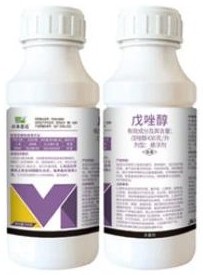
- Tebuconazole 430 g/L suspension concentrate (SC) — wheat powdery mildew at 15–25 mL/667 m², Sichuan-pepper rust and apple Alternaria leaf spot at dilution sprays.
- Difenoconazole 10% water-dispersible granule (WDG) — watermelon anthracnose at 40–60 g/667 m² and sesame stem rot at 50–70 g/667 m².
- Propiconazole 250 g/L emulsifiable concentrate (EC) and flusilazole 400 g/L EC — banana leaf spot at 500–1000× dilution.
All rates are Chinese registration label rates; the destination label governs uses and rates in your own market.
The Strobilurin Line (FRAC 11)
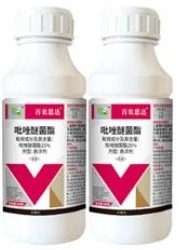
The QoI line is led by pyraclostrobin 25% SC, registered for wheat Fusarium head blight at 30–40 mL/667 m² and banana leaf spot at 1000–3000×. Its program value comes from the two properties in the table above: protectant-led activity placed ahead of the infection window, and the greening effect that keeps canopy working through the fill period — the reason strobilurin applications so often show up as “greener for longer” in the field even where disease pressure is only moderate.
The Mixtures: Two Modes in One Pass
Because the classes complement each other, the registered premixes are where both actives perform best. Three built-in combinations sit in the BNSD Agro range:
- Pyraclostrobin + epoxiconazole 17% SC — soybean leaf spot at 50–60 mL/667 m², wheat powdery mildew at 40–60 mL/667 m², maize northern leaf blight at 40–60 mL/667 m². The classic QoI + triazole pairing: protectant plus curative across three crop labels.
- Pyraclostrobin + tebuconazole 30% SC — wheat powdery mildew and rust at 20–40 mL/667 m², pepper anthracnose at 60–70 mL/667 m². Built for the cereal heading window, where one pass must both protect and cure.
- Pyraclostrobin + metiram 60% WDG — apple Alternaria leaf spot at 1500–2000× and Chinese kale/broccoli downy mildew at 50–60 g/667 m². Here the QoI pairs with a multi-site protectant (FRAC M), a different but equally deliberate resistance strategy.
Three rules make the class decision simple in practice. Start protective sprays with the strobilurin side of the program before infection windows. Bring the triazole in when lesions threaten or when the window carries curative risk. And prefer the registered premix over tank-mixing, because a premix delivers a fixed, tested ratio of both modes at a consistent formulation quality. At BNSD Agro every batch is analysed by HPLC or GC and released against the registration standard before shipment (company practice).
FAQ
Which is stronger, a triazole or a strobilurin?
Neither in absolute terms. Triazoles are systemic and curative — the right tool when infection has started. Strobilurins are protectant-led with a greening benefit — the right tool ahead of the infection window. Registered mixtures deliver both behaviors in one pass.
What triazole fungicides does BNSD Agro offer?
Tebuconazole 430 g/L SC, difenoconazole 10% WDG, propiconazole 250 g/L EC and flusilazole 400 g/L EC, plus epoxiconazole inside the 17% pyraclostrobin + epoxiconazole SC premix — each with its own Chinese label uses and rates.
Why do strobilurins have stricter resistance limits?
FRAC classifies group 11 as resistance-critical: resistance to QoI chemistry can appear abruptly under repeated solo use. Limit the number of group 11 applications per season, always alternate or mix with other modes of action, and favor premixes.
Should I tank-mix a triazole and a strobilurin myself, or buy a premix?
A registered premix fixes the ratio of both actives at a tested formulation quality and simplifies resistance management. Where a registered premix matches your target, it is the more reliable route; tank-mixing remains an option where labels permit and local guidance supports it.
WhatsApp / WeChat: +86 199 0636 5856