
Few insecticides generate as many buyer enquiries as thiamethoxam. Field teams ask which formulation to choose for a given crop; procurement teams ask which registrations actually back those formulations; and both ask how to judge the quality of a 70% WDG before it ships. This guide answers all three questions from the standpoint of a Chinese manufacturer, using the registered uses and label rates on file at BNSD Agro (Shandong Bainong Sida Biotechnology Co., Ltd.).
What Is Thiamethoxam?
Thiamethoxam is a second-generation neonicotinoid insecticide classified in IRAC group 4A. Like all group 4A actives it works on the insect nervous system, binding to nicotinic acetylcholine receptors and disrupting signal transmission. Three properties explain its wide adoption:
- Systemic activity. The molecule is xylem-mobile. Taken up by roots or through seed, it moves into new growth, protecting tissue that emerges after treatment — the reason it performs in drenches and seed treatments as well as sprays.
- Contact and stomach action. On foliage it kills both by contact and when larvae and sucking pests feed on treated plant surfaces.
- Formulation flexibility. The chemistry is registered across foliar sprays, seed treatment, root drenches and granules, which is why a manufacturer’s thiamethoxam range typically spans several formulation types rather than one.
Mammalian toxicity is comparatively low — a well-established property of the group — but the environmental profile demands care: group 4A actives are highly toxic to bees and aquatic organisms, a point that shapes application practice below.
The Formulation Ladder: WDG, SC and Seed-Treatment SC
In China, thiamethoxam is registered as a ladder of contents and formulation types. BNSD Agro’s portfolio (company information) spans five single-active registrations plus combination products:
| Formulation | Registered use (Chinese label) | Label rate | Pack sizes |
|---|---|---|---|
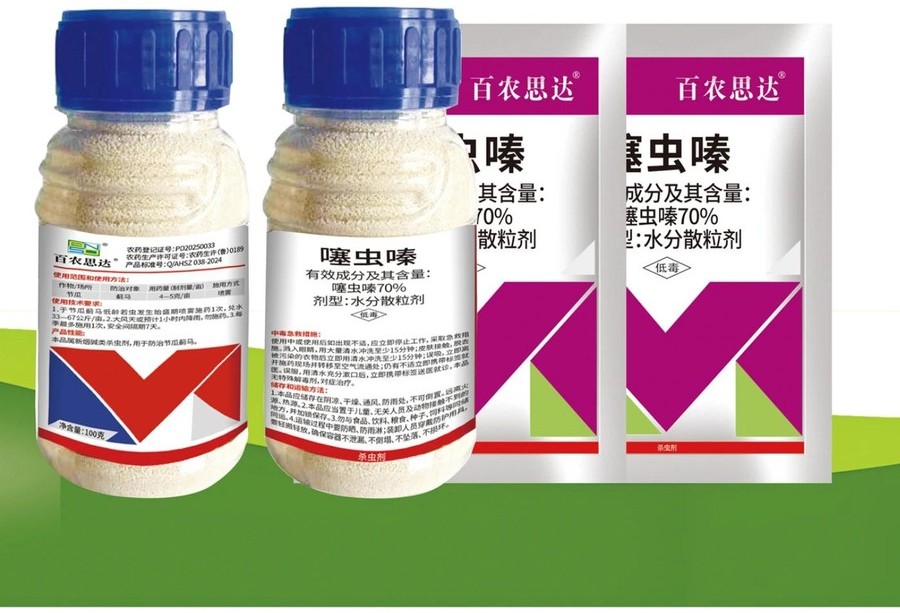
| 70% WDG | Chieh-qua thrips | 4–5 g/667 m² | 4 g × 1000 sachets; 100 g × 100 sachets; 100 g × 80 jars; 1 kg × 10 bags; 25 kg drum |
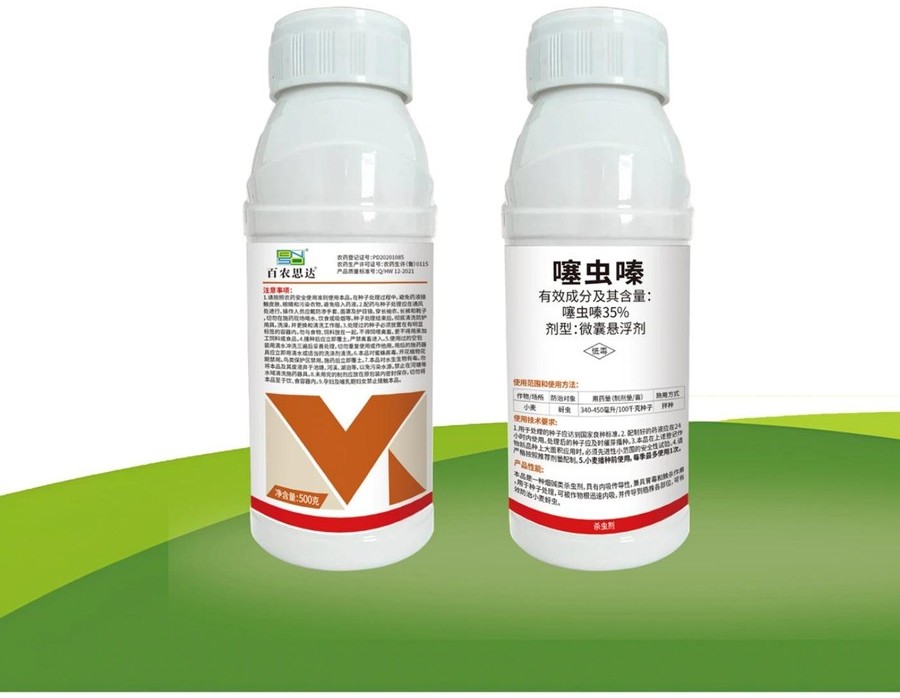
| 35% SC (seed treatment) | Wheat aphids, seed dressing | 340–450 mL/100 kg seed | 100 g × 80; 200 g × 40; 500 g × 20; 1 kg × 12 bottles |
| 30% SC | Planthopper and other sucking-pest uses | per label | — |
| 25% WDG | Rice planthopper, mirid bug, thrips, root maggots | see section below | 10 g × 800 through 25 kg drum |
| 3% granule (GR) | Sugarcane stem borer | per label | 2.5 kg × 6 bags |
All rates quoted here are Chinese registration label rates (667 m² = one mu, 1/15 ha). In your own market, always follow the destination-market label — registration scopes and rates differ by country.
Why the 70% WDG is the exporter’s workhorse
A water-dispersible granule can carry the highest active content of the common foliar formulations, which means less freight per kilogram of active and fewer packs per hectare. WDG also stores well: it contains no water, so it is not damaged by freezing, and modern air-milled granules are essentially dust-free. The trade-off is that quality lives in the dispersion — a poorly made granule either cakes in the bag or fails to disperse evenly in the tank. That is the single most important thing to test when sourcing (see checklist below).
Why seed treatment uses an SC
Seed treatment needs a film, not a spray deposit. The 35% SC is formulated to coat wheat seed uniformly at 340–450 mL per 100 kg seed, adhere to the seed surface without rubbing off, and flow steadily through treating equipment. Using a foliar WDG as a substitute seed treatment is not just off-label — the physical behaviour on seed is entirely different. This is why buyers sourcing thiamethoxam seed treatment should insist on a formulation registered and built for the purpose.
The 25% WDG: One Registration, Five Use Patterns
The 25% WDG illustrates how one formulation can serve very different delivery methods on the Chinese label:
- Rice planthopper — 3–8 g/667 m², foliar spray;
- Winter jujube mirid bug — 4000–5000× dilution spray;
- Welsh onion thrips — 10–20 g/667 m² spray;
- Garlic root maggot — 180–360 g/667 m², drench;
- Chive maggot — 180–240 g/667 m², root drench.
Note the span: the drench rates run roughly forty to seventy times the foliar rate per mu. Same molecule, completely different dose — which is why the label of the destination market, not a rule of thumb, must decide how a product is positioned.
Resistance Management: Rotate Away from Group 4A
Neonicotinoid resistance is the most common reason thiamethoxam “stops working” in the field, and the standard IRAC guidance for group 4A applies:
- Do not follow a group 4A application with another group 4A product in the same pest generation.
- Limit the number of 4A applications per crop cycle and rotate with unrelated modes of action (IRAC groups 1, 3, 6, 28, for example, as registered locally).
- Where planthopper or whitefly populations are known to carry 4A resistance, position the product against susceptible targets and monitor efficacy.
Mixtures are part of this logic. Pairing thiamethoxam (4A) with a pyrethroid such as lambda-cyhalothrin (3A) combines systemic residual with fast knockdown, and both actives should remain effective where neither group has been overused.
Pollinator timing. Group 4A actives are acutely toxic to bees. Standard practice everywhere: never spray a flowering crop, spray in the evening when pollinators are least active, prevent drift to flowering weeds and neighbouring crops, and follow the bee-protection provisions of the destination-market label.
Sourcing a Thiamethoxam 70% WDG: Buyer Checklist
For importers and formulators, six checks separate a professional WDG from a repacked one:
- Content accuracy. Every batch should ship with a certificate of analysis from HPLC, with declared content matching the registration certificate. Vague “70% or higher” claims are a red flag — content is a registered value, not a marketing range.
- Dispersion and suspensibility. Granules should disperse quickly with light agitation and hold a uniform suspension for the duration of spraying.
- Dust-free granule. Excessive fines mean handling loss, operator exposure and a product that bridges in the pack.
- Storage behaviour. No caking or hardening after compression; stable through hot and cold storage typical of the shipping route.
- Pack ladder. Small sachets for smallholder retail, 1 kg bags for farm cooperatives, 25 kg drums for local formulators and blenders. Confirm the full ladder in the contract.
- Documents. The pesticide registration certificate, production licence and batch traceability should all be in the supplier’s own name and match the goods.
The BNSD Agro Thiamethoxam Line
Beyond the single-active formulations above, BNSD Agro’s thiamethoxam portfolio (company information) includes:
- 22% thiamethoxam + lambda-cyhalothrin SC, marketed under the name “Ruika” — wheat aphids 5–7 mL/667 m² and tea leafhopper 5–7 mL/667 m²;
- 5% bifenthrin + thiamethoxam SC — wheat aphids 30–50 mL/667 m²;
- A co-pack of bifenthrin emulsifiable concentrate (EC) + thiamethoxam 25% WDG covering jujube mirid bug, onion and garlic soil pests and rice planthopper programs.
The full export range of 43 insecticide and acaricide SKUs is listed in the insecticides and acaricides catalogue, with the complete 99-SKU portfolio on the products page. For samples, registration documents or OEM packing, contact BNSD Agro.
FAQ
What is thiamethoxam best used for?
Sucking pests — aphids, planthoppers, thrips, leafhoppers and mirid bugs — across foliar, seed-treatment, drench and granule use patterns. On the Chinese labels held by BNSD Agro, registered targets include chieh-qua thrips (70% WDG), wheat aphids (35% SC seed treatment), rice planthopper and root maggots (25% WDG) and sugarcane stem borer (3% GR). Always follow the destination-market label.
Can a 70% WDG be used as a seed treatment?
No. Seed treatment requires the formulation registered for that purpose — here the 35% SC, designed to coat seed evenly and adhere without dusting off. Physical behaviour on seed is a formulation property, not a content property.
What is the difference between thiamethoxam 25% WDG and 70% WDG?
Content, and therefore the registered use set. The 70% WDG is a high-content foliar product (chieh-qua thrips on the Chinese label); the 25% WDG carries the broader crop list, including foliar, dilution and root-drench uses with very different rates.
How should thiamethoxam be rotated?
With products from other IRAC groups — group 4A should not follow group 4A on the same pest generation, and the number of 4A applications per crop cycle should be capped. Mixtures with other modes of action, such as the 22% thiamethoxam + lambda-cyhalothrin SC, are one rotation-friendly option.
WhatsApp / WeChat: +86 199 0636 5856