
Tebuconazole is one of the most frequently requested triazole fungicides in enquiries to Chinese manufacturers, and the reasons are not hard to find: it combines systemic movement with protectant, curative and eradicant activity, and it is registered in China across field crops, orchards and specialty crops at the same time. This guide sets out the registered uses and label rates for the tebuconazole portfolio held by BNSD Agro (Shandong Bainong Sida Biotechnology Co., Ltd.), the combination products built around the molecule, and the physical checks that decide whether a suspension concentrate is worth shipping. The complete range sits on the fungicides catalogue, and samples or registration documents are available through the contact page.
What Is Tebuconazole?
Tebuconazole is a triazole fungicide in FRAC group 3, the DMI (demethylase inhibitor) family. Like other group 3 actives it blocks C14-demethylation in fungal sterol biosynthesis, a single-site mode of action that disrupts membrane formation in growing fungal tissue. Three properties account for its working breadth:
- Systemic, xylem-mobile activity. Applied to foliage, tebuconazole is taken up and moves upward in the plant’s water stream, reaching new growth and protecting tissue that was never directly sprayed.
- Three-phase activity: protect, cure, eradicate. Unlike purely protectant materials, a DMI can stop an infection that has already started and suppress established lesions. That is why triazoles anchor disease programs at key windows rather than sitting in the tank as insurance only.
- Rate flexibility across crop types. Chinese registrations express field-crop rates per 667 m² and orchard rates as dilution sprays — on the same molecule, in the same product.
Under FRAC guidance the DMI family carries a medium resistance risk: resistance shifts develop more slowly than in the high-risk groups, but they do develop, which is why the rotation discipline in this guide matters.
Registered Uses and Chinese Label Rates
| Product | Registered target (Chinese label) | Label rate |
|---|---|---|
| Tebuconazole 430 g/L SC | Wheat powdery mildew | 15–25 mL/667 m² |
| Tebuconazole 430 g/L SC | Sichuan-pepper rust | 3000–5000× dilution |
| Tebuconazole 430 g/L SC | Apple Alternaria leaf spot | 5000–6000× dilution |
All rates are Chinese registration label rates; 667 m² equals one mu, roughly 1/15 hectare. In your own market the destination label governs — registration scope and rates differ country by country, and the numbers above are a positioning reference, not a spray recipe for another jurisdiction.
Note the two rate expressions. A field crop such as wheat takes a per-area rate (15–25 mL per mu), which converts directly into per-hectare program planning. Perennial targets — Sichuan-pepper rust and apple Alternaria leaf spot — are labelled as dilution sprays (3000–6000×), because orchard work is planned in spray volume per tree rather than per mu. Export buyers should expect both expressions on the Chinese source label and translate both into destination-label terms before quoting.
Packaging for the 430 g/L SC runs the standard export ladder: 10 g × 800 sachets for smallholder retail up to 1 kg × 12 bottles for farm-scale programs.
Tebuconazole Combination Products
Two built-in combinations extend the molecule’s reach, each registered as a separate product:
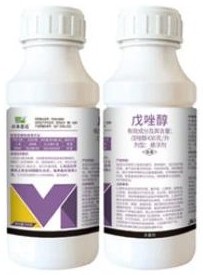
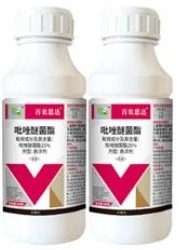
30% pyraclostrobin + tebuconazole SC. A QoI (FRAC 11) paired with the triazole (FRAC 3) — a respiration inhibitor plus a sterol-inhibition partner, two modes of action in one pass. Chinese label uses: wheat powdery mildew and rust at 20–40 mL/667 m², and pepper anthracnose at 60–70 mL/667 m². This is the classic “one spray, two sites” construction used around the wheat heading window, and it is also the most rotation-friendly way to deploy either active alone.
400 g/L tebuconazole + prochloraz oil-in-water emulsion (EW). The triazole paired with prochloraz, a second sterol-biosynthesis inhibitor of the imidazole type with its own spectrum strengths. Chinese label uses: wheat head scab (Fusarium head blight) at 30–40 mL/667 m², and banana leaf spot at 1000–3000× dilution. FHB is a flowering-window disease where coverage and timing decide everything, so a twin-DMI formulation aimed specifically at that window is a deliberate registration choice, not an accident.
Rotation: Keeping FRAC 3 Working
Because tebuconazole is a single-site systemic, its long-term value depends on how it is sequenced. The standard FRAC guidance for group 3 products applies:
- Cap the number of group 3 applications per crop cycle. Treat tebuconazole as a limited-use tool inside a program, not as a repeat spray.
- Rotate with unrelated modes of action — QoI products (FRAC 11), multi-site protectants (FRAC M) or a registered mixture such as the 30% pyraclostrobin + tebuconazole SC, which delivers the rotation in the same pass.
- Monitor performance on powdery mildew targets, where DMI sensitivity shifts are most often reported, and adjust the program rather than simply raising the dose.
Sourcing a Tebuconazole SC: Buyer Checklist
A suspension concentrate is a solid active dispersed in a liquid phase, so its quality is physical as much as chemical. Five checks separate a professional SC from a repacked one:
- No crystallisation. The active must stay evenly dispersed through the hot and cold cycles of the shipping route. Recrystallised particles grow larger, scorch leaves, block nozzles and never deliver registered efficacy.
- Suspensibility after dilution. The diluted suspension should stay uniform for the whole spray job with only gentle agitation — no hard bottom sediment and no layering.
- Content released by HPLC against the registration standard. Content is a registered value, not a marketing range. At BNSD Agro every batch is analysed by HPLC or GC and released against the registration standard before shipment (company practice).
- Viscosity and pouring behaviour. An over-thick SC pours badly, foams in the tank and short-weights on the filling line.
- Documents and pack ladder. Pesticide registration certificate, production licence and batch traceability in the supplier’s own name, with retail sachets through bulk packs agreed in the contract.
FAQ
What is tebuconazole 430 g/L SC registered for?
On the BNSD Agro Chinese registrations: wheat powdery mildew at 15–25 mL/667 m², Sichuan-pepper rust at 3000–5000× and apple Alternaria leaf spot at 5000–6000×. Which of these uses applies in your market is decided by the destination label.
Can tebuconazole be bought as a mixture?
Yes. Two registered combinations extend the molecule: 30% pyraclostrobin + tebuconazole SC for wheat powdery mildew and rust plus pepper anthracnose, and 400 g/L tebuconazole + prochloraz EW for wheat head scab and banana leaf spot.
How often can tebuconazole be used in one season?
Follow FRAC guidance for group 3: limit total and consecutive group 3 applications per crop cycle, rotate with other mode-of-action groups, and use registered mixtures to cut selection pressure on the single target site.
What should buyers check when sourcing a tebuconazole SC?
No crystallisation through temperature cycling, suspensibility after dilution, HPLC content release against the registration standard, sensible viscosity, a complete pack ladder and clean documents — the checklist above.
WhatsApp / WeChat: +86 199 0636 5856