
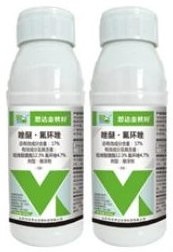
Leaf spot diseases are the quiet yield tax on soybean. Frogeye-style lesions, brown spot and related foliar diseases build through the vegetative stages and do their worst damage after pod fill begins — exactly the window when the crop can least afford to lose canopy. Chinese registrars have answered with a purpose-built combination: pyraclostrobin + epoxiconazole 17% SC, registered for soybean leaf spot at 50–60 mL/667 m², with wheat powdery mildew and maize northern leaf blight on the same label. This guide walks through what the registration covers, why the QoI + triazole construction has become the default architecture for leaf-spot programs, and the application notes that decide whether the product delivers. Samples and technical documents are available through the contact page, and the wider range sits on the fungicides catalogue.
The Registered Uses: One Product, Three Crops
On the Chinese registration held by BNSD Agro (Shandong Bainong Sida Biotechnology Co., Ltd.), the 17% SC carries three label targets:
| Product | Registered target (Chinese label) | Label rate |
|---|---|---|
| Pyraclostrobin + epoxiconazole 17% SC | Soybean leaf spot | 50–60 mL/667 m² |
| Pyraclostrobin + epoxiconazole 17% SC | Wheat powdery mildew | 40–60 mL/667 m² |
| Pyraclostrobin + epoxiconazole 17% SC | Maize northern leaf blight | 40–60 mL/667 m² |
All rates are Chinese registration label rates; 667 m² equals one mu, roughly 1/15 hectare. In your own market the destination label governs — registration scope and rates differ country by country, and these figures are a positioning reference, not a spray recipe for another jurisdiction.
Three things stand out for export buyers. First, the soybean rate sits slightly above the cereal rates, reflecting the denser canopy and harder spray penetration in broadleaf rows. Second, all three targets are foliar diseases that respond to the same two-mode architecture. Third, a single formulation covering bean, cereal and maize windows gives distributors a genuine rotation product across a mixed farming area rather than a single-crop specialist.
Why QoI + Triazole Is the Standard Leaf-Spot Architecture
The 17% SC pairs a strobilurin (FRAC 11) with a triazole (FRAC 3), and the pairing works because the two families cover each other’s weaknesses:
- Pyraclostrobin, the QoI partner. FRAC 11 chemistry inhibits fungal respiration at the Qo site. It is protectant-led — strongest when applied ahead of infection — and it contributes the well-documented physiological greening effect: greener leaves held longer, which in practice supports the fill period.
- Epoxiconazole, the triazole partner. FRAC 3 chemistry blocks sterol biosynthesis. It is systemic and curative, so it stops infections that have already penetrated and suppresses established lesions the strobilurin cannot reach.
- Two target sites, one pass. Resistance built against a single-site active develops fastest when that active is used alone and repeatedly. A built-in mixture halves that exposure by design: any resistant escape must defeat both modes in the same spray.
This is why QoI + triazole premixes have become the default foliar architecture across soybean, wheat and maize programs worldwide — not marketing, but complementary modes of action aimed at the same lesion types.
Application Notes That Decide Performance
A premix only delivers when the spray job delivers. Four notes matter most on soybean:
- Time the first pass at early lesions. Spray when the first leaf-spot lesions appear or disease models flag the first infection window — early enough for the QoI to protect, late enough that the triazole has lesions to stop. On soybean this usually lands around the flowering window when canopies close and humidity under the canopy rises.
- Coverage is the product. Leaf spot lives in the middle and lower canopy, so plan water volume for penetration, not just wetting. A suspension concentrate should stay uniform in the tank with gentle agitation through the whole job.
- Two passes beat one heavy pass. A second application 10–14 days later keeps protection on through pod fill, where the real yield sits. Leave at least the label interval between sprays.
- Respect the mode-of-action count. Even with a built-in mixture, cap total group 11 and group 3 applications per season per FRAC guidance, and rotate toward unrelated groups or multi-site protectants in subsequent passes.
Sourcing Notes for Importers
Buyers quoting this premix should check the physical quality that an SC lives or dies by: no crystallisation through temperature cycling, suspensibility after dilution, viscosity that pours and fills cleanly. At BNSD Agro every batch is analysed by HPLC or GC and released against the registration standard before shipment (company practice), with registration documents and export packs agreed in the contract.
FAQ
What is pyraclostrobin + epoxiconazole 17% SC registered for?
On the BNSD Agro Chinese registrations: soybean leaf spot at 50–60 mL/667 m², wheat powdery mildew at 40–60 mL/667 m² and maize northern leaf blight at 40–60 mL/667 m². Which uses apply in your market is decided by the destination label.
Why use a QoI + triazole mixture instead of a single active?
The strobilurin is protectant-led with a greening benefit; the triazole is systemic and curative. Together they cover infection stages the other misses and put two target sites in every spray, which slows resistance development in both.
When should soybean leaf spot spraying start?
At the first lesions or the first flagged infection window, typically around flowering when the canopy closes. A second pass 10–14 days later carries protection through pod fill, where most of the yield loss would otherwise occur.
How many applications are safe per season?
Follow FRAC guidance: limit total and consecutive group 11 and group 3 applications per crop cycle, even inside a premix, and rotate with unrelated modes of action or multi-site protectants in later passes.
WhatsApp / WeChat: +86 199 0636 5856