
A seed treatment is the smallest dose of pesticide a farm will ever apply — millilitres per hundred kilograms of seed — and often the most consequential, because it decides how the crop wakes up. This guide walks through the seed and seedling-care registrations on file at BNSD Agro (Shandong Bainong Sida Biotechnology Co., Ltd.): an insecticidal seed dressing for wheat aphids, damping-off control in rice seedling trays, and nursery soil treatment for cucumber, each with its Chinese label rate and the reasoning behind the dose basis.
Why Treat Seed at All
Seed treatment puts a precisely metered quantity of active ingredient exactly where the young crop needs it — on and around the seed — rather than distributing it over a whole field. The economics follow from the placement:
- A tiny dose covers the crop. Grams of active per 100 kg of seed replace multiple early-season foliar passes aimed at the same pests.
- Protection starts at germination. Seedlings are most vulnerable in their first weeks; a seed treatment is already in place when the first sucking pests or soil pathogens arrive.
- The dose basis tells you the use. Per-100-kg-seed rates belong to seed dressings; per-square-metre rates belong to bed and tray treatments; per-667 m² rates belong to field soil treatment.
One constraint follows: the formulation must be built for the purpose — a film-forming, machine-flowable seed-treatment SC, not a repurposed foliar product.
Insecticidal Seed Treatment: Thiamethoxam 35% SC on Wheat
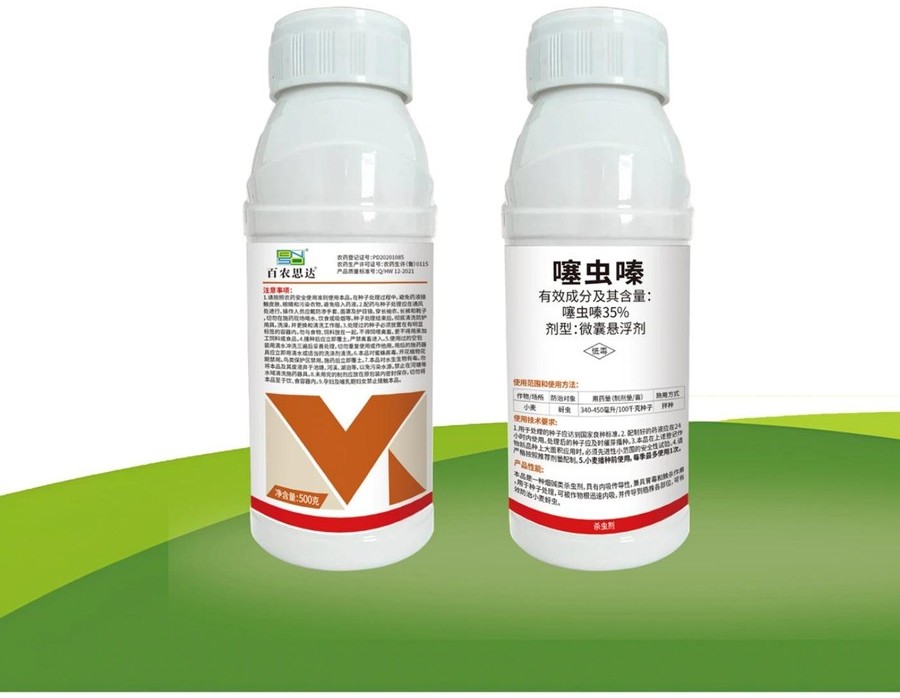
The Chinese label for thiamethoxam 35% SC registers wheat aphid control as a seed dressing at 340–450 mL/100 kg seed.
Thiamethoxam is a systemic IRAC group 4A neonicotinoid. Coated onto the seed, it is absorbed by the roots as the seedling develops and translocated through the whole seedling — the label describes root uptake with whole-seedling movement. Aphids feeding on the young crop then contact the active through their feeding, and suppression of aphids in the early season also limits the viruses they transmit in cereal crops.
Formulation is the quiet difference here. A seed-treatment SC is engineered to coat seed uniformly, adhere without rubbing off during handling and drilling, and flow steadily through treating equipment. That is why the product is an SC built for seed — and why substituting a foliar formulation is not a label-supported option.
Damping-Off in Rice Seedling Trays
The Chinese label for metalaxyl + hymexazol 30% aqueous solution (AS) registers rice seedling damping-off control at 1.2–1.5 g/m².
Damping-off in seedling trays is a complex, not a single pathogen: oomycetes such as Pythium and Phytophthora together with fungi such as Fusarium and Rhizoctonia, all favoured by the dense sowing, warmth and constant moisture of tray nurseries. The two actives divide that complex: metalaxyl is a phenylamide (FRAC group 4) specific to oomycetes, while hymexazol covers soil-borne fungi.
The dose basis — grams per square metre — reflects the treated unit: the tray bed, not the field. Calculate the total bed area of the nursery, apply evenly, and keep to the label range.
Cucumber Nursery Soil Treatment
The Chinese label for fenaminosulf + thiram 10% wettable powder (WP) registers soil treatment against cucumber nursery damping-off at 1670–2000 g/667 m².
Here the treated unit is the nursery bed soil itself: the product is applied to the soil before sowing so that germinating seed and emerging seedlings sit in treated soil through their most vulnerable phase. Fenaminosulf is a long-established damping-off active, paired with the protectant thiram — two modes of action covering the seedling-disease complex.
The Three Treatments at a Glance
| Treatment | Product | Dose basis | Chinese label rate |
|---|---|---|---|
| Wheat aphid seed dressing | Thiamethoxam 35% SC | per 100 kg seed | 340–450 mL |
| Rice seedling tray damping-off | Metalaxyl + hymexazol 30% AS | per m² of bed | 1.2–1.5 g |
| Cucumber nursery soil treatment | Fenaminosulf + thiram 10% WP | per 667 m² of soil | 1670–2000 g |
Practical Notes for Treaters and Nurseries
- Calibrate before the batch. Set treater output against seed weight so the finished coating sits inside the label range, and mix the lot thoroughly for even coverage.
- Check the dose basis twice. Per-100-kg-seed, per-square-metre and per-667 m² rates must never be converted by feel — the basis defines the placement.
- Follow the label on treated-seed handling, including sowing-depth guidance and keeping treated seed out of food and feed chains.
- All rates above are Chinese registration label rates (667 m² = one mu, ≈ 1/15 ha). Always follow the destination-market label, where registered uses and rates may differ.
The seed-treatment SC and other systemic insecticides are in the insecticides catalogue; the nursery disease products are in the fungicides catalogue. For registration documents, samples or OEM packing, contact BNSD Agro.
FAQ
Why is the thiamethoxam rate quoted per 100 kg of seed instead of per hectare?
Because the treated unit is the seed lot, not the field. A hectare’s seed rate varies with variety and sowing density; quoting per 100 kg seed keeps the dose per seed accurate regardless of planting rate. Field rate is the consequence, not the input.
Can a foliar thiamethoxam water-dispersible granule (WDG) be used as a seed treatment instead?
No. Seed treatment needs the formulation registered for that purpose — the 35% SC, designed to coat seed evenly, adhere without dusting off and flow through treating equipment. Physical behaviour on seed is a formulation property, not an active-content property.
What causes damping-off in seedling trays, and why a two-active product?
A complex of oomycetes (Pythium, Phytophthora) and fungi (Fusarium, Rhizoctonia) under warm, wet, dense nursery conditions. Metalaxyl targets the oomycetes and hymexazol the soil-borne fungi, so the 30% AS covers both halves of the complex at 1.2–1.5 g/m².
Does a seed treatment replace foliar aphid sprays for the whole season?
No. It covers the establishment phase, which is when aphid injury hurts wheat most. Monitor the crop afterwards and spray only per the destination label when populations exceed thresholds later in the season.
WhatsApp / WeChat: +86 199 0636 5856