
Scale insects and mealybugs are the pest group that most often gets sprayed with the wrong product at the wrong moment. An adult scale sits under a waxy shield that contact insecticides barely penetrate; a mealybug colony hides in bark crevices, leaf sheaths and fruit calyxes, wrapped in wax and attended by ants. Yet the same pests pass through one brief, defenceless window — the crawler stage — and respond to two very different tools: a physical smothering agent with no resistance problem, and a systemic that travels to where the colony feeds. This guide sets out that program: the biology that makes timing decisive, the two product positions from BNSD Agro (Shandong Bainong Sida Biotechnology Co., Ltd.) with their label conditions, and the pruning work that decides coverage.
Why Scales and Mealybugs Are Hard to Kill
These are sap-sucking insects, and their defence is chemical architecture. Scale nymphs settle within days of hatching and secrete a wax covering that hardens into a shield; mealybugs coat themselves in waxy filaments and retreat into the least reachable parts of the plant. Sprays bead off wax the way they bead off a raincoat.
The damage accumulates quietly:
- Sap loss weakens shoots, dulls foliage and stunts growth long before anyone names the cause.
- Honeydew — the sugary waste excreted by soft scales and mealybugs — drips onto leaves below, where sooty mould grows, shading the leaf surface and cutting photosynthesis. On fruit, the mould is a cosmetic defect that downgrades the pack.
- Hidden spread. Colonies sit under bark flaps and calyxes; infestations travel on nursery stock and pruning tools.
Armoured scales never move again after settling; soft scales and mealybugs retain some mobility. All of them, however, begin life as crawlers — first-instar nymphs with legs, no wax coat, and every intention of walking to a new feeding site. That walk is the program’s window.
Mineral Oil 99% EC: the Physical-Mode Anchor
Mineral oil does not target a receptor; it deposits a film of oil that plugs the spiracles of insects and the egg shell’s gas exchange, and the pest suffocates. At a 150–300× dilution this physical mode covers eggs, crawlers and settled adults alike — a reach no receptor-active insecticide offers, because adults and eggs are exactly what waxy coverings protect from chemistry. And since suffocation has no target site to mutate, resistance is not part of the story: oil is the most stable rotation partner a scale program can carry.
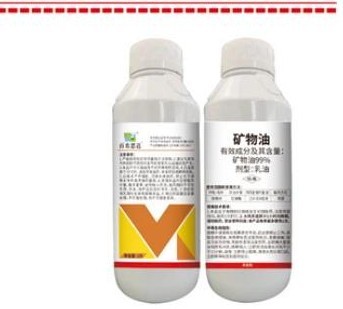
The label conditions matter as much as the rate:
- Chinese label position. On the Chinese label, mineral oil 99% EC is registered on citrus red spider mite at 150–300×; scale and mealybug uses depend on the destination-market registration, which governs. The physical mode itself is the same film in every case.
- Once per season. The label positions this as roughly a once-per-season pass. Make it the pass that counts — typically where overwintering females, eggs and the first crawler generation overlap.
- Never near sulphur. Mineral oil must not be mixed with sulphur sprays — including lime sulphur — or applied within days of them; oil-plus-sulphur is the classic phytotoxicity combination.
- Respect the temperature window. Spraying oil in the hottest hours risks leaf burn. Spray in the cooler parts of the day on unstressed trees, with thorough, film-forming coverage — suffocation needs a continuous layer, not scattered droplets.
Systemic Support: Thiamethoxam 30% SC at Crawler Stage
The second tool attacks from inside the plant. Thiamethoxam is a neonicotinoid (IRAC group 4A) with systemic, contact and stomach action; the 30% SC in the BNSD line is positioned for systemic control of the young crawler stage, where it reaches newly settled nymphs through the plant’s own sap flow — precisely the feeding route a settled scale depends on. Because the insect ingests the active as it feeds, the waxy shield that blocks contact sprays offers no protection against a systemic.

Timing is the whole product. The systemic does not reach insects that have not yet started feeding, and crawlers that have already hardened into second-instar shields are far harder targets. Work the application into the crawler flush:
- Detect the hatch. Wrap double-sided tape around a pruned infested branch and check it weekly; the tiny yellow crawlers stuck to the tape mark the start of the window. Destination extension services publish per-crop crawler timing.
- Match the product to the stage. Mineral oil covers crawlers and eggs alike; a systemic bites once crawlers settle and feed. The two are complements, not substitutes — and neither works on a schedule built around visible adults.
Rates for both products are Chinese registration label rates; always confirm crops, pests and dilutions on your destination-market label.
Pruning: the Free Half of the Program
- Cut out what carries the colony. Heavily infested twigs are removed and destroyed, not sprayed — no coverage reaches a colony under a bark flap, and pruning eliminates it outright.
- Open the canopy. Every practice that improves light and airflow also improves spray penetration to the stem and leaf undersides where crawlers land.
- Mind the ants. Ants defend mealybug colonies for their honeydew and move crawlers to new shoots. Managing ants removes both the bodyguard service and the transport system.
- Clean tools and planting stock. Infestations spread on pruners and nursery material; hygiene is cheaper than another pass.
Sourcing and Program Support
The mineral oil and thiamethoxam positions above sit in the insecticides catalogue; Bainong Sida holds 70 ICAMA registrations with about 60 pending, releases every batch against the registration standard by HPLC/GC, and packs OEM orders from 10 mL to 40 kg. For samples, documents or private-label packing, contact the export team.
FAQ
What is the most effective treatment for scale insects?
A two-track program: mineral oil 99% EC at 150–300× as the physical-mode pass that smothers eggs, crawlers and adults under their wax, and a systemic such as thiamethoxam 30% SC applied at the crawler stage so newly settled nymphs ingest the active as they feed. Both tools depend on timing and thorough coverage more than on rate.
When is the crawler stage, and how do I know?
Crawlers emerge when eggs hatch, typically as the season warms and around new flush growth. The practical method is double-sided tape on an infested branch, checked weekly — the trapped crawlers tell you the window has opened. Local extension bulletins give crop-specific dates for your destination market.
How often can mineral oil be sprayed?
On the Chinese label, mineral oil 99% EC is positioned at 150–300× and roughly once per season — it is a strategic pass, not a repeat tool, and it must never be mixed or sequenced within days of sulphur or lime sulphur sprays. Confirm how your destination registration conditions the use.
Why is honeydew a problem if the insects survive on the plant?
Honeydew feeds sooty mould that shades leaves and reduces photosynthesis, marks fruit and downgrades packs, and attracts ants that actively protect and relocate mealybug colonies. Controlling honeydew is not cosmetic — it removes the ecology that keeps the infestation alive.
WhatsApp / WeChat: +86 199 0636 5856