
Of all the insects that feed on rice, stem borers punish late action hardest. A leaf folder eats the leaf you can see; a stem borer larva disappears into the culm within a day or two of hatching and spends the rest of its life beyond the reach of any spray. By the time a dead heart or a white head shows up in the paddy, the damage is already booked. That is why rice stem borer control is a timing discipline built around moth flight peaks, not a rescue operation — and why the programs that work combine a short, well-timed chemistry window with sanitation and water management that lower the pressure before the season even starts.
This guide walks through the damage pattern, the timing logic, where chlorantraniliprole-class chemistry and its rotation partners fit, and the field hygiene that carries the program between generations. Product positions below come from BNSD Agro’s (Shandong Bainong Sida Biotechnology Co., Ltd.) Chinese registration labels.
Damage You Can Only Count After It Happens
The two stem borer species that dominate Asian rice are the striped rice stem borer (Chilo suppressalis) and the yellow rice stem borer (Scirpophaga incertulas). Both follow the same blueprint: moths lay egg masses on leaves near the canopy, the larvae hatch, wander to the stem base, and bore inside. From there they feed on the inner stem wall, severing the vascular tissue that carries water and nutrients.
What you see depends on the crop stage the larva attacks:
- Dead hearts — the youngest leaf whorl browns and dies while the plant is still vegetative. The dead central shoot pulls out easily and smells rotten at the base.
- White heads — the larva attacks at booting or heading, cutting the vascular supply so the entire panicle emerges bleached, upright and filled with empty grains.
White heads are the more expensive symptom, because a single larva can destroy a whole panicle that had already cost a full season of inputs. Both symptoms share one uncomfortable property: they are records of damage already done. The larva that caused them is inside the stem, sealed off from foliar sprays. The only window in which insecticide chemistry reaches the pest is short — between egg hatch and stem entry, while the young larva crawls on the outside of the plant.
Timing: Act at the Moth Flight Peak, Not After Symptoms
Stem borers cycle through generations, each producing a flush of moth activity followed by egg laying and hatch. A program that treats “when I see damage” will always be one generation behind. Prevention is anchored on the flight peak:
- Monitor moth activity. Light traps and pheromone traps catch the upward trend of each generation; local extension bulletins usually publish peak windows for the main borer generations in your region.
- Scout egg masses. Egg masses appear as whitish scale-like patches on leaf surfaces. When egg-mass density starts climbing toward local thresholds, the hatch window is close.
- Spray into the hatch window. The deposit must be on the stem base and lower canopy when larvae hatch and before they bore in. A spray placed correctly at the flight peak protects the whole generation; the same product applied after dead hearts appear protects nothing for that generation.
- Track every generation. In warm climates two or more borer generations overlap the crop, so the calendar resets with each flight peak rather than being set once.
This is the core of Chilo suppressalis management and it costs less than it looks: one well-placed pass per generation beats repeated corrective sprays.
Chemistry: Chlorantraniliprole-Class and Its Rotation Partners
Chlorantraniliprole is a diamide (IRAC group 28) that acts on the insect ryanodine receptor, and the class is well established as effective against rice stem borers. In the BNSD Agro line, chlorantraniliprole 200 g/L SC carries the Chinese registration for rice leaffolder at 7–10 mL per 667 m²; a stem borer claim for this product depends on the destination-market label, which governs wherever you sell or spray.
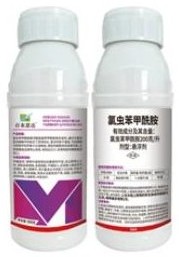
A single mode of action will not carry a full-season program, so the rice portfolio is built to rotate. The products below carry Chinese registration label rates for the leaffolder/borer complex:
| Product | Mode of action | Registered use (Chinese label) | Label rate |
|---|---|---|---|
| Chlorantraniliprole 200 g/L SC | IRAC 28, diamide | Rice leaffolder | 7–10 mL/667 m² |
| Emamectin + indoxacarb 9% SC | IRAC 6 + 22A | Rice leaffolder | 10–20 g/667 m² |
| Abamectin 5% ME | IRAC 6 | Rice leaffolder | 8–16 mL/667 m² |
| Bt 16000 IU WP | Biological (Bacillus thuringiensis) | Rice leaffolder/borer program | 100–150 g/667 m² |
One rotation rule matters more than the rest here: emamectin and abamectin both sit in IRAC group 6, so they count as the same group when you plan a season. Alternate across generations — for example an IRAC 28 pass at one flight peak, the 6 + 22A combination at the next — rather than repeating any single group, and keep the biological option where the pressure allows it. The wider resistance logic is set out in our pesticide resistance management guide.
Sanitation and Water Management Between Generations
Chemistry covers the hatch window; field hygiene covers everything else. Three practices carry real weight in stem borer pressure:
- Clear the stubble. Borer larvae overwinter inside rice stubble and ratoon regrowth. Destroying stubble after harvest — rotovation, ploughing-in, or removal — collapses the bridge that carries the population into next season’s crop.
- Synchronize planting. Where neighbours stagger their planting dates, borers enjoy a continuous supply of young rice across the whole locality. Coordinated planting windows starve the generations in between.
- Manage the water. Stem borer pupae sit in the stem base near the waterline. Temporarily raising the water level during a peak pupation period drowns many pupae before they can emerge as the next moth generation — a low-cost lever that works with, not instead of, your spray timing.
None of these are glamorous, and that is precisely why they are the difference between a program and a series of emergency purchases.
Sourcing and Program Support
Bainong Sida holds 70 ICAMA registrations with about 60 pending, releases every batch against the registration standard by HPLC/GC, and packs OEM orders from 10 mL to 40 kg across eight-plus formulation types. The rice insecticide options above sit in the insecticides catalogue; for samples, registration documents or private-label packing, contact the export team.
All rates above are Chinese registration label rates. Registered crops, pests and doses differ by country — always follow the destination-market label.
FAQ
When should I spray for rice stem borers?
At and just after each moth flight peak, when egg masses are peaking and larvae are hatching but have not yet entered the stems. Traps, egg-mass scouting and local extension bulletins give you that window. Spraying after dead hearts or white heads appear only reduces the next generation, not the damage in front of you.
What is the difference between dead hearts and white heads?
Dead hearts are the vegetative-stage symptom: the central leaf whorl dies after a larva severs the growing point’s vascular supply. White heads are the reproductive-stage symptom: the panicle emerges bleached and empty because the stem was cut at booting or heading. White heads usually cost more, because the whole panicle is lost.
Is chlorantraniliprole effective against rice stem borer?
The diamide class (IRAC 28) is well established as effective against rice stem borers. BNSD Agro’s chlorantraniliprole 200 g/L SC is registered for rice leaffolder at 7–10 mL/667 m² on the Chinese label; whether it carries a stem borer claim in your market depends on the destination-market registration, which should always be checked before positioning the product.
How do I reduce stem borer pressure before the season starts?
Destroy stubble and ratoon regrowth that harbour overwintering larvae, synchronize planting dates across your locality so no continuous host supply exists, and use water management — such as temporarily raising water levels at peak pupation — to cut moth emergence. Lower starting pressure makes every in-season spray decision easier.
WhatsApp / WeChat: +86 199 0636 5856