
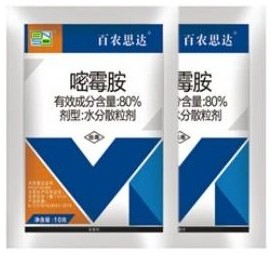
Grey mould is the disease that defines protected cropping. Wherever cucumbers, tomatoes, strawberries or flowers are grown under plastic, Botrytis cinerea finds its conditions — still air, high humidity, senescing petals and pruning wounds — and a single missed spray window can turn a full crop into compost. Pyrimethanil was built for exactly this problem: a specialist against Botrytis and a small circle of related pathogens, with a mode of action and a volatility profile that fit dense greenhouse canopies. This guide explains how the BNSD Agro (Shandong Bainong Sida Biotechnology Co., Ltd.) pyrimethanil 80% WDG works, the Chinese label rate, and the rotation discipline that keeps it working. The complete range sits on the fungicides catalogue, and samples or registration documents are available through the contact page.
What Is Pyrimethanil?
Pyrimethanil is an anilinopyrimidine fungicide, FRAC group 9. Unlike multi-site protectants, it acts at a specific point in the infection process: it interferes with the secretion of the hydrolytic enzymes the pathogen needs to penetrate host tissue. Blocked at the penetration stage, the germ tube cannot establish — which is why the group is described as a penetration blocker.
Three properties matter for grey mould programs:
- Specialist spectrum. Pyrimethanil is tuned to Botrytis and a narrow circle of related ascomycetes, not to the whole leaf-disease spectrum. That focus is a feature: it slots into programs alongside broader partners rather than replacing them.
- Vapour-phase activity. The active has enough volatility to redistribute within the canopy after application, reaching dense foliage and fruit clusters that the spray itself only touched. In a closed greenhouse this vapour effect is a genuine coverage advantage.
- Medium resistance risk. FRAC classes group 9 as medium risk: single-site chemistry with resistance documented where the group is overused, but manageable with normal rotation discipline — unlike the high-risk single-sites.
Registered Use and Chinese Label Rate
| Product | Registered target (Chinese label) | Label rate |
|---|---|---|
| Pyrimethanil 80% WDG | Cucumber grey mould | 30–45 g/667 m² |
All rates are Chinese registration label rates; 667 m² equals one mu, roughly 1/15 hectare. Multiply by fifteen for the per-hectare equivalent, and re-express against the destination label — registration scope and rates differ country by country, and the figures above are a positioning reference, not a spray recipe for another jurisdiction.
On-target notes: cucumber grey mould in protected culture starts on senescing flower petals and pruning wounds and spreads from there onto fruit shoulders and stems. Timing the spray to the flowering and first-infection window, ahead of symptom build-up, is what separates successful programs from catch-up spraying.
The water-dispersible granule (WDG) formulation is the modern handling format: dust-free granules, measured by the sachet, that disperse quickly in the tank. Packaging runs 10 g × 800 sachets for smallholder retail, 100 g × 50 and 500 g × 20 for farm and institutional programs.
Grey Mould in Protected Cropping: What the Spray Must Beat
A greenhouse grey mould program is as much husbandry as chemistry, and the fungicide works only when the conditions are understood:
- Humidity drives everything. Botrytis sporulates and infects under high relative humidity and free moisture. Ventilation, heating-dewpoint management and drip irrigation that keeps foliage dry do half the program’s work.
- The infection court is the flower. Petals are the entry point; targeting sprays at flowering and at fruit set, when petals and stigmas are still attached, puts the active where the pathogen actually lands. The vapour effect helps here, reaching the inner canopy where flowers hide.
- Wounds are doors. Pruning scars, leaf-pick stubs and harvest wounds are direct entry points. Hygiene — removing infected debris from the house — reduces the spore load the next spray has to face.
- Coverage still counts. Vapour redistribution is an advantage, not a substitute for application quality; thorough deposition on stems, fruit shoulders and the lower canopy remains the base layer of protection.
Rotation: Keeping Group 9 Working
Botrytis is one of the most adaptable pathogens in the field, and it has demonstrated resistance to every major group when programs lean on one mode of action. For group 9 the discipline is standard:
- Cap the number of group 9 applications per crop cycle and never spray it consecutively.
- Rotate with unrelated Botrytis modes — dicarboximides (FRAC 2), phenylpyrroles (FRAC 12), SDHIs (FRAC 7) where locally registered — and with multi-site protectants, which are the cheapest resistance insurance a program can buy.
- The rotation and mixture framework is set out in the resistance-management guide; apply it before resistance appears, not after.
Sourcing the 80% WDG
Water-dispersible granules are judged on disintegration behaviour. Good granules collapse in water within a minute, without lumps, and disperse into a uniform suspension that holds through the spray job; the granule itself should be hard enough to survive bagging, transport and humid warehouses without dusting or caking. Confirm content by HPLC against the registration standard — at BNSD Agro every batch is analysed and released on that basis before shipment (company practice) — and make sure the commercial ladder is in the contract: 10 g × 800 sachets for retail, 100 g × 50 and 500 g × 20 for farm and institutional programs, with the registration certificate, production licence and batch traceability in the supplier’s own name.
FAQ
What is pyrimethanil 80% WDG registered for on the Chinese label?
Cucumber grey mould at 30–45 g/667 m². Which uses apply in your market is decided by the destination label — the Chinese registration is a positioning reference, not an authorization for another jurisdiction.
How does pyrimethanil control Botrytis?
It is a FRAC 9 anilinopyrimidine: it blocks secretion of the hydrolytic enzymes the pathogen needs to penetrate host tissue, stopping infection at the entry stage. Its vapour-phase activity also redistributes the active through dense greenhouse canopies after application.
Why is pyrimethanil suited to protected crops?
The spectrum is specialized on Botrytis, the disease of protected cropping; the vapour effect reaches the dense, still-air canopy inside greenhouses; and the WDG format handles cleanly in measured sachets. Confirm the destination label before positioning beyond the registered scope.
How should pyrimethanil be rotated?
Limit group 9 to a few applications per cycle, never consecutive, and rotate with unrelated modes — FRAC 2, FRAC 12, FRAC 7 where registered — plus multi-site protectants. Botrytis adapts to every single-site group when programs lean on one mode.
WhatsApp / WeChat: +86 199 0636 5856