
Pyraclostrobin is the QoI fungicide buyers most often meet inside a mixture first and as a single active second — and there is a reason for that ordering, which this guide explains. It sets out what the chemistry does, the registered uses and Chinese label rates for the pyraclostrobin products held by BNSD Agro (Shandong Bainong Sida Biotechnology Co., Ltd.), the registered mixtures built on the molecule, and the rotation rules that decide whether a QoI still works in year five of a program. The complete line-up is on the fungicides catalogue, and samples or OEM pack requests go through the contact page.
What Is Pyraclostrobin?
Pyraclostrobin belongs to the QoI (quinone outside inhibitor) family, FRAC group 11 — the strobilurins. It blocks respiration at the Qo site of the mitochondrial cytochrome bc1 complex, cutting the energy supply of the fungus. Two characteristics shape how the chemistry is used:
- Protectant-led activity. A respiration inhibitor performs best applied before or at the very start of infection, shielding healthy tissue rather than repairing established lesions. QoI programs therefore live or die by timing and interval discipline.
- The physiological greening effect. Beyond disease control, strobilurins are well known for a “greening” influence on the crop — leaves stay greener and function longer under stress. This is general knowledge about the chemistry class, and it is a genuine part of why growers ask for pyraclostrobin by name in high-yield wheat and banana programs.
The class also carries one of the highest resistance-risk ratings in fungicide practice. FRAC treats group 11 strictly: few applications, no back-to-back use, and mixtures wherever possible. More on that below, because it is the single biggest thing a buyer should understand about this molecule.
The 25% SC and Its Registered Uses
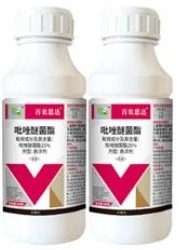
The single-active 25% SC carries two registered uses on the Chinese label:
- Wheat head scab (Fusarium head blight) — 30–40 mL/667 m², applied in the flowering window;
- Banana leaf spot — 1000–3000× dilution spray.
The pairing is instructive. FHB is a narrow-window, high-stakes infection where a QoI contributes protectant cover in the same pass as more curative partners, and banana leaf spot is a canopy-disease program where long intervals and greening effects give the chemistry room to show what it does best. Both rates are Chinese registration label rates (667 m² = one mu, about 1/15 hectare); destination-label guidance always governs in your own market.
Pyraclostrobin Mixtures: The Registered Combinations
Most pyraclostrobin volume moves in mixtures, and BNSD Agro’s portfolio (company information) holds two registered combinations alongside the single active:
| Product | Registered target (Chinese label) | Label rate |
|---|---|---|
| 60% pyraclostrobin + metiram water-dispersible granule (WDG) | Apple Alternaria leaf spot | 1500–2000× dilution |
| 60% pyraclostrobin + metiram WDG | Chinese kale / broccoli downy mildew | 50–60 g/667 m² |
| 17% pyraclostrobin + epoxiconazole SC | Soybean leaf spot | 50–60 mL/667 m² |
| 17% pyraclostrobin + epoxiconazole SC | Wheat powdery mildew | 40–60 mL/667 m² |
| 17% pyraclostrobin + epoxiconazole SC | Maize northern leaf blight | 40–60 mL/667 m² |
Each mixture solves a different problem. Pyraclostrobin + metiram pairs the QoI with a multi-site protectant (FRAC M3) — broad-spectrum surface cover plus systemic protection, built for apple orchard Alternaria and downy mildew on brassica crops. Pyraclostrobin + epoxiconazole pairs the QoI with a triazole (FRAC 3), the standard protectant-plus-curative construction across soybean, wheat and maize leaf diseases. For a buyer, the commercial point is simple: these are rotation-ready products, because every application already delivers two modes of action.
QoI Rotation Stewardship
FRAC’s guidance for group 11 is among the strictest in the book, because QoI resistance — driven by a single target-site mutation — appears suddenly rather than gradually. The rules:
- Never apply QoI back-to-back. Between group 11 sprays, use fungicides from unrelated groups.
- Cap the number of QoI applications per crop season; programs typically allow only a limited number of passes, after which the chemistry sits out.
- Prefer pre-formulated mixtures, such as the two combinations above, which halve the selection pressure on the single site.
- Do not compensate for a weak first application with a second QoI — that is precisely the usage pattern that breeds resistance.
These rules cost nothing to follow and protect the product’s value across seasons, which is why professional buyers treat them as part of the product spec rather than as advice.
Sourcing Notes for QoI Products
Formulation physics decides how a pyraclostrobin product performs in the tank. For the 25% SC and the 17% SC: check suspensibility after dilution, confirm no crystallisation through hot/cold storage cycling, and require batch release by HPLC against the registration standard — at BNSD Agro every batch is analysed by HPLC or GC before shipment (company practice). For the 60% WDG: the metiram combination carries a very high solid load, so dispersibility is the make-or-break test — granules should disperse instantly and dust-free, with no caking in the bag. Pack ladders run from retail sachets to 1 kg bags and bulk packs, and registration documents should always be in the supplier’s own name. Product specifics are on the fungicides catalogue.
FAQ
What is pyraclostrobin 25% SC registered for?
On the BNSD Agro Chinese registration: wheat head scab at 30–40 mL/667 m² and banana leaf spot at 1000–3000×. Both are Chinese label rates; your destination-market label governs locally.
What mixtures are built on pyraclostrobin?
Two registered combinations: 60% pyraclostrobin + metiram WDG for apple Alternaria leaf spot and brassica downy mildew, and 17% pyraclostrobin + epoxiconazole SC for soybean leaf spot, wheat powdery mildew and maize northern leaf blight.
Why does QoI resistance management matter so much?
Group 11 resistance can appear abruptly through a single target-site change, not slowly over seasons. FRAC guidance therefore limits the number of QoI applications per season, forbids consecutive group 11 sprays and favours mixtures.
What should buyers check when sourcing pyraclostrobin products?
For SCs: suspensibility, freedom from crystallisation and HPLC batch release. For the metiram WDG: instant, dust-free dispersibility and storage stability. Plus clean registration documents and a pack ladder that matches your channel.
WhatsApp / WeChat: +86 199 0636 5856