
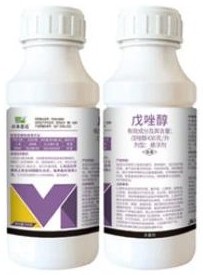
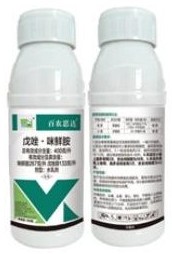
Prochloraz rarely arrives in a buyer’s enquiry as a standalone request — and that is a clue to how the molecule is actually used. Across the export enquiries handled by BNSD Agro (Shandong Bainong Sida Biotechnology Co., Ltd.), prochloraz demand concentrates on one product: a 400 g/L tebuconazole + prochloraz EW built for wheat head scab and banana leaf spot. This guide explains what an imidazole DMI brings to that pairing, the Chinese label rates behind the product, why the EW formulation is chosen, and the checks that decide whether an emulsion-in-water is worth shipping. The wider catalogue sits on the fungicides page, and samples or registration documents are available through the contact page.
What Is Prochloraz?
Prochloraz is an imidazole fungicide, and like the triazoles it belongs to FRAC group 3 — the DMI (demethylase inhibitor) family of ergosterol biosynthesis inhibitors. All DMIs block the same biochemical step, C14-demethylation in fungal sterol synthesis, which disrupts membrane formation in actively growing fungal tissue. Two properties define the imidazole branch of the family:
- Protectant plus curative activity. A DMI does not only prevent infection; it can stop an infection that has already begun and suppress lesions that have started to develop. That curative depth is exactly what prochloraz contributes in combination products.
- A spectrum profile distinct from the triazoles. Although both chemical families act on the same target enzyme, their activity balance across pathogens differs. Prochloraz is notably active against Ascomycete pathogens — the group that includes Fusarium head scab in wheat and the Sigatoka leaf spot complex in bananas.
Under FRAC guidance the DMI family carries a medium resistance risk, which means rotation discipline still applies even inside a mixture.
Registered Uses: 400 g/L Tebuconazole + Prochloraz EW
In the BNSD Agro range, prochloraz is registered in China as half of a twin-DMI combination:
| Product | Registered target (Chinese label) | Label rate |
|---|---|---|
| 400 g/L tebuconazole + prochloraz EW | Wheat head scab (Fusarium head blight) | 30–40 mL/667 m² |
| 400 g/L tebuconazole + prochloraz EW | Banana leaf spot | 1000–3000× dilution |
All rates are Chinese registration label rates; 667 m² equals one mu, roughly 1/15 hectare. In your own market the destination label governs — registration scope and rates differ country by country, so treat these figures as a positioning reference, not a spray recipe for another jurisdiction.
Note again the two rate expressions. Wheat head scab takes a per-area rate, which converts cleanly into per-hectare program planning; banana leaf spot is labelled as a dilution spray, because plantation work is planned by spray volume per bunch and per plant. Export buyers should expect both expressions on the Chinese source label.
Why the Combo Works: Curative Depth on a Protectant Base
The construction of the 400 g/L EW is deliberate. Tebuconazole anchors the product with a protectant base — systemic, xylem-mobile, laying down residual protection before and as infection pressure builds. Prochloraz then adds curative depth: when the spray window slides and some infections have already started, the second chemistry is there to stop them.
Wheat head scab (Fusarium head blight) is the clearest illustration. FHB infects through the flowering window, the risk period is short, and a spray delayed by a few days of rain is the norm rather than the exception — which is precisely the situation where curative depth in the tank matters. It is also a disease with downstream consequences (grain quality and mycotoxin concerns), so programs are built around the most robust option available for that single critical pass.
Banana leaf spot is the second registered target. Sigatoka-type leaf spots demand continuous protectant coverage through the wet season, and twin-DMI mixtures are a standard tool for holding the leaf area that determines bunch fill. A single formulation carrying both chemistries simplifies the program for plantation buyers sourcing at container scale.
The EW Advantage: Low Solvent, Operator-Friendly
EW stands for emulsion in water — the active ingredients are dissolved in a small organic phase that is emulsified into water, instead of being carried in the high solvent load of a conventional EC. For the buyer and the end user, the practical differences are:
- Low solvent content. Less organic solvent in the pack means less odour, fewer solvent-related phytotoxicity concerns on sensitive foliage, and a formulation that is generally easier to position with regulators and distributors conscious of solvent loads.
- Operator-friendly handling. Lower solvent load means a milder product for the spray operator during mixing and application — a real commercial argument in markets where operator comfort influences brand choice.
- Crop safety through the flowering window. For a product whose headline use is a flowering-stage spray, a gentle formulation is part of the registration logic, not an accident.
Sourcing a Tebuconazole + Prochloraz EW: Buyer Checklist
An EW is a two-phase liquid, and its quality is physical as much as chemical. Five checks separate a professional formulation from a repacked one:
- Emulsion stability after dilution. The diluted product should form a uniform milky liquid with no cream layer, no oil film on top and no separation at the bottom through the whole spray job.
- Low-temperature stability. EWs must survive the cold cycles of an ocean route without cracking or phase separation. Ask how the batch behaves at cold-storage temperatures, not only at 20 °C.
- Solvent profile documented. If the selling point is low solvent, the CoA and formulation declaration should say so — and the flash-point paperwork should be consistent with it for shipping.
- Content released by HPLC/GC against the registration standard. Content is a registered value, not a marketing range. At BNSD Agro every batch is analysed by HPLC or GC and released against the registration standard before shipment (company practice).
- Documents and pack ladder. Pesticide registration certificate, production licence and batch traceability in the supplier’s own name, with pack sizes agreed in the contract.
FAQ
What is prochloraz registered for in China?
In the BNSD Agro range, prochloraz appears in the 400 g/L tebuconazole + prochloraz EW, registered for wheat head scab (Fusarium head blight) at 30–40 mL/667 m² and banana leaf spot at 1000–3000× dilution. Which uses apply in your market is decided by the destination label.
Can prochloraz be sourced as a single active?
Most export demand sits in the tebuconazole combination, where the two DMI chemistries cover protectant and curative phases of the same disease window. Whether a single-activity prochloraz is available for your destination depends on your own registration position — raise it on the contact page and the documentation can be checked case by case.
Why combine prochloraz with tebuconazole instead of using one DMI alone?
Both are sterol-biosynthesis inhibitors (FRAC 3), but they are different chemical families with different spectrum strengths. Tebuconazole provides the systemic protectant base; prochloraz adds curative depth for infections that start before the spray lands. For a flowering-window disease like wheat head scab, that depth is the point of the mixture.
What should buyers check when sourcing a tebuconazole + prochloraz EW?
Emulsion stability after dilution, low-temperature stability through shipping, a documented low-solvent profile, HPLC/GC batch release against the registration standard, and complete documents with an agreed pack ladder — the checklist above.
WhatsApp / WeChat: +86 199 0636 5856