
Ask three factories to quote the same crop problem and you will receive three different numbers. That is not confusion — an FOB price is the visible sum of several distinct cost drivers, and each quote sits somewhere different on them. Understanding the drivers turns price comparison from guesswork into arithmetic: you can see why a quote is high, whether a discount was real, and where a suspiciously cheap offer is actually cutting. This guide walks through the five factors that move pesticide FOB prices out of China, then shows how to compare quotes apples-to-apples.
What an FOB Quote Actually Contains
FOB (free on board) means the seller delivers the goods, cleared for export and loaded on the vessel at a Chinese port; freight and insurance beyond that point belong to the buyer. What the number is made of, from the bottom up: the active ingredient, the formulation work built around it, the packaging, the per-batch compliance and documentation, and the factory’s margin. Every driver below acts on one or more of those layers.
Driver 1: Active Ingredient Content
The active ingredient is usually the largest single cost component in a formulated product, and its weight scales arithmetically with the declared content. A 70% water-dispersible granule (WDG) carries more than twice the active per kilogram of a 30% WDG of the same chemistry — so before comparing anything else, confirm that both quotes describe the same concentration. Two follow-ons matter in practice. The technical active’s own market price moves, which is why quotes carry validity periods. And content is also a quality lever — which is why vague offers at “content or higher” deserve scrutiny rather than applause.
Driver 2: Formulation Type
The same active at the same content can carry very different processing cost depending on the formulation code. A wettable powder (WP) is the simple end: grinding and blending. A WDG adds air-milling to fine particle size, wetting and dispersing agent systems, granulation and drying. A suspension concentrate (SC) requires wet milling and a suspending system that stays stable in the pack for the product’s shelf life. Solvent-based emulsifiable concentrates (EC) carry solvent cost; oil-in-water emulsions (EW) buy low-odour, crop-safe performance with more sophisticated emulsifier systems. This is why WDG and SC build cost sits above WP for the same active — and why the formulation code belongs in every price comparison. BNSD Agro builds more than eight formulation types, from WP and WDG through SC, EC, EW and beyond, in packs from 10 mL to 40 kg (company information).
Driver 3: Pack Format
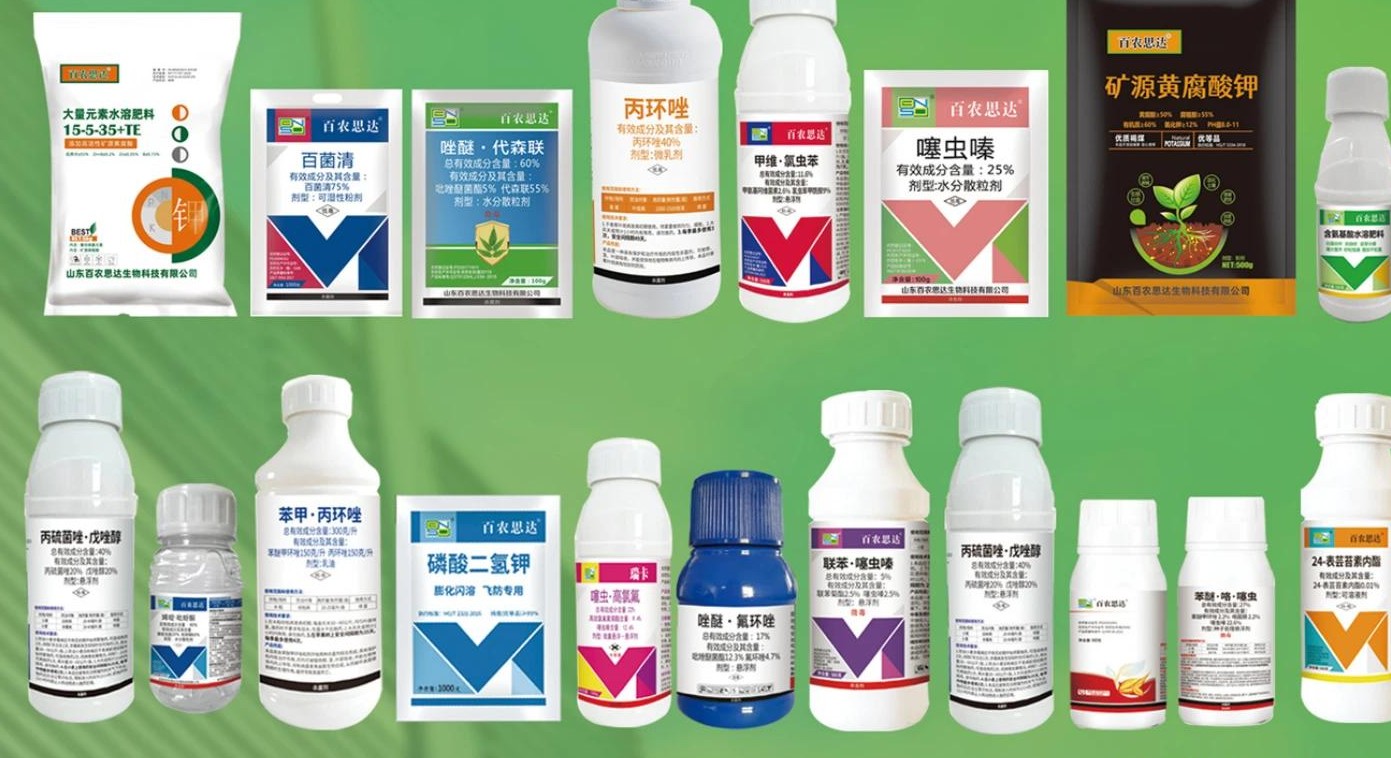
Per kilogram of product, packaging economics are ruthless at the small end. A 10 mL bottle means a bottle, a cap, a seal, a label, a leaflet, a carton cell and slower line speeds — for the same active load that a 25 kg drum or 40 kg bag ships in one package. Retail-format goods are not overpriced; they simply carry more packaging material and labour per gram of active. When comparing quotes, fix the pack format and the packs per carton — a “cheaper” quote is often just a bigger bottle.
Driver 4: Order Volume
Volume moves the price through three channels: production runs fill tanks and mills economically instead of half-empty; packing lines change over less often per unit produced; and container-level shipping spreads fixed handling over more product. Trial-size orders are priced accordingly — the same batch testing, documentation and booking work is spread over fewer kilograms.
Driver 5: Registration Support Scope
A plain FOB quote buys goods. A quote with registration support buys goods plus the dossier package, technical data, trial samples, analytical support — sometimes exclusivity while you register. The broader the support scope, the more of it appears in the unit price, and rightly so: in markets where registration is the barrier to entry, that support is real work with real value. Compare support scopes separately from goods prices; folding them together is how buyers end up judging a quote without knowing what it included.
Comparing Quotes Apples-to-Apples
A comparison is only as honest as the variables held constant. Before putting two quotes side by side, align:
| Hold constant | Why it moves the price |
|---|---|
| Active ingredient and content % | The active is the dominant cost — different contents are different products |
| Formulation code (WP/WDG/SC/EC/EW…) | Processing and adjuvant cost differ by formulation type |
| Pack format and packs per carton | Small-format packaging carries more cost per kilogram of product |
| Order volume | Fixed costs per batch and per container spread over the quantity |
| Incoterm and validity date | FOB and CIF quotes are not comparable; an expired quote is not a price |
Then ask each supplier for the product specification sheet and the registration certificate number for the exact product quoted. A quote you cannot trace to a registration is a quote for something else.
The Hidden Cost Behind the Cheapest Quote
When one quote lands far below the others at an identical specification, the difference is being cut somewhere: active content at the bottom of tolerance, coarser particle size, thinner adjuvant packages, weaker seals. None of it shows on a proforma invoice; all of it shows in the field — re-sprays, callbacks and a distributor’s damaged reputation cost far more per litre than was ever saved. The full economics of this trade-off, including what cheap products actually compromise, are laid out in our formulation quality economics guide. Price is a legitimate factor in sourcing; specification discipline is what makes price comparable.
Browse the product range to see how formulations and pack formats are organized, or request a factor-by-factor quotation for your market via the contact page.
FAQ
Why do two factories quote different FOB prices for the same active?
Because “the same active” is rarely the same product. Differences in declared content, formulation code, pack format, order volume and support scope all move the number. Align those five variables and the residual gap is quality economics — what each factory actually puts into the formulation.
Does higher active ingredient content mean proportionally higher price?
Roughly, yes — the active is usually the dominant cost component, so a 70% formulation carries much more active per kilogram than a 30% one. Formulation processing costs do not scale linearly with content, so the price rises somewhat less than proportionally, but the direction is fixed.
Why is a retail-pack quote so much more expensive per litre?
Small packs add a bottle, cap, seal, label, leaflet and carton — plus slower line speeds — for the same active load. The product is identical; the packaging material and labour per gram of active are not.
What should I hold constant when comparing quotes?
Active and content, formulation code, pack format, order volume and Incoterm, with matching validity dates. Anything you do not hold constant is doing the comparing for you.
WhatsApp / WeChat: +86 199 0636 5856