
New pesticide importers tend to treat packaging as the last detail — something the factory decides while the real conversation happens over price per liter. Experienced ones treat it as channel strategy, because it is. The pack you choose decides which customers can buy your product, at what price point, and whether a sachet survives the journey from your warehouse to a smallholder’s field. This guide walks the pack ladder at BNSD Agro (Shandong Bainong Sida Biotechnology Co., Ltd.), explains the logic behind retail, wholesale and plantation pack formats, and shows how to frame the whole decision in cost per hectare.
The Pack Ladder
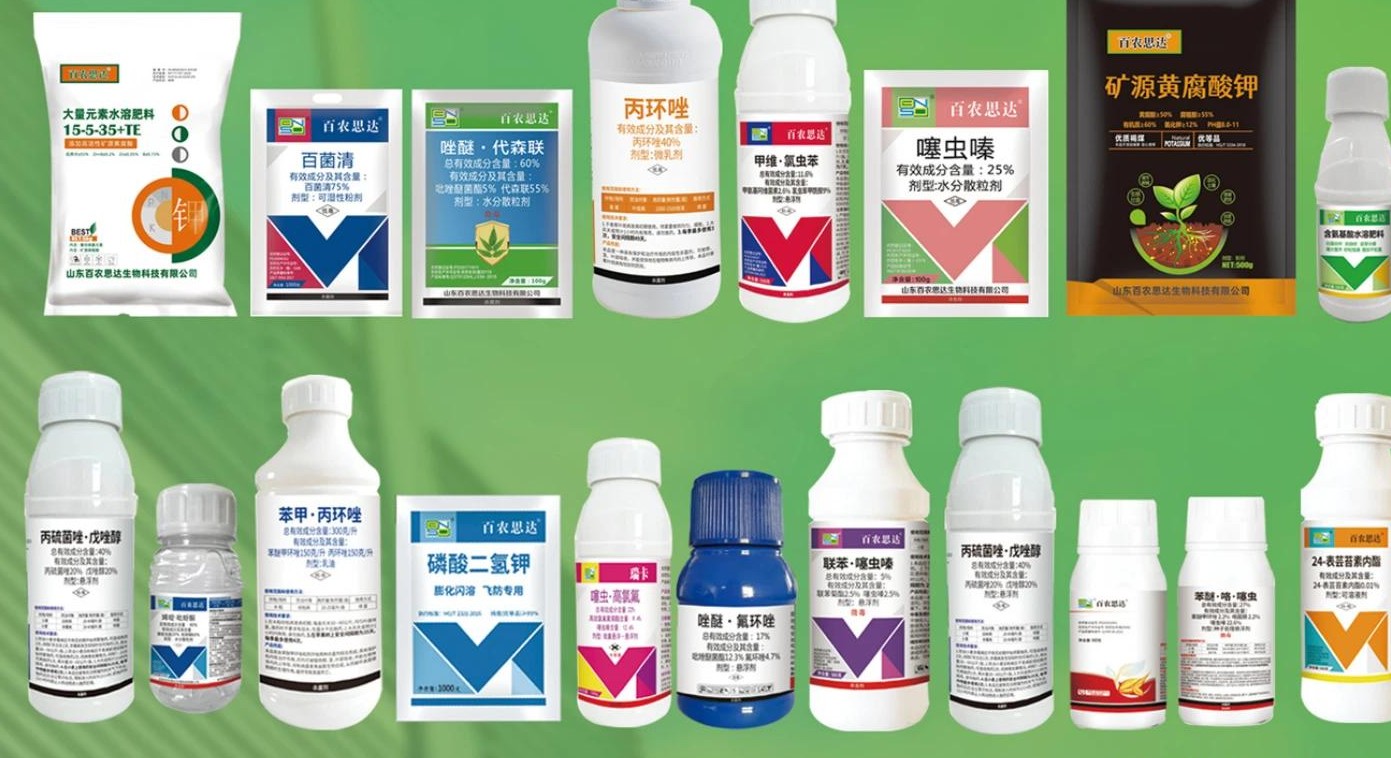
BNSD Agro’s export range runs the full ladder from single-dose retail units to bulk industrial packs (company information): sachets starting at 4 g, bottles from 10 mL up to 1 L, bags from 500 g up to 40 kg, and 25 kg drums. Real products from the catalog show how the same active ingredient can occupy several rungs at once:
- Acetamiprid 70% water-dispersible granule (WDG) — 4 g×1000 sachet packs for retail, 100 g×80 jars for trade supply.
- Imidacloprid 10% wettable powder (WP) — 10 g×800 sachets down at the smallholder end, 500 g×20 bags for distributors.
- Lambda-cyhalothrin 25 g/L emulsifiable concentrate (EC) — 500 mL×20 and 1 L×12 bottle packs.
- Mancozeb 80% WP — 1 kg×10 bags for farm supply.
- Thiamethoxam 70% WDG — up to 25 kg drums for bulk users.
- Granule fertilizer-pesticide products — 40 kg bags moved as sack goods.
The takeaway is that pack selection is not a single choice per product. It is a decision about how many rungs of this ladder your market needs you to cover.
| Pack format | Typical range | Best-fit channel |
|---|---|---|
| Sachets | 4–10 g | Smallholder retail — one sachet, one purchase |
| Bottles | 10 mL–1 L | Retail counters and distributor shelves |
| Bags | 500 g–40 kg | Distributors, farms, repack operations |
| Drums | 25 kg | Plantations, institutional users, blenders |
Retail Logic: The Sachet Is the Purchase Decision
At the smallholder end, the pack is the point of sale. A 4 g water-dispersible sachet is not a container — it is a dose, priced at a level a farmer can decide on at the counter. Good retail packs share three traits: the pack size maps onto a real treatment area (more on that below), the material protects the product through humid storage, and the artwork carries the dose instructions in the buyer’s language. Importers who undersize their first retail order into fragile, poorly sealed sachets usually learn this lesson in a returns claim.
Wholesale Logic: Cases, Jars and Shelf-Ready Packs
Between retail units and bulk sits the trade tier: 100 g jars, 500 g bags, 500 mL and 1 L bottles, packed in cases sized for distribution — think 1 L×12 or 500 g×20. This is the tier that stockists and agro-dealers reorder on price and reliability, so the considerations shift: case count per carton, pallet efficiency in the container, and label durability during handling. Wholesale packs also feed the repack trade in some markets, where authorized local businesses split bulk into local-language packs — legal only where local regulation permits it, so check before planning around it.
Plantation Logic: Bulk Packs and Cost per Hectare
Plantations and institutional buyers think in seasons, not sachets. For them, 25 kg drums and 40 kg bags exist because every gram of packaging is a cost without a function once the mixing tank is calibrated. What matters at this tier is metering convenience at the tank, drum integrity after weeks of storage, and consistent product across the whole season’s supply — one reason batch-level traceability matters more for bulk buyers than for anyone else.
Artwork and Labeling Considerations
Whatever the pack size, the label carries three loads at once: regulatory (the destination registration’s approved label requirements), commercial (your brand, and if you are building a private label, your OEM partner’s ability to print it), and practical (rates, crops and safety text legible in field conditions). Involve your registration paperwork and your printer in the pack decision early — artwork changes are cheap before printing plates are made and expensive after. For OEM packing options, see our OEM service page.
Frame It as Cost per Hectare
The unifying way to compare pack options is cost per hectare of treated area, not price per pack. The arithmetic comes straight off the label rate. Take acetamiprid 70% WDG on cucumbers at 1.5–2.5 g per 667 m²: a single 4 g sachet treats roughly one-and-a-half to two-and-a-half mu, which is what makes it a natural one-purchase dose for a smallholder — the pack size and the label rate were designed to meet. The same arithmetic, applied at plantation scale, shows why a 25 kg drum simply bundles many doses into one handling unit. Match the pack to the dose unit of your customer, and both the sachet and the drum justify themselves.
The products behind these pack formats are cataloged on the products page. If you want pack sizes matched to your market’s channels — including custom counts and private-label artwork — start through the contact page.
FAQ
Which pack sizes should a first order include?
Start with the format your main channel actually sells. If you supply agro-dealers, one retail unit (a sachet or small bottle) plus one trade pack (500 g–1 kg or 500 mL–1 L) usually covers the launch; add bulk packs once plantation or institutional demand appears. Spreading a first order across the whole ladder ties up capital in slow-moving formats.
Can packs be customized for a private label?
Yes — pack size, case counts, bottles, drums and printed artwork are standard OEM variables (BNSD Agro runs 8+ formulation types with packs from 10 mL to 40 kg for OEM buyers). What cannot be improvised is the destination label: artwork must respect the approved registration label of your market.
Are water-soluble sachets available?
Yes, at the small-dose end of the ladder — the 4 g format used for WDG products is exactly this type: the sachet drops into the tank and dissolves, which removes the handling step for the farmer and the exposure risk with it. Suitability depends on the formulation and the destination market’s acceptance, so confirm per product.
How do pack sizes relate to drone spraying programs?
Low-volume drone spraying changes the dose unit: a flight batch covers several mu per tank load, so packs grouped for quick drum filling and case opening work better than single-dose sachets. If your market is moving to UAV application, ask for the pack formats used in our UAV-oriented programs when planning the order.
WhatsApp / WeChat: +86 199 0636 5856